

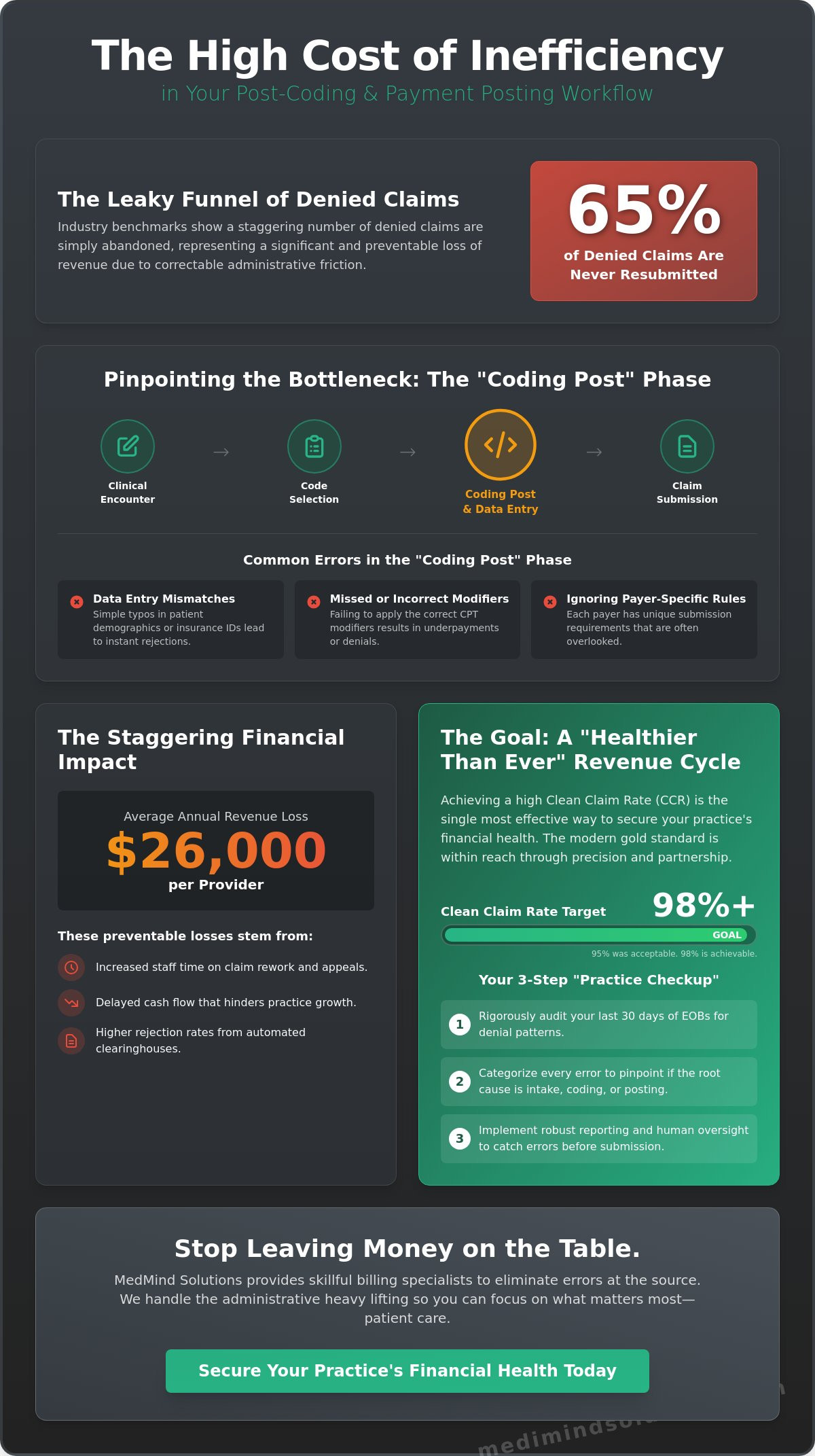
Industry benchmarks show that 65% of denied medical claims are never resubmitted, which leaves thousands of dollars on the table simply because of clerical friction during the coding post process. You likely feel the weight of this inefficiency every time you look at aging A/R reports or struggle to reconcile complex ERAs with original claims. It’s frustrating when simple entry errors stand between your practice and the revenue you’ve earned through diligent patient care. We believe your financial health should be as robust as the clinical outcomes you provide for your patients.
This guide shows you how to optimize your post-coding and payment posting workflows to eliminate these common bottlenecks. You’ll learn the exact steps to maintain a clean claim rate above 98% while significantly reducing your reimbursement cycles. We’re providing a comprehensive Practice Checkup to help you identify where precision is lacking and how to fix it immediately. By the end of this article, you’ll have a clear roadmap to secure your cash flow and ensure your billing operations are more skillful and efficient than ever before.
Key Takeaways
- Understand how the administrative bridge between code selection and payment reconciliation keeps your practice’s financial health “healthier than ever.”
- Learn to audit your internal processes with clinical precision to identify and eliminate data entry errors before they impact your bottom line.
- Expose the hidden dangers of relying solely on automated software and discover why human oversight is vital for a secure coding post workflow.
- Implement robust reporting tools and practice management best practices to monitor your KPIs daily and accelerate your practice’s cash flow.
- Find out how a skillful billing partner acts as the perfect match to help you scale your operations while ensuring maximum profits and data security.
What is a “Coding Post” Workflow and Why It Determines Your Practice’s Financial Health
Your practice’s clinical work ends when the patient leaves the exam room, but the financial journey is just beginning. The coding post phase serves as the critical administrative bridge between selecting a CPT or ICD-10 code and achieving final payment reconciliation. It is the engine room of Revenue Cycle Management (RCM), turning medical documentation into actual cash flow. When this transition is handled with precision, your practice remains healthier than ever; when it’s neglected, revenue leaks through the cracks of the billing system.
The transition from CPT selection to the actual “posting” of the claim in your billing system is where many practices lose momentum. It’s not enough to be a great doctor; you must have a robust system to capture the value of that care. By optimizing this specific phase, you secure maximum profits and faster collections. This proactive approach transforms your billing from a back-office chore into a strategic asset for growth. Experience precision billing and see your savings grow by treating every entry as a high-stakes financial transaction.
The Anatomy of the Post-Coding Revenue Cycle
The journey from a clinical encounter to a successful claim submission involves more than just selecting a code. While clinical coding focuses on the medical accuracy of the diagnosis, the administrative posting of those codes requires a different level of scrutiny. A thorough Practice Checkup often reveals that the biggest leaks occur during this handoff. Inefficient workflows at this stage lead to data entry mismatches, missed modifiers, and incorrect patient demographics. A skillful team ensures that every coding post action aligns perfectly with payer requirements before the claim ever leaves your office. This distinction between clinical intent and administrative execution is what separates struggling practices from those that thrive.
The High Cost of Posting Errors
Precision is not just a goal; it’s a financial necessity. Industry data shows that even a small 5% error rate in the posting phase can devastate annual practice profitability. Inefficient practices often see a loss of $26,000 per provider every year due to these preventable administrative gaps. These losses stem from:
- Increased staff time spent on claim rework and appeals.
- Delayed cash flow that hinders practice expansion.
- Higher rejection rates from automated payer clearinghouses.
MedMind Solutions acts as your Meticulous Growth Partner, providing a group of skillful billing specialists who eliminate these errors at the source. We handle the heavy lifting of administration so you can focus on patient care. By implementing precision billing, we ensure your bottom line reflects the high quality of your clinical work, keeping your practice financially stable and ready for long-term success.
How to Audit Your Current Code Posting and Payment Posting Process
A healthy practice requires more than just clinical excellence; it demands a rigorous “Practice Checkup” of your financial workflows. To master the coding post stage, you must move beyond a reactive stance. Waiting for denials to pile up is a recipe for stagnation. Instead, adopt a proactive strategy that treats data entry with clinical precision. Start by reviewing your last 30 days of Explanation of Benefits (EOB) documents. Look for recurring patterns in partial payments or line-item denials. These trends often reveal systemic weaknesses in how data flows from the exam room to the billing office.
Step 1: Analyzing Your Clean Claim Rate (CCR)
Your Clean Claim Rate is the percentage of claims that pass through the payer’s system without being rejected or denied on the first submission, and a 98% target is the new gold standard for high-performing practices. While 95% was once acceptable, modern automation makes higher precision achievable. When auditing your CCR, categorize every rejection. If the error involves a mismatched modifier, the issue lies at the coding post level. If the error involves incorrect patient demographics or insurance IDs, the breakdown is likely occurring during the initial intake or posting phase. Identifying this distinction allows your skillful billing specialists to apply surgical fixes to the workflow.
Step 2: Tracking Days in Accounts Receivable (A/R)
Slow posting cycles act as a silent drain on your practice’s vitality. They artificially inflate your days in A/R, making your financial health appear worse than it is. To calculate your average collection time, divide your total accounts receivable by your average daily charges. If your A/R exceeds 35 days, your posting speed is likely the culprit. Efficient workflows offer the best of both worlds: increased profitability and rapid cash recovery. By shortening the gap between service and posting, you ensure your bottom line remains robust and predictable.
Step 3: Reconciling ERAs with Bank Deposits
Electronic Remittance Advice (ERA) files are the backbone of modern payment posting, yet they require constant vigilance. You must verify that every dollar “posted” in your software matches the actual “deposited” amount in your bank account. Variances of even 1% can signal deeper issues like embezzlement or unposted recoupments. During this digital reconciliation, maintain strict HIPAA compliance by ensuring all PHI is encrypted and accessible only to authorized personnel. This meticulous approach protects your practice from audits while optimizing your bottom line for long-term growth.
Identifying the 3 Most Common Pitfalls in Post-Coding Administration
Many practice managers believe a common myth: “Our software handles the posting automatically.” While modern platforms offer robust tools, relying solely on automation is a dangerous strategy that often leads to leaking revenue. Software cannot catch the nuanced errors that a group of skillful billing specialists identifies during a manual review. MedMind Solutions acts as your meticulous growth partner, providing the human oversight necessary to ensure every coding post is accurate and optimized for your bottom line.
Automated systems lack the critical thinking required to spot patterns of underpayment or subtle contractual shifts. Without professional intervention, these “financial stressors” accumulate, quietly draining your practice’s resources. We provide a comprehensive financial health checkup for your workflow, replacing automated guesswork with clinical precision.
1. Manual Entry Fatigue and Data Silos
Manual code entry across multiple platforms involves significant administrative heavy lifting. When your EHR and billing software don’t communicate perfectly, data silos emerge. These silos cause coding post discrepancies that delay your cash flow and create reconciliation nightmares. To protect your practice, we utilize advanced data encryption and strict HIPAA-compliant protocols. This ensures that during any manual transfer, your PHI remains secure while we eliminate the errors born from staff fatigue and disconnected systems.
2. Misalignment of CPT Codes and Payer Contracts
A code can be clinically accurate but still result in a rejection if it doesn’t align with specific payer rules. For instance, the 99214 CPT code is a standard for office visits, yet its reimbursement varies wildly depending on the specific payer contract and the provider’s credentialing status. MedMind Solutions ensures codes are posted to the correct networks from the start. We verify that your provider credentialing is current, ensuring you receive maximum reimbursement rather than a “denied” notification due to a simple network misalignment.
- Payer Rule Validation: We cross-reference every post against current contract terms.
- Credentialing Verification: We ensure the rendering provider is correctly linked to the specific payer network.
- Reimbursement Optimization: Our team targets the highest allowable rate for every submitted code.
3. Failure to Manage Denials at the Posting Phase
The most expensive mistake a practice can make is simply “posting the denial” and moving on to the next claim. This habit turns recoverable income into a permanent loss. It’s vital to distinguish between a “soft” rejection, which often involves simple data corrections, and a “hard” denial based on policy or coverage limits. According to industry data from the Medical Group Management Association, failing to aggressively manage and appeal these denials results in a 15% to 25% loss in potential practice revenue. We don’t just record the denial; we initiate the appeal process immediately to protect your financial health.
Best Practices for Optimizing Your Post-Submission Revenue Cycle
Streamlining your revenue cycle requires more than just submitting claims; it demands a proactive strategy to ensure every dollar is captured. By integrating robust reporting tools, you can monitor KPIs like Days in A/R and clean claim rates daily. This level of visibility turns Practice Management from a reactive chore into a tool for optimizing your bottom line. Skillful billing begins with transparency, allowing you to identify bottlenecks before they impact your financial health.
Implementing Real-Time Eligibility Verification
Verifying insurance before the coding post phase prevents 50% of common denials. When your team confirms coverage at the point of service, you establish the foundation for Precision Billing. We recommend a regular Practice Checkup for front-desk workflows to ensure staff verify secondary payers and specific coverage limits. This single step eliminates the administrative stress of retroactive corrections. It’s the most effective way to ensure your practice remains healthier than ever by stopping errors at the source.
Standardizing Payment Posting Workflows
Efficiency relies on a Relational group of documents where parent-to-child data results in seamless billing updates. Successful Practice Management Software Implementation allows for this synchronization, ensuring that every EOB matches the original claim perfectly. Switching from weekly batches to daily reconciliation provides immediate transparency. This consistency leads to increased cash flow and maximum profits by catching discrepancies within 24 hours of receipt. You’ll see your savings grow when the data flow is automated and precise.
Leveraging Professional Denial Management
Unpaid claims aren’t just lost revenue; they’re a drain on your team’s energy. Diligent follow-up on every unpaid claim is essential for high performance in the coding post environment. Our A/R Recovery specialists handle the complex appeals that often stall internal teams. By outsourcing these technical challenges, providers return to their clinical focus while a group of skillful billing specialists secures the reimbursement they’ve earned. This partnership offers the best of both worlds: increased profitability and more time for patient care.
Ready to transform your financial health and eliminate administrative burden? Experience precision billing with MedMind Solutions today.
Why a “Skillful Partner” is the Best Match for Your Post-Coding Needs
Choosing a partner for your revenue cycle isn’t just a simple business transaction. It’s about finding the perfect match to help your practice scale effectively. MedMind Solutions bridges the gap between administrative complexity and clinical excellence. We believe a practice that bills well, grows well. By focusing on the coding post-submission phase with absolute precision, we ensure your financial health remains as robust as the care you provide to your patients. Our team handles the intricate details so you can return your focus to the exam room.
The MedMind Advantage: Precision and Security
Data integrity sits at the heart of our operations. HIPAA compliance and rigorous PHI security aren’t just checkboxes for us; they’re non-negotiable standards that protect your reputation and your patients’ privacy. We use advanced encryption and secure portals to manage every claim. When you partner with us, you gain access to a group of skillful billing specialists who act as a dedicated extension of your own office.
Every partnership begins with a Practice Checkup. This comprehensive evaluation identifies leaks in your current revenue cycle and sets the stage for a more profitable future. We don’t guess at what your practice needs. We use historical data and current KPIs to drive results. This meticulous approach ensures that every coding post action is backed by industry expertise and technical authority.
Seeing the Results: Your Bottom Line, Reimagined
Our success is directly tied to yours. We utilize a percentage-based collection fees model, which means we only win when you do. This alignment of interests transforms us into a Meticulous Growth Partner rather than a simple service provider. While your staff focuses on patient outcomes, our specialists handle the heavy lifting of claim denials, complex appeals, and constant follow-ups. We treat your practice’s cash flow with the same urgency you treat a patient’s vitals.
The impact of this partnership is tangible and immediate. On average, providers see a revenue increase of $26,000 through optimized billing workflows and significantly reduced error rates. You can stop worrying about the intricacies of the billing cycle and start focusing on practice expansion. Experience precision billing and see your savings grow by letting experts manage the backend. Your practice deserves to be healthier than ever before. We provide the stability you need to navigate a changing healthcare landscape with confidence.
Ready to transform your revenue cycle and maximize your profits? Schedule your Practice Checkup with MedMind Solutions today!
Secure Your Practice’s Financial Future Today
Mastering your post-submission workflow isn’t just about paperwork; it’s about safeguarding every dollar your practice earns. By auditing your current processes and eliminating the common pitfalls in post-coding administration, you transform your revenue cycle into a reliable growth engine. Refining the coding post submission process ensures that no reimbursement is left on the table. MedMind Solutions acts as your meticulous growth partner, offering a performance-based, percentage-of-collections pricing model that aligns our success with yours. We prioritize security through comprehensive HIPAA compliance and PHI data encryption, so your sensitive data always remains protected. Our providers see an average revenue increase of $26,000, proving that precision pays off. It’s time to stop guessing about your financial health and start seeing the results your hard work deserves. You don’t have to handle the heavy lifting of administration alone when a skillful partner is ready to help. See how MedMind Solutions can optimize your bottom line; get a Practice Checkup. Your practice is ready to thrive with the right support by your side.
Frequently Asked Questions
What is the difference between medical coding and payment posting?
Medical coding involves translating clinical documentation into standardized alphanumeric codes like ICD-10 or CPT. Payment posting is the critical final step where our skillful specialists record actual insurance payments and patient responsibilities into your system. This process ensures your financial records stay accurate and your bottom line remains healthier than ever.
How long does it typically take for a claim to be posted after a patient visit?
Claims are typically posted within 24 to 48 hours after your practice receives an Electronic Remittance Advice (ERA) or Explanation of Benefits (EOB). Fast turnaround times are essential for maintaining a steady cash flow and meeting your monthly KPI targets. Delaying this step can obscure your true financial health and lead to missed filing deadlines.
Can I use my existing EHR software with a “coding post” specialist?
You can absolutely use your existing EHR or PM software with a dedicated coding post specialist. Our team integrates seamlessly with leading platforms like Epic, Athenahealth, and Cerner to ensure a perfect match for your workflow. This collaborative approach allows you to keep your familiar tools while benefiting from our expert oversight and precision billing techniques.
What happens if a code is posted incorrectly to the insurance company?
Incorrectly posted codes lead to immediate claim denials or significant underpayments. The Medical Group Management Association (MGMA) reports that the average cost to rework a single denied claim is $25. Avoiding these errors through a precision workflow saves your staff hours of administrative heavy lifting and protects your revenue from unnecessary leaks.
How does “coding post” accuracy affect my clean claim rate?
High coding post accuracy directly correlates to a clean claim rate of 95% or higher. When data is entered with precision, insurance companies process payments faster without the need for manual intervention. This efficiency reduces your days in A/R and ensures your practice stays on a path of continuous growth and maximum profitability.
Is payment posting part of full-service medical billing or a separate service?
Payment posting is a standard feature of full-service medical billing, though some providers offer it as a standalone specialty. Most successful practices prefer the full-service model because it creates a unified loop between the initial claim and the final payment. This holistic strategy is the best way to maximize your reimbursement and streamline your operations.
What are the security risks involved in outsourcing my payment posting?
Outsourcing involves sharing Protected Health Information (PHI), which requires robust security measures. We utilize 256-bit data encryption and maintain strict HIPAA compliance to keep your data secure. Partnering with a specialist who follows these industry-leading protocols eliminates risk and provides the peace of mind you deserve while handling sensitive financial data.
How much does it cost to have a professional manage my post-coding workflow?
Professional management costs are usually offset by the 30% reduction in administrative overhead reported by the Healthcare Financial Management Association (HFMA). While we don’t set a flat fee without a custom practice checkup, the investment typically yields a high return through faster collections. You’ll see your savings grow as we eliminate common billing leaks.