

Did you know that Medicare automatically reduces your reimbursement by 15% the moment you submit a claim under a PA’s NPI? For many practices, this “mid-level penalty” is an accepted cost of doing business, but it shouldn’t be your reality. You’ve likely felt the frustration of watching your revenue shrink while trying to decode the shifting definitions of split/shared billing and incident-to rules. It’s exhausting to manage high-quality care while fighting a constant stream of claim denials when billing physician assistant services.
This case study shows you exactly how to move beyond that 85% ceiling to capture the full value of your mid-level providers. We’re providing a clear framework for achieving 100% reimbursement through compliant coding and optimized workflows. By the end of this article, you’ll understand how to conduct a “Practice Checkup” on your NPP billing to ensure your financial health is just as robust as your patient outcomes. Our team of skillful specialists is here to help you secure the maximum profits your practice deserves.
Key Takeaways
- Learn how to bridge the gap between the standard 85% Medicare reimbursement and full 100% payments by understanding the nuances of NPP status.
- Master the essential compliance rules for “Incident-to” and Split/Shared billing to ensure your practice captures maximum revenue while minimizing audit risks.
- Discover how a proactive strategy for billing physician assistant services can transform a reactive, denial-prone workflow into a robust engine for financial growth.
- Perform a “Practice Checkup” using our professional auditing checklist to identify documentation gaps and verify the accuracy of your PA claims.
- Explore how partnering with specialized billing experts allows you to focus on patient care while optimizing your practice’s bottom line and long-term financial health.
Understanding the PA Billing Gap: The 85% vs. 100% Reimbursement Reality
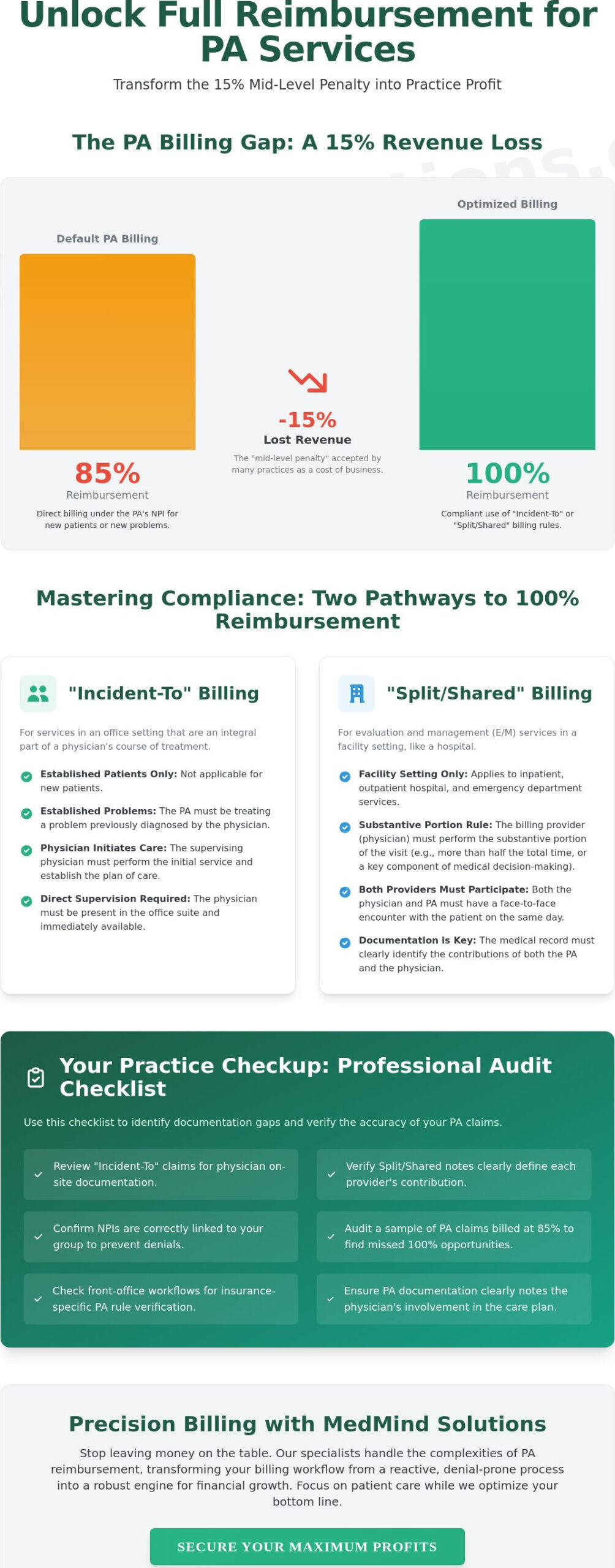
Medicare sets the standard for how we value mid-level providers. Under the standard Physician Fee Schedule, services provided by a Physician Assistant are typically reimbursed at 85% of the rate paid to a physician. This 15% discount often creates a quiet crisis in practice management. When you overlook the nuances of billing physician assistant services, you’re effectively choosing to leave significant revenue on the table. It’s a stressful reality for many practice owners who feel they’re working harder for less reward. This “Non-Physician Practitioner” (NPP) status doesn’t have to be a financial ceiling; it’s a baseline that you can optimize with the right expertise.
To bridge this gap, you must master the two primary pathways to 100% reimbursement: “incident-to” and “split/shared” billing. These aren’t just administrative hurdles. They’re essential tools for your practice’s financial health. Relying solely on the 85% model because of “conservative” billing fears can cost a single-provider practice thousands of dollars annually. We believe your practice deserves to be healthier than ever, and that starts with capturing every dollar you’ve earned through skillful coding.
The Direct Billing Model for PAs
Direct billing occurs when you submit claims using the PA’s own National Provider Identifier (NPI). This is the only compliant option when a PA sees a new patient or treats an existing patient for a new medical problem. While it simplifies the workflow, it locks your reimbursement at that 85% baseline. Many practices use this as their default to avoid the complexities of higher-level billing. However, this “set it and forget it” approach ignores the potential for growth. Experience precision billing by identifying exactly when direct billing is required and when you can leverage more profitable models.
The Financial Health Impact of Proper Coding
Small errors in how you credential your team lead to cascading revenue leaks. NPI hygiene is critical. If a PA isn’t properly linked to your group, claims will bounce or default to the lowest possible rate. We view these details as the pulse of your business. Precision in billing physician assistant claims ensures that every encounter contributes to your bottom line rather than draining it. Our team acts as a meticulous growth partner, handling the heavy lifting of administration so you can focus on patient care. PA reimbursement is a strategic variable that determines the long-term scalability and profitability of your medical practice.
Case Study: Transitioning from Reactive to Proactive PA Billing
Oakwood Medical Group, a mid-sized multispecialty practice with 12 providers, faced a common financial hurdle. Their PA claims were hitting a wall of denials. To avoid the perceived risk of audits, the administrative team defaulted to billing all services at the standard 85% rate. They lacked the internal expertise to navigate complex CMS physician assistant billing policies, which resulted in thousands of dollars left on the table every month. Their financial health was suffering because of a reactive, fear-based approach to billing physician assistant services.
Identifying the Revenue Leakage
The practice’s revenue leak wasn’t just a trickle; it was a steady stream of missed opportunities. An audit of their 2023 records revealed that 40% of PA-led visits met the strict “incident-to” criteria but were still billed at the lower rate. Documentation gaps were the primary culprit. PAs weren’t clearly noting the physician’s involvement in the plan of care, which is a core requirement for 100% reimbursement. Additionally, credentialing errors for two new hires meant their claims sat in limbo for over 90 days. These systemic failures made billing physician assistant services a source of frustration rather than a growth engine for the practice.
Implementing the Solution
To fix this, Oakwood adopted a Meticulous Growth workflow. We restructured their front-office intake to verify insurance-specific PA rules before the patient even reached the exam room. Clinical staff received targeted training on documentation requirements for 100% reimbursement scenarios. By implementing automated claim scrubbing, the practice could catch PA-specific coding errors before submission. This shift proved that profitability doesn’t have to come at the expense of compliance. It’s about having a skillful billing specialist who understands the nuances of the law and handles the heavy lifting of administration.
The transformation was rapid and measurable. Within six months, Oakwood Medical Group saw a 15% increase in total PA-related revenue. Their days in AR dropped from 52 to 40, a 23% improvement in cash flow speed. By moving away from a “safe” 85% default and toward a precision-based model, the practice secured an additional $28,000 in annual revenue per provider. Their latest practice checkup showed a healthier bottom line and a more confident clinical team that no longer fears the billing process. This proactive approach ensures that every service provided is a service paid at its maximum legitimate value.
Mastering Compliance: Incident-To vs. Split/Shared Billing Rules
Fear of an audit shouldn’t stop your practice from capturing the full value of your team. Many administrators leave 15% of their revenue on the table because they worry about the “fraudulent” label when seeking 100% reimbursement. When billing physician assistant services, compliance is your strongest asset, not a barrier to growth. By following Medicare’s ‘incident-to’ rules with precision, you ensure your practice’s financial health remains robust while staying well within regulatory guardrails. Achieving the best of both worlds, maximum profit and total security, requires a meticulous approach to these six pillars.
The 6 Pillars of Incident-To Billing
To qualify for the full physician fee schedule rate in an office setting, you must meet six specific criteria. First, the service must be an integral part of the physician’s professional service. Second, it must occur in a non-institutional setting like a private clinic. Third, the physician must initiate the treatment plan by personally seeing the patient during the first visit for that specific diagnosis. Fourth, the physician must remain actively involved, which requires periodic visits to show ongoing management of the case. Fifth, the physician must provide direct supervision, meaning they’re in the office suite and ready to assist. Finally, the PA must be an employee or a contracted professional of the billing practice.
Understanding supervision levels is vital for error-free claims. General supervision requires the physician’s overall direction but doesn’t mandate their physical presence. Direct supervision requires the physician to be in the office suite. Personal supervision, the most stringent level, requires the physician to be in the room during the procedure. Misidentifying these levels is a leading cause of claim denials that can stall your cash flow.
Navigating Split/Shared Billing in 2026
The landscape for facility-based billing is shifting. For 2026, the “substantive portion” of a split or shared visit determines which provider bills the service. You can define this portion by either more than 50% of the total time spent or by the performance of a substantive part of the medical decision-making. This flexibility allows your practice to choose the method that best reflects the actual work performed. Documentation must clearly show which provider handled the key elements of the encounter to justify the billing provider’s NPI.
Don’t assume private payers like Blue Cross or Aetna follow these exact steps. While many align with CMS, some require billing physician assistant codes at the PA’s own NPI regardless of the supervision level. Our skillful billing specialists recommend a “Practice Checkup” of your top five payer contracts to ensure you aren’t applying Medicare rules where they don’t apply. This proactive step protects your bottom line from unexpected take-backs and keeps your revenue cycle healthier than ever.
A Professional Checklist for Auditing Your PA Billing Workflow
Your practice deserves a clean bill of health. To ensure your revenue remains robust, you must perform a routine Practice Checkup on your administrative processes. This diagnostic approach allows you to identify leaks in your cash flow before they become systemic failures. Start by selecting a representative sample of your last 50 claims involving a billing physician assistant. This sample size is large enough to reveal recurring errors but small enough to manage within a single afternoon.
The Internal Audit Framework
When you review your claims, look for red flag patterns that typically invite payer scrutiny. High frequencies of level 5 E/M codes or a lack of variety in modifiers often trigger automated audits. You’re looking for clinical precision. Precision billing occurs when every clinical nuance in the PA’s note mirrors the specific complexity of the submitted CPT code, leaving no room for payer scrutiny. During this audit, verify that every “Incident-to” claim has a corresponding physician note or signature that proves the doctor was present in the office suite. You should also evaluate your EHR’s ability to track split-visit data, as missing timestamps can lead to immediate denials.
- Credentialing Status: Confirm that every PA is fully credentialed with your top 10 insurance carriers. Outdated provider data causes 35% of preventable claim delays.
- Supervision Logs: Ensure your system captures the relationship between the PA and the supervising physician for every encounter.
- Denial Analysis: Identify the top 5 reasons for PA claim denials in your practice. Common culprits include missing Modifier 25 or incorrect NPI usage.
Staff Training and Communication
Bridging the gap between your clinical PAs and the billing department is vital for maintaining a healthy bottom line. PAs are focused on patient outcomes, while billers focus on technical accuracy. To align these goals, create a documentation “Cheat Sheet” that lists the specific phrases required to support higher-level codes. This tool acts as a roadmap for the PA, ensuring their skillful care is reflected in the final claim.
Regular RCM reporting keeps your team’s performance transparent and measurable. By reviewing monthly KPIs, you can see exactly how documentation improvements lead to faster collections and increased profitability. This collaborative approach turns your billing department into a growth partner rather than a back-office expense. If you’re ready to secure your practice’s financial future, it’s time to experience precision billing with our expert team. This proactive oversight ensures your practice remains healthier than ever while you focus on delivering exceptional patient care.
Precision Billing with MedMind Solutions: Optimizing Your Bottom Line
Running a high-volume medical practice requires more than just clinical skill; it demands fiscal vigilance. MedMind Solutions takes over the heavy lifting of billing physician assistant tasks, allowing your team to focus on what matters most: patient care. Our partnership is built on a performance-based model. Because we operate on a percentage of collected revenue, our goals are perfectly aligned with yours. We don’t just process claims; we drive growth. This “Practice Checkup” approach ensures your financial health is as robust as your clinical outcomes.
Our meticulous growth approach transforms denial management from a reactive chore into a strategic advantage. While industry data suggests that up to 65% of denied claims are never resubmitted, our specialists work to ensure no dollar is left behind. We analyze every rejection, file precise appeals, and recover revenue that would otherwise be lost to administrative errors. It’s the best of both worlds: you get the speed of a high-tech system and the profit of a dedicated human team. By outsourcing these complexities, practices often see a significant increase in cash flow, sometimes reaching an average revenue increase of $26,000 per provider.
Expert Credentialing and Enrollment
Administrative bottlenecks often delay a new PA’s ability to generate revenue for 90 to 120 days. We eliminate these delays through proactive CAQH management and meticulous enrollment tracking. Our team ensures your PAs are correctly linked to the practice NPI for all payers from day one. This reduces the administrative burden on your local clinical staff and prevents the common friction that occurs during onboarding. Your providers start seeing patients, and your practice starts receiving reimbursements without the typical waiting period.
Advanced RCM Technology and Reporting
Transparency is the foundation of a healthy practice. Our advanced RCM platform provides real-time visibility into PA productivity and reimbursement trends. You can monitor key performance indicators (KPIs) through a secure, HIPAA-compliant interface that protects all patient and financial records. We use robust data encryption to ensure your PHI remains safe while giving you the insights needed to make informed business decisions. This level of precision helps you identify which services are most profitable and where your billing physician assistant workflows can be further refined.
Elevate Your Revenue Through Precision PA Billing
Navigating the complexities of the 15% reimbursement gap and mastering incident-to versus split/shared rules is essential for any modern practice. When you shift from a reactive stance to a proactive workflow, you eliminate the administrative friction that stalls your growth. Effective billing physician assistant strategies aren’t just about compliance; they’re about ensuring your practice receives every dollar it’s earned. Precision in these workflows protects your bottom line and provides the stability needed to expand your patient services.
MedMind Solutions serves as your meticulous growth partner by providing full-service credentialing and RCM integration. Our specialists maintain a 98% clean claim rate, ensuring your collections are both fast and accurate. We handle the heavy lifting of financial administration so your clinical team can stay focused on what matters most.
Your practice’s financial health is just as vital as the care you provide. Let’s work together to make your business stronger and more resilient than ever.
Frequently Asked Questions
Can a Physician Assistant bill Medicare directly under their own NPI?
Yes, PAs can bill Medicare directly using their own National Provider Identifier (NPI). When billing under their own NPI, Medicare typically reimburses the service at 85% of the Physician Fee Schedule rate. This direct billing method is essential for services that don’t meet the strict incident-to requirements, ensuring your practice maintains compliance while capturing revenue for every patient encounter. It protects your practice from audit risks while maintaining steady cash flow.
What is the difference between incident-to and split/shared billing for PAs?
The primary difference lies in the clinical setting and the level of physician involvement. Incident-to billing applies to office-based services where a physician has already established a plan of care, allowing for 100% reimbursement. Split/shared billing occurs in institutional settings like hospitals. In these cases, a physician and a PA both perform part of the visit, and reimbursement depends on who provides the substantive portion of the encounter according to CMS guidelines.
Does the physician need to be in the room for a PA to bill incident-to?
No, the physician doesn’t need to be in the same room, but they must be immediately available in the same office suite. According to CMS guidelines, this means the physician is present in the office to provide assistance if needed. If the physician is off-site or in a different building, the service fails the incident-to test. You must then bill under the PA’s NPI at the 85% rate to avoid compliance penalties.
Can a PA bill for a new patient visit at 100% reimbursement?
No, a PA cannot bill a new patient visit at 100% reimbursement under incident-to rules. Medicare requires the physician to perform the initial visit and establish the plan of care for a specific problem. Because a new patient has no established plan, the PA must bill these services under their own NPI. This results in the standard 85% reimbursement rate for billing physician assistant services, ensuring your practice stays compliant with federal regulations.
What happens if the physician is out of the office when the PA sees an incident-to patient?
If the supervising physician is out of the office, you cannot bill the service as incident-to. Medicare requires direct supervision, meaning a physician from the same group must be physically present in the office suite. If no physician is on-site, the PA must bill the encounter under their own NPI. Failing to adjust this can lead to costly audits, as 100% of incident-to claims require documented on-site physician availability during the encounter.
How do private insurance companies usually reimburse for PA services compared to Medicare?
Private insurers vary, but about 70% of commercial payers follow Medicare’s lead by reimbursing PA services at 85% of the physician rate. However, some major carriers like UnitedHealthcare or Aetna may have specific policies that differ from federal guidelines. It’s vital to review individual payer contracts regularly. Some private plans allow PAs to be credentialed and reimbursed at 100% for certain primary care codes, which can significantly boost your practice’s bottom line.
What are the most common documentation errors in PA billing?
The most frequent error is failing to document the physician’s presence in the office during incident-to services. Another common mistake involves the substantive portion requirement in split/shared visits, where the medical record doesn’t clearly show who performed the medical decision-making. According to industry audits, nearly 30% of denied PA claims stem from missing signatures or lack of evidence that a physician established the initial plan of care for the patient during the first visit.
Is it worth the effort to bill incident-to for a 15% increase in payment?
Yes, capturing that 15% difference significantly impacts your bottom line when scaled across hundreds of patient visits. For a practice seeing 20 patients a day, billing physician assistant services at the full 100% rate can prevent thousands of dollars in annual revenue leakage. While the documentation requirements are stricter, the financial health of your practice depends on optimizing every reimbursement opportunity to ensure long-term profitability. It’s a skillful way to maximize your practice’s growth.