

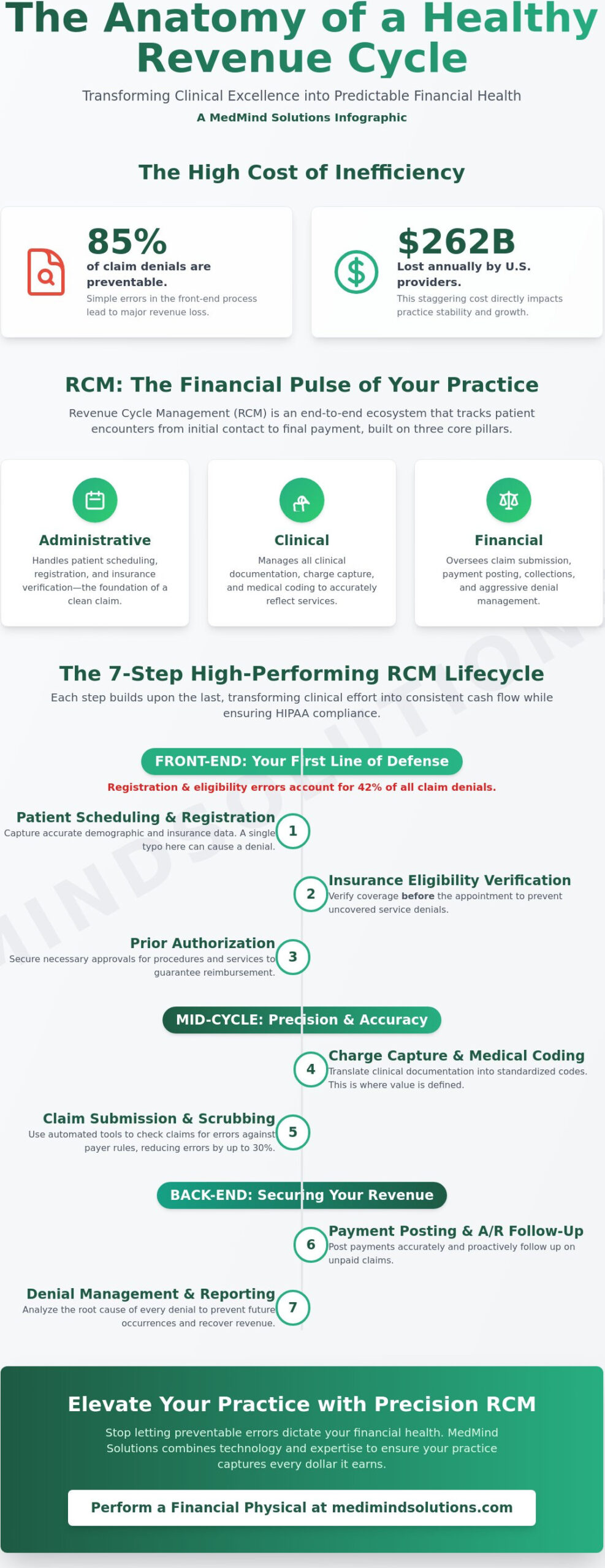
Did you know that roughly 85% of medical claim denials are preventable, yet these errors cost U.S. healthcare providers nearly $262 billion annually? It’s exhausting to watch your clinical excellence get overshadowed by high days in Accounts Receivable and the constant stress of administrative burnout. You likely agree that your team shouldn’t have to choose between patient care and fighting complex payer rules just to get paid. Managing these financial hurdles requires the same precision you bring to the exam room.
It’s time for a thorough practice checkup to ensure your fiscal well-being is as robust as your medical outcomes. We’ll show you how to transform your clinical documentation into consistent cash flow through a precision-engineered revenue cycle management system. By the end of this guide, you’ll understand exactly how to reduce coding errors, stabilize your bottom line, and achieve the predictable financial health your practice deserves. You’re about to see how a skillful approach to billing can make your practice healthier than ever before.
Key Takeaways
- Shift your perspective from basic billing to a holistic financial ecosystem that tracks every patient encounter from initial registration to final reimbursement.
- Discover a high-performing 7-step lifecycle that ensures your practice captures maximum value before the patient even walks through the door.
- Evaluate the total cost of ownership between in-house teams and specialized partners to determine the most profitable model for your revenue cycle management.
- Learn how to perform a “financial physical” to identify and repair leaks in your revenue pipe, such as unbilled encounters and ignored denials.
- Experience the “best of both worlds” by pairing meticulous precision with faster collection speeds to ensure your practice’s bottom line is healthier than ever.
What is Revenue Cycle Management (RCM) in Modern Healthcare?
Revenue cycle management is the vital financial pulse of your practice. It represents the end-to-end process of tracking patient care episodes, starting from the moment a patient schedules an appointment and ending when the final payment reaches your bank account. To gain a foundational understanding of these stages, providers often examine What is Revenue Cycle Management and its role in coordinating clinical and administrative data. In the 2026 healthcare environment, RCM isn’t just a back-office function; it’s the heartbeat of a sustainable practice that ensures you can focus on patient care without financial strain.
Modern RCM relies on three distinct pillars to maintain stability. The Administrative pillar handles registration and scheduling. The Clinical pillar manages documentation and coding. Finally, the Financial pillar oversees billing, collections, and denial management. When these three areas work in harmony, your practice achieves a state of “Financial Health” that goes beyond simple medical billing. This holistic ecosystem protects your bottom line by ensuring every service rendered is accurately captured and reimbursed at the maximum possible rate.
The Evolution from Billing to Strategic RCM
Traditional fee-for-service models are giving way to complex value-based care systems. This shift means your practice must track outcomes and quality metrics to secure full reimbursement. Simple billing is no longer enough. Strategic revenue cycle management now incorporates AI and automation to eliminate human error. In fact, implementing automated scrubbing tools can reduce charge entry errors by as much as 30% compared to manual entry. We view “Financial Health” as a superior metric to “Total Collections” because it accounts for the cost of collection and the long-term stability of your cash flow. It’s a proactive approach that keeps your practice healthier than ever.
Key Components of the Revenue Cycle
A skillful RCM strategy breaks the cycle into three critical phases to ensure precision at every step:
- Pre-claim activities: This includes rigorous eligibility verification and obtaining prior authorizations. Catching insurance issues here prevents 65% of common denials before the patient even sees a provider.
- Claim activities: This phase involves medical coding and claim scrubbing. We use leading technology to ensure every claim meets HIPAA standards and payer-specific requirements.
- Post-claim activities: This involves aggressive denial management and clear patient statements. We don’t just accept a rejection; we analyze the root cause to prevent future occurrences and secure your rightful revenue.
Your practice deserves a “Practice Checkup” to ensure these components are functioning at peak efficiency. By optimizing these stages, you’ll see your savings grow and your administrative burden shrink. It’s the best of both worlds: increased profitability and the freedom to prioritize your patients.
The 7-Step Lifecycle of a High-Performing Revenue Cycle
Your practice’s financial health depends on a rhythmic, seven-step process that transforms clinical effort into consistent cash flow. This lifecycle doesn’t begin when a provider enters the exam room; it starts the moment a patient first contacts your office. Effective revenue cycle management requires a proactive approach where each phase builds upon the last to eliminate errors before they become costly denials. Every transition of Protected Health Information (PHI) must adhere to strict HIPAA-compliant protocols to ensure data integrity and patient privacy.
Front-End: Registration and Eligibility
The front-end is your first line of defense against revenue leakage. Data from 2023 indicates that registration errors and eligibility issues account for nearly 42% of all claim denials. By prioritizing accuracy here, you create a foundation for a “perfect match” between services rendered and reimbursements received.
- Step 1: Patient Scheduling and Registration. Capture accurate demographic data and insurance details during the initial call. It’s the best time to confirm contact info and secondary insurance.
- Step 2: Insurance Eligibility Verification. Verify coverage before the appointment to reduce “uncovered service” denials. This step ensures you aren’t providing care that the payer won’t reimburse.
- Step 3: Prior Authorization. Secure necessary approvals from payers to document medical necessity. This prevents the financial stress of retroactive denials after care is delivered.
Mid-Cycle: Documentation and Coding
Mid-cycle activities bridge the gap between clinical care and financial reporting. Precision is vital here to ensure that the complexity of the patient encounter is reflected in the final claim. Many practices find that optimizing RCM processes in this stage leads to a significant reduction in audit risks and undercoding.
- Step 4: Clinical Documentation and Charge Capture. Align clinical notes with CPT codes in real-time. This ensures every billable minute is accounted for and medically justified.
- Step 5: Medical Coding. Apply ICD-10 and HCPCS codes with surgical precision. Skillful coders prevent the “heavy lifting” of the back-end by getting the details right the first time.
Back-End: Submission and Resolution
The back-end focuses on the final push toward reimbursement and the resolution of any discrepancies. The Clean Claim Rate is the gold standard for RCM efficiency, representing the percentage of claims paid on the first submission without manual intervention. High-performing practices aim for a rate of 95% or higher to maintain a robust bottom line.
- Step 6: Claim Submission. Utilize clearinghouses and automated “scrubbers” to catch errors before they reach the payer. This digital gatekeeping is essential for HIPAA-compliant data handling.
- Step 7: Remittance Processing and Denial Management. Reconcile payments and aggressively appeal any rejections within 24 to 48 hours. Quick action keeps your cash flow healthier than ever.
Achieving this level of precision doesn’t have to be a solo endeavor. If you want to see your savings grow, our skillful billing specialists can help you master every step of your revenue cycle management to ensure your practice remains profitable and secure.
Analyzing Your RCM Performance: Internal vs. Outsourced Models
Think of this evaluation as a “Practice Checkup” for your administrative vitals. Just as you monitor a patient’s heart rate, you must monitor the flow of capital through your office. Many providers feel a heavy administrative burden that distracts from patient care. To determine if your current setup is healthy, you must compare the Total Cost of Ownership of an in-house team against the efficiency of a specialized partner. While an internal team feels familiar, the financial reality often tells a different story. Choosing the right path is about finding a perfect match for your growth goals.
Hidden Costs of In-House Medical Billing
The price of internal billing extends far beyond base salaries. When you manage billing yourself, you’re responsible for software licensing fees, hardware maintenance, and the expensive square footage required for administrative desks. Staff turnover remains a critical risk. According to 2023 industry data, medical billing roles see an average turnover rate of 25%. Each time an employee leaves, you face the high cost of recruiting and continuous coding education to keep up with changing regulations. There is also a significant “Opportunity Cost” for providers. If a physician spends five hours each week reviewing administrative appeals instead of seeing patients, the practice loses thousands in potential billable revenue. These hidden drains prevent you from optimizing your bottom line.
Benefits of a Full-Service RCM Partnership
A full-service partnership gives you access to a skillful group of billing specialists who act as a protective shield for your revenue. This model offers the best of both worlds: professional expertise and technical precision. Key advantages include:
- Scalability: If your practice volume grows by 20% after an expansion, a partner handles the surge immediately. You don’t have to worry about the hiring headache or training new staff.
- Advanced Reporting: You gain real-time visibility into KPIs like Days in AR and Net Collection Rate. You’ll see exactly where every dollar is at any moment.
- Precision Billing: Specialized teams focus exclusively on error elimination, which leads to faster collections and increased cash flow.
The most frequent objection to outsourcing is the perceived loss of control. In reality, a robust partnership increases your control by providing better data than most internal systems can generate. Most specialized firms use a percentage-based fee model. This structure aligns our incentives with yours. We don’t get paid until you receive your reimbursement. This performance-based identity ensures that your partner is just as motivated as you are to capture every cent of your revenue cycle management earnings. By offloading the heavy lifting, you ensure your practice remains healthier than ever while you focus on delivering leading patient care.
How to Audit and Optimize Your Practice Financial Health
A regular “Financial Physical” is the only way to ensure your practice remains profitable. Without a systematic audit, small errors compound into massive losses over time. Days in AR measures the average number of days it takes for your practice to receive payment after a service is rendered, and top-tier practices maintain a benchmark of under 35 days. If your practice exceeds this, you’re likely losing money to “leaks” in your revenue pipe. These leaks often take the form of unbilled encounters that sit forgotten in your EHR or ignored denials that your staff lacks the time to resubmit.
Preparing for the future is just as vital as fixing current errors. By 2026, the No Surprises Act will demand even greater transparency in patient billing, requiring precise cost estimates for every encounter. Strengthening your revenue cycle management now ensures you’re ready for these regulatory shifts while maximizing your current cash flow. A proactive approach protects your bottom line from the financial stress of unexpected audits or compliance penalties.
Calculating Your Key Performance Indicators (KPIs)
You can’t manage what you don’t measure. Use these three metrics to gauge your fiscal health and identify where your “skillful” billing specialists should focus their efforts:
- Net Collection Ratio: This reveals if you’re collecting every dollar you’re contractually owed. If this falls below 96%, you’re leaving money on the table that belongs to your practice.
- First-Pass Clean Claim Rate: Aim for 95% or higher. High clean claim rates mean your billing is precise, leading to faster reimbursements and less administrative rework for your team.
- Denial Rate Analysis: Break your denials down into “Controllable” versus “Uncontrollable.” Controllable denials, such as coding errors or missing data, are easy wins for your team to fix through better training.
Workflow Optimization Strategies
Optimizing your workflow requires a mix of technology and training. Start by implementing real-time eligibility checks at the front desk. This prevents the frustration of seeing a patient only to find their coverage has lapsed. Next, standardize your clinical templates. Precise documentation is required to support “99214” coding levels, and better templates ensure your providers don’t leave revenue behind due to vague notes. Finally, automate your patient statements. Moving to a digital, automated system reduces the “Self-Pay” collection lag, which often drags down your overall revenue cycle management performance. These skillful adjustments make your practice healthier than ever and allow you to focus on patient care.
Elevate Your Practice with MedMind Solutions: Precision RCM
Finding the right partner for your revenue cycle management shouldn’t feel like a compromise. MedMind Solutions acts as the perfect match for practices that refuse to settle for mediocre growth. We provide the best of both worlds; we deliver a significant boost in profitability alongside much faster collection speeds. Your practice deserves a partner that values precision as much as you do. We protect your PHI with robust encryption and HIPAA-certified workflows. This ensures your data stays secure while your revenue climbs. We handle the heavy lifting of administration so you can return your focus to patient care.
Our team functions as a meticulous growth partner. We don’t just process claims; we integrate with your team to foster a healthier financial environment. By combining technical sophistication with an approachable, collaborative style, we alleviate the financial stress that often plagues busy medical providers. You can trust that your practice is in skillful hands, allowing you to breathe easier knowing your bottom line is protected by industry experts.
Our Skillful Approach to Denial Management
Many billing companies simply resubmit claims and hope for the best. Our specialists treat every denial as a learning opportunity to improve your internal workflows. The MedMind promise involves diligent follow-up until every single dollar is reconciled. This meticulous attention to detail delivers real-world results. On average, our intervention leads to a revenue increase of $26,000 per provider. We don’t just fix errors. We eliminate the root causes of revenue leakage. Our team analyzes patterns in payer behavior to prevent future rejections before they happen. This proactive stance keeps your cash flow steady and predictable.
Transparency Through Advanced Financial Reporting
You can’t manage what you can’t measure. Our custom dashboards provide a 360-degree view of your practice’s fiscal well-being in real time. We go beyond static numbers by hosting monthly strategy calls to review your KPIs. This ensures our “Action-Result” pipeline stays optimized for your specific goals. You’ll see exactly where your money is and how we’re working to collect it.
Our reporting suite includes several vital tools for your success:
- Detailed aging reports to track outstanding reimbursements.
- Payer performance analytics to identify slow-paying carriers.
- Clear visualizations of your net versus gross collection rates.
- Month-over-month comparisons to track growth trends.
Stop guessing about your financial future and start planning with confidence. Your practice’s financial health is just as vital as the physical health of your patients. We’re here to ensure both are thriving. Schedule your complimentary Practice Checkup today to see your potential savings and experience the power of precision revenue cycle management firsthand.
Achieve Lasting Financial Vitality for Your Practice
Optimizing your financial health requires more than just submitting claims. It demands a rigorous approach to the entire revenue cycle management lifecycle. By shifting from reactive billing to a proactive, data-driven strategy, you can eliminate the bottlenecks that lead to claim denials and delayed reimbursements. Whether you manage operations internally or partner with experts, regular performance audits are vital to maintaining a robust bottom line.
You don’t have to navigate these complexities alone. MedMind Solutions provides a dedicated team of skillful billing specialists who ensure every dollar is accounted for while maintaining HIPAA-certified data security and PHI protection. Our partners see an average revenue increase of $26,000 per provider through our precision systems. It’s time to focus on your patients and let us handle the heavy lifting of your administration. Experience precision billing and see your savings with a MedMind Practice Checkup.
Your practice deserves a financial foundation as strong as the care you provide. We’re ready to help you build it and keep your practice healthier than ever.
Frequently Asked Questions
What is the average cost of revenue cycle management services?
Most medical practices pay between 3% and 9% of their monthly net collections for comprehensive revenue cycle management services, according to reports from the Medical Group Management Association (MGMA). This performance-based pricing model ensures that your billing partner’s success is directly tied to your practice’s profitability. While smaller clinics might see rates on the higher end of this spectrum, high-volume surgical centers often leverage their scale to secure lower percentage points. It’s a transparent way to align incentives and drive maximum results.
How does RCM differ from traditional medical billing?
Traditional medical billing focuses narrowly on the submission of claims and collection of payments, while RCM manages the entire patient journey from scheduling to the final zero balance. It integrates front-office tasks like eligibility verification with back-office functions like denial management and patient collections. By treating the financial process as a continuous loop, you identify bottlenecks earlier in the cycle. This holistic approach transforms a simple administrative task into a robust strategy for long-term practice growth.
Can revenue cycle management reduce our claim denial rate?
A proactive strategy can reduce your claim denial rate by 20% or more within the first 6 months of implementation. Our skillful billing specialists use advanced scrubbing software to catch coding errors before they ever reach the payer. By analyzing monthly remittance advice, we pinpoint why 90% of your denials occur and implement systemic fixes to prevent them. This precision ensures your practice stops leaving money on the table due to preventable clerical mistakes or outdated insurance information.
What are “Days in AR” and why do they matter for my practice?
Days in Accounts Receivable (AR) represents the average number of days it takes your practice to get paid after a service is provided. According to HFMA standards, a healthy practice should maintain a Days in AR of 40 days or fewer. Monitoring this KPI is vital because it directly impacts your cash flow and liquidity. When this number climbs above 50, it signals deep inefficiencies in your collection process that require immediate intervention to protect your bottom line.
Is my practice too small to benefit from outsourced RCM?
No practice is too small to benefit from outsourced revenue cycle management, as solo providers often face the highest administrative burdens. Outsourcing eliminates the $50,000 to $70,000 annual cost of a full-time, in-house biller, including benefits and training. Small clinics gain access to the same enterprise-level technology used by large hospitals, which helps level the playing field. This allows you to focus 100% of your energy on patient care while experts handle the heavy lifting of your financial health.
How does RCM software ensure HIPAA compliance and data security?
Modern software protects patient data using 256-bit AES encryption and strict multi-factor authentication protocols for every user. These systems maintain detailed audit trails that record every instance a staff member accesses Protected Health Information (PHI), meeting all HIPAA Title II requirements. Regular SOC 2 Type II audits provide third-party verification that these security controls are effective and up to date. You can rest easy knowing your practice’s reputation and your patients’ privacy are guarded by leading-edge defensive technology.
What is a “Clean Claim Rate” and what should our target be?
The Clean Claim Rate (CCR) measures the percentage of claims that pass through the payer’s system and get paid on the first submission without manual intervention. Your practice should target a CCR of 95% or higher to maximize efficiency and minimize administrative costs. If your rate falls below 85%, you’re likely spending too much time on costly re-works and manual appeals. Reaching the 95% benchmark ensures a steady, predictable stream of revenue and reduces the workload on your staff.
How long does it take to see results after optimizing our revenue cycle?
You’ll typically see a measurable increase in cash flow within the first 30 to 60 days of optimizing your workflows. Full stabilization of your Days in AR and denial rates usually occurs between 90 and 120 days as the new processes take hold. During this period, our team identifies historic bottlenecks and clears out any backlog of aging claims. This phased approach leads to a “Practice Checkup” that leaves your finances healthier and more resilient than ever before.