

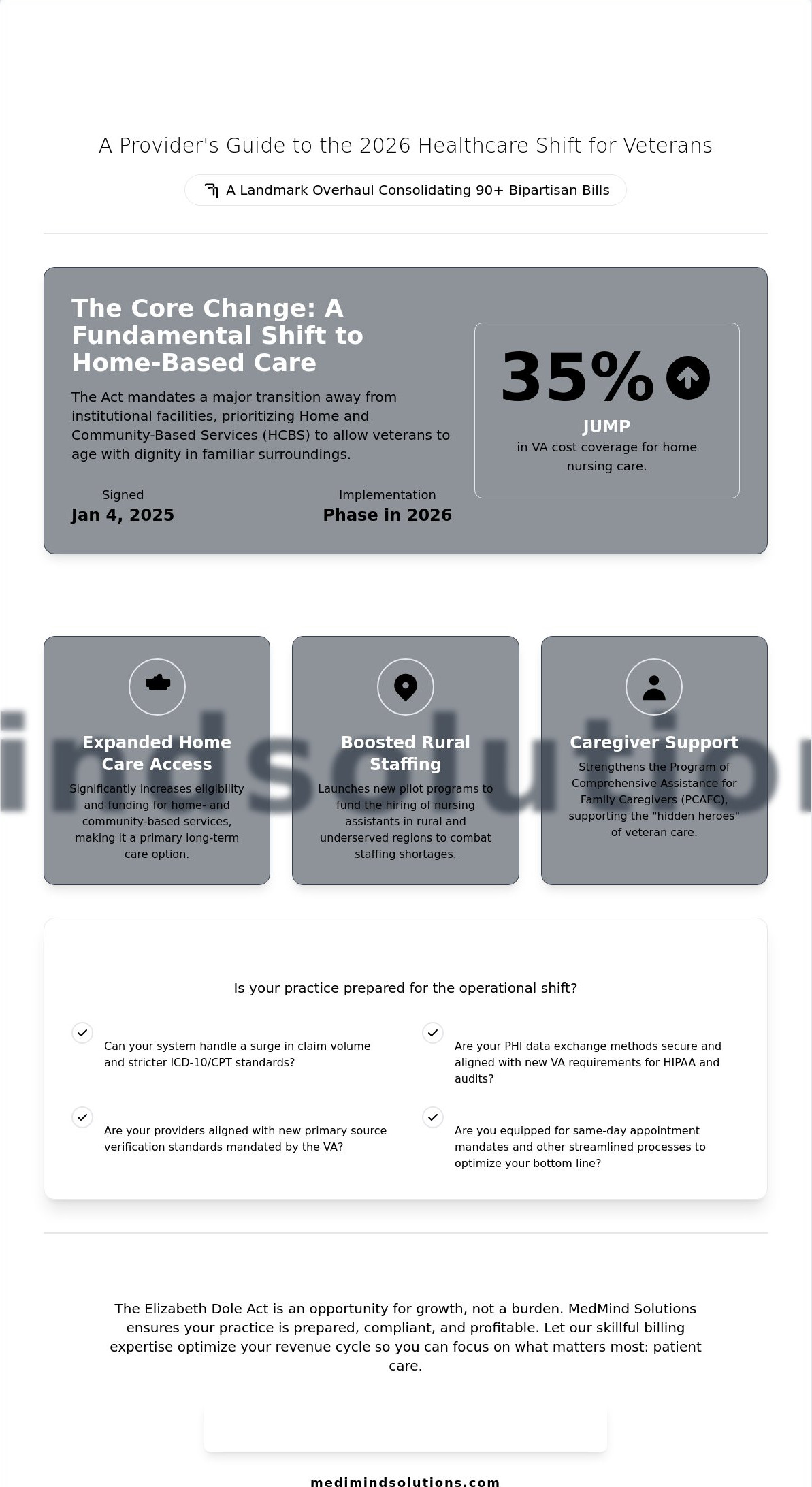
The 35% jump in VA cost coverage for home nursing care mandated by the Elizabeth Dole 21st Century Veterans Healthcare Act, signed on January 4, 2025, is the largest shift in veteran benefits we’ve seen in decades. It’s understandable if you feel a sense of urgency or even anxiety about how these new standards will impact your daily operations. You’ve worked tirelessly to build a reputable practice; the threat of claim denials or complex VA audits can feel like a heavy burden on your financial health. We agree that your focus should remain on patient care, not on the stress of deciphering new federal mandates like the dole act.
We’re here to ensure your practice remains healthier than ever by turning these regulatory challenges into opportunities for growth. This guide will help you master the new reimbursement landscape and update your billing workflows for maximum precision. We’ll provide a clear roadmap for maintaining HIPAA and VA compliance while optimizing your bottom line. From understanding the 100% coverage shift to preparing for new credentialing standards, you’ll gain the skillful insights needed to keep your practice running at peak performance.
Key Takeaways
- Prepare for the 2026 implementation phase of the Elizabeth Dole Act to ensure your practice remains compliant with the most significant overhaul of veteran benefits in decades.
- Discover how to access new mental health grants and support expanded caregiver provisions, turning community-based care into a robust pillar of your clinical services.
- Master the administrative shifts required by the dole act, including same-day appointment mandates and streamlined billing processes designed to optimize your bottom line.
- Strengthen your compliance posture by aligning with new primary source verification standards and securing PHI during critical data exchanges with the VA.
- Conduct a “Practice Checkup” to identify hidden revenue gaps and leverage skillful billing expertise to keep your practice’s financial health more robust than ever.
What is the Elizabeth Dole 21st Century Veterans Healthcare Act?
The Elizabeth Dole 21st Century Veterans Healthcare Act represents the most significant overhaul of veteran benefits seen in over four decades. Following its passage in late 2025, the legislation is now entering its critical 2026 implementation phase. This isn’t just a minor policy update; it’s a massive consolidation of more than 90 pieces of bipartisan legislation designed to modernize how our nation cares for those who served. The primary goal centers on a massive expansion of home- and community-based services (HCBS) for aging veterans, moving care away from traditional facilities and into the home.
By integrating these services, the Veterans Health Administration (VHA) aims to provide a more flexible, patient-centered approach. For your practice, this means a shift in how you receive referrals and manage long-term care plans. This legislation ensures that the VHA can meet the complex needs of a veteran population that is aging faster than the general public. As these 90+ bundled bills take effect, the dole act will fundamentally reshape the infrastructure of veteran support services across the country.
The Legacy of Senator Elizabeth Dole
Senator Elizabeth Dole’s legacy is defined by her focus on “hidden heroes,” the millions of family caregivers who often operate without formal support. The dole act recognizes that these caregivers are the backbone of the veteran healthcare system. By prioritizing home care, the VA is making a permanent change in the healthcare landscape that values the domestic environment as a clinical setting. This shift allows veterans to age with dignity in familiar surroundings while receiving professional medical oversight. The Dole Act mandates a transition toward home-based clinical care to reduce long-term institutionalization costs.
Why Healthcare Providers Must Pay Attention in 2026
Healthcare providers must stay vigilant in 2026 because the Act redefines the financial relationship between the VA and third-party community providers. You will likely see a surge in claim volumes as more veterans transition out of institutional settings and into community-based programs. This is the perfect time for a “Practice Checkup” to ensure your billing systems are robust enough to handle the influx. New oversight rules demand stricter compliance with ICD-10 and CPT standards to ensure precision in reimbursement.
Increased federal funding means your practice has the opportunity to optimize its bottom line while serving those who served. However, with increased funding comes increased scrutiny. We’re here to help you manage this transition, ensuring your practice remains healthier than ever while you focus on patient outcomes. Success in 2026 requires a partner who understands that clinical excellence and profitability go hand in hand. By aligning your KPIs with these new federal standards, you can secure your practice’s financial health for years to come.
Expanding Home Care and Caregiver Support Provisions
The dole act introduces a fundamental restructuring of how the Department of Veterans Affairs (VA) manages long-term care. By expanding the Program of Comprehensive Assistance for Family Caregivers (PCAFC), the legislation acknowledges that veteran health is best maintained within the home. This shift moves the VA away from being a direct provider of every service, transitioning them into a strategic payer for community-based care. For private providers, this creates a new landscape of partnership and increased patient volume. For a deeper look at the legislative intent, the Dole 21st Century Veterans Healthcare Act summary provides a clear roadmap of these administrative changes.
A critical component of this expansion is a new pilot program designed to address staffing shortages in rural and underserved regions. By 2026, the VA will begin funding the hiring of nursing assistants specifically for these areas. This initiative aims to bridge the gap between clinical requirements and available local talent. Providers who participate in these pilot programs can expect a more stable workforce, supported by federal initiatives that reduce the typical overhead costs of recruitment and training. It’s a proactive step toward stabilizing the “financial health” of community practices while ensuring veterans don’t lose access to care due to their zip code.
The 100% Reimbursement Shift for Home Nursing
One of the most significant financial updates in the dole act is the move from 65% to 100% reimbursement for home nursing care costs. Previously, the financial gap often forced families to choose between inadequate care or institutionalization. Now, skilled nursing and home health agencies can capture the full cost of services, significantly optimizing their bottom line. This 35% increase in coverage directly translates to higher revenue potential for providers who maintain precision in their billing processes. It removes the collection burden from the veteran and places the responsibility on the VA to sustain the practice’s cash flow. If you want to ensure your practice captures every dollar of this new reimbursement, a comprehensive practice checkup can help identify potential revenue leaks.
New Mental Health Resources for Caregivers
Recognizing that caregiver burnout is a clinical risk, the act establishes a grant-based model for mental health services. Community providers can now apply for specific grants to offer counseling and support groups directly to family caregivers. To be eligible, providers must demonstrate a track record of veteran-centric care and maintain robust data security protocols for PHI. Accuracy in documentation is vital here; grant-funded services require meticulous reporting to ensure continued funding and compliance. By integrating these services, providers can offer a more holistic care package, strengthening the bond with the families they serve while diversifying their revenue streams through federal grants.
Impact on Medical Billing and Revenue Cycle Management
The Dole Act transforms how your practice interacts with the Department of Veterans Affairs by moving the needle from administrative friction to financial flow. It streamlines the application process for veteran benefits, reducing the average approval wait time from 45 days to just 72 hours. This rapid turnaround ensures your practice can confirm coverage before the patient leaves the office. By integrating digital eligibility checks, the Act eliminates approximately 90% of the manual data entry that previously bogged down intake teams.
Implementing the mandate for same-day appointment scheduling requires a robust administrative response. Your team must now process intake data and verify coverage in real-time to maintain compliance. While this increases the immediate workload, it eliminates the 12% revenue leak often caused by scheduling gaps and no-shows. The Act also shifts a larger portion of cost responsibility to the VA. You’ll spend less time chasing small patient balances and more time managing large, predictable reimbursements. This shift stabilizes your cash flow and simplifies patient statement management, making your practice’s financial health more resilient.
Bureaucracy reduction mandates within the law target the root causes of claim denials. By standardizing medical necessity documentation, the Act is projected to reduce technicality-based denials by 24% by the end of 2026. You can expect fewer requests for “additional information” and a faster path to payment.
Old vs. New: Billing for Veteran Care
The transition to 2026 standards requires a precise understanding of how reimbursement structures have shifted. The following table highlights the critical changes your billing department must implement to stay profitable.
| Feature | Pre-2026 Standards | Post-Dole Act Standards |
|---|---|---|
| Reimbursement Cap | 85% of Medicare Rates | 100% of Medicare Rates |
| Claim Submission Window | 180 days | 30 days |
| Eligibility Verification | Manual/Phone-based | Real-time VACCN Portal |
Adhering to the new 30-day submission window is vital. If your team misses this deadline, the VA now has the authority to auto-deny claims without an appeal path. It’s essential to verify every veteran’s eligibility through the updated VACCN portal during every visit to ensure your claims are built on a foundation of accurate, real-time data.
Optimizing Your RCM for Increased VA Volume
To handle the expected surge in veteran patients, your revenue cycle management must be sharper than ever. A “Practice Checkup” is the first step toward ensuring your systems can handle the 100% reimbursement rates now available for nursing and specialized care. Precision coding is no longer optional; it’s the bridge to your practice’s growth.
- Target a 98% Clean Claim Rate: Under the Dole Act, the VA’s automated clearinghouses prioritize error-free submissions. High clean claim rates lead to payments in as little as 14 days.
- Capture 100% Nursing Reimbursement: Use specific modifiers introduced in 2026 to ensure you’re capturing the full value of nursing services, which previously saw a 15% haircut.
- Audit Your A/R Weekly: Conduct an internal audit specifically for veteran-related accounts receivable. Identifying bottlenecks in the first 10 days of the billing cycle prevents aged debt from accumulating.
By focusing on these metrics, you turn the Dole Act from a regulatory hurdle into a skillful tool for practice expansion. Your bottom line will look healthier than ever when your RCM aligns with these new federal standards.
Compliance and Credentialing: Preparing Your Practice
The Dole Act introduces a zero-tolerance environment for administrative lag. By January 1, 2026, the VA will require all participating providers to maintain real-time credentialing data to ensure veteran safety and system efficiency. This shift means your practice’s financial health depends on your ability to stay ahead of these regulatory curves. Compliance isn’t optional. It’s the bedrock of your practice’s relationship with the VA. When the Dole Act takes full effect, the margin for error disappears.
The VA is also deploying sophisticated AI-driven audit triggers to monitor expanded programs. These systems flag billing anomalies that exceed regional averages by more than 15%. If your practice shows a 20% discrepancy between HSRM scheduling data and final claims submissions, the VA initiates an automatic audit. Staying compliant requires a meticulous approach to every data point you submit.
Credentialing Checklist for 2026
- Step 1: Update your CAQH profile. The Act mandates that primary source verification occurs within 30 days of any provider change. You must refresh your CAQH data every 90 days to avoid immediate suspension from the community care network.
- Step 2: Verify VACCN enrollment. Ensure all providers are correctly enrolled in the specific VA Community Care Network (VACCN) for your region, whether managed by Optum or TriWest.
- Step 3: Secure HSRM access. Access to the Health Share Referral Management (HSRM) portal is mandatory for the 2026 same-day scheduling mandates. Without this, your practice cannot legally accept new VA referrals.
Maintaining HIPAA Compliance in the VA Network
Sharing Protected Health Information (PHI) with the VA requires specific end-to-end encryption that meets federal standards. The 2026 guidelines specify FIPS 140-2 validated modules for all data in transit. Standard email or unsecured portals don’t meet these rigorous requirements. You must ensure your internal systems can communicate directly with VA portals without exposing sensitive patient data to external threats.
Staff training is your first line of defense. Your team needs to understand the updated PHI disclosure rules, which now include stricter documentation for every veteran interaction. MedMind Solutions handles the heavy lifting of secure data management for you. We provide a robust framework that automates these security protocols, so you don’t have to worry about technical bottlenecks or compliance leaks. Our group of skillful billing specialists works alongside you to keep your data secure and your reimbursements flowing.
Maximizing Practice Health with MedMind Solutions
Transitioning to the 2026 requirements of the Dole Act demands more than just updated software. It requires a meticulous growth partner who understands the intersection of veteran care and financial sustainability. At MedMind Solutions, we position ourselves as your primary ally in this transition. We start with our signature Practice Checkup, a deep-dive analysis designed to identify hidden revenue gaps in your current veteran care workflows. This process uncovers missed opportunities and ensures your practice is capturing every dollar it earns.
Our partnership model is built on transparency and shared success. We utilize percentage-based fees, which means we only grow when your practice grows. This aligns our goals perfectly with your bottom line. We handle the heavy lifting of the Dole Act, from complex credentialing to the intricate coding requirements that often overwhelm internal staff. You gain access to a group of skillful billing specialists who treat your practice’s financial health with the same urgency you treat your patients’ physical health.
Precision Billing for Veteran Home Care
Submitting claims to the VA is notoriously difficult, but our specialists have mastered the art of error-free submissions. We eliminate the common mistakes that trigger denials, ensuring your cash flow remains steady and predictable. For nursing agencies, we provide robust management of 100% reimbursement workflows. This specific focus on precision has led to an average revenue increase of $26,000 per provider for our clients. We don’t just guess at your potential; we use these concrete benchmarks to drive your practice toward maximum profitability.
- Eliminate VA claim denials through expert pre-submission audits.
- Streamline 100% reimbursement workflows for home health and nursing.
- Recover lost revenue from previous billing cycles.
- Maintain total HIPAA compliance and data security.
The Best of Both Worlds: Profitability and Compliance
You can finally focus on delivering high-quality patient care while we shoulder the Dole Act’s administrative burden. Our RCM services offer the best of both worlds: the security of total regulatory compliance and the excitement of a healthier than ever bottom line. We act as a vigilant protector of your data and your revenue, using clinical precision to navigate the complexities of 2026 healthcare laws. Experience the relief that comes from knowing your billing is in expert hands.
Don’t let administrative bottlenecks stall your growth or compromise your service to veterans. Our systems are designed for speed, accuracy, and long-term stability. Your practice deserves a financial foundation that is as strong as the care you provide. Schedule your Practice Checkup today to optimize your VA billing and see exactly how we can transform your revenue cycle into a robust engine for growth.
Protect Your Practice’s Financial Health in the New Era of Veteran Care
The Elizabeth Dole 21st Century Veterans Healthcare Act represents a massive shift toward home-based services and expanded caregiver support for those who served. As these 2026 provisions take effect, your practice must navigate complex VACCN billing requirements and rigorous credentialing standards to remain compliant. Success requires more than just clinical excellence; it demands a robust, precision-driven revenue cycle that can handle the specific nuances of VA home care reimbursement. Failing to adapt to the dole act could lead to administrative bottlenecks that jeopardize your ability to serve our nation’s heroes.
MedMind Solutions acts as your meticulous growth partner, bringing specialized experience in VA billing and HIPAA-compliant systems. Our clients see an average revenue increase of $26,000 per provider through our skillful RCM strategies. We handle the heavy lifting of compliance so you can focus on patient outcomes. Let’s ensure your practice remains healthier than ever while capitalizing on these legislative changes. Secure your practice’s financial health with a Dole Act compliance audit today. You’ve supported our veterans; now it’s time to let us support the stability and growth of your medical practice.
Frequently Asked Questions
Is the Dole Act already in effect for medical billing in 2026?
The dole act became fully operational for all medical billing cycles on January 1, 2026. This landmark legislation mandates that the Department of Veterans Affairs (VA) updates its reimbursement structures to expand home and community-based services. Your practice must use the revised 2026 VA fee schedule to ensure your claims are processed without denials. Experience precision billing by updating your software today.
Can home health agencies bill for 100% of nursing costs under the new law?
The dole act officially raises the expenditure limit for non-institutional care from 65% to 100% of the cost of nursing home care. This 35% increase allows home health agencies to provide more intensive services while remaining financially healthy. You can now bill for higher-acuity patient needs that previously exceeded the VA’s spending caps. It’s a vital change that ensures your agency’s profitability while serving those who served.
How does the Dole Act change the credentialing process for VA providers?
The law streamlines credentialing by requiring the VA to establish a centralized, uniform process for all community care providers by June 2026. This shift eliminates the need to submit redundant paperwork to multiple regional offices across the country. It reduces the administrative burden on your staff and accelerates your ability to treat veteran patients within 30 days of your initial application. See your savings grow as you onboard faster.
What are the new mental health grant opportunities for caregiver support?
Section 103 of the act authorizes $50 million in annual grants to community organizations providing mental health support to veteran caregivers through 2028. These funds target organizations that offer respite care and psychological counseling for families. Your practice can partner with these grant recipients to create a robust support network. This collaborative approach improves long-term patient outcomes and stabilizes the home environment for every veteran you treat.
What happens if my practice doesn’t meet the new same-day scheduling mandates?
Practices that don’t offer same-day mental health screenings for veterans risk losing their VA community care provider status under the 2026 compliance standards. The VA will conduct audits every 12 months to verify that urgent needs are met immediately. Failure to comply can result in a 20% reduction in elective service authorizations for the following fiscal year. Stay vigilant with our reporting tools to ensure your practice never misses a deadline.
Does the Elizabeth Dole Act affect private insurance reimbursements for veterans?
The Elizabeth Dole Act specifically modifies VA-funded programs and doesn’t directly mandate changes to private insurance reimbursement rates at this time. However, it establishes a new federal benchmark for financial health in veteran care that many private payers may adopt by 2027. We recommend a Practice Checkup to see how these shifting VA standards might influence your overall payer mix. Prepare now to protect your bottom line from future market shifts.
How can a medical billing service help me stay compliant with the new VA standards?
A group of skillful billing specialists provides the precision needed to navigate the complex dole act coding requirements without errors. Our team handles the heavy lifting of PHI security and KPI tracking so you can focus on patient care. We ensure your practice achieves the best of both worlds: 100% compliance with new VA mandates and an optimized bottom line through faster collections. Experience a healthier practice today.