

Did you know that the average claim denial rate surged to 11% in 2022, marking a 28% increase over just six years? It’s a frustrating reality for many providers who see their hard work stall in administrative limbo. You likely agree that the constant evolution of ICD-10 and CPT codes feels less like a clerical task and more like a barrier to providing care. When billing and coding errors lead to high days in A/R, your practice’s financial health suffers, creating unnecessary stress for your entire team.
It’s time for a practice checkup to ensure your revenue cycle is as robust as your clinical outcomes. This guide helps you master these complexities so you can discover how precision billing and coding drive a healthier bottom line. We’ll show you how to maximize reimbursements and reduce the heavy lifting of administrative tasks. You’ll also learn the exact steps to maintain 100% compliance with federal regulations, giving you the security and relief you need to focus on what matters most: your patients.
Key Takeaways
- Understand the symbiotic relationship between clinical care and financial reimbursement to ensure your documentation translates into maximum revenue.
- Map the seven critical stages of the revenue cycle to identify and plug “leakage points” that are currently draining your practice’s profits.
- Discover how precision in billing and coding prevents the domino effect of denials and ensures your claims result in immediate cash flow.
- Learn to perform a “Practice Checkup” by tracking four essential KPIs that serve as a diagnostic tool for your practice’s long-term financial health.
- Explore the “best of both worlds” promise by comparing in-house management with professional RCM solutions designed to optimize your bottom line.
Understanding the Essentials: Medical Billing vs. Medical Coding
Your practice thrives when clinical excellence meets financial precision. Medical billing and coding represent two halves of a single heartbeat, working together to sustain your revenue cycle. Coding functions as the translation layer, turning a patient’s complex medical story into a universal language that insurance companies understand. Billing then takes that data and acts as your provider advocate, navigating the maze of payer complexities to secure your reimbursement. This perfect match ensures your practice remains healthier than ever, protecting your bottom line from administrative friction.
When these two roles align, your financial health reflects your clinical success. A group of skillful billing specialists transforms your documentation into a robust stream of cash flow. By treating your practice’s fiscal well-being with the same care you give your patients, you create a foundation for long term growth and stability. You don’t just survive the complexities of healthcare administration; you master them.
The Language of Coding: ICD-10, CPT, and HCPCS
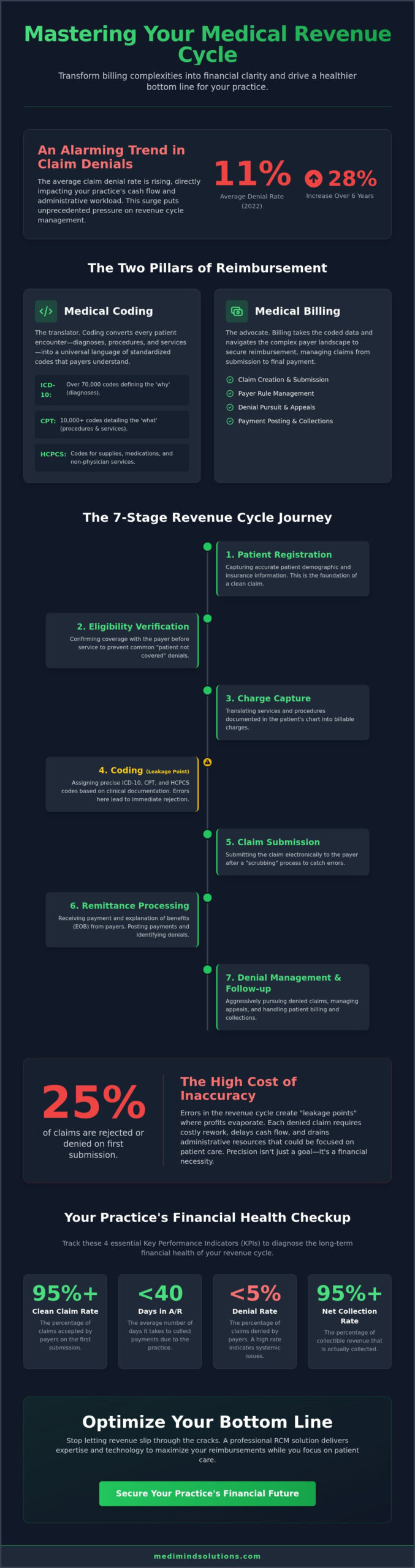
Accurate coding is the bedrock of compliance and the first step toward maximum profits. The ICD-10-CM system, which features over 70,000 diagnostic codes, provides the “why” behind every patient encounter. Meanwhile, CPT codes describe the “what,” detailing the 10,000 plus procedures and services available to clinicians. Precision in this translation is vital. Even a minor error in a fifth digit can lead to an immediate claim rejection, stalling your revenue.
HCPCS Level II codes complete the picture by capturing supplies, medications, and non-physician services that CPT codes don’t cover. Clinical documentation is the foundation of every code assigned. If a provider doesn’t record a specific detail, a coder cannot legally assign the code. Experience precision billing by ensuring your team understands that every note in the EHR is a financial building block. When documentation is thorough, your coding becomes a leading indicator of your practice’s profitability.
The Bridge to Reimbursement: What is Medical Billing?
If coding is the language, billing is the vehicle that carries your claims to the finish line. This Medical Billing Overview highlights how the process moves from claim creation through to payment posting and patient collections. It’s a high stakes game of advocacy. Billing specialists must manage payer specific rules that change constantly. In fact, some major payers updated their medical policies more than 20 times in the last year alone. Staying ahead of these shifts is essential for maintaining a high clean claim rate.
Billing specialists act as the frontline for your practice’s cash flow. They don’t just submit forms; they manage contract terms and aggressively pursue denials. See your savings grow as these experts reduce your days in accounts receivable. By handling the heavy lifting of payer negotiations and patient billing inquiries, they free your staff to focus on patient care. This meticulous approach to billing and coding creates the best of both worlds: increased speed and increased profitability for your entire organization.
The Revenue Cycle Journey: How a Claim Becomes Cash
The Revenue Cycle Management (RCM) process functions as your practice’s financial roadmap. It transforms a patient encounter into tangible reimbursement through seven distinct stages: registration, eligibility verification, charge capture, coding, claim submission, remittance processing, and follow-up. Industry data indicates that nearly 25% of medical claims are rejected or denied on the first pass, creating significant “leakage points” where revenue simply evaporates. Understanding What is Medical Billing and Coding? helps clarify how these steps integrate to protect your bottom line. Precision at each stage ensures your practice remains healthier than ever.
Front-End Excellence: Registration and Eligibility
Financial success begins before the provider enters the exam room. Capturing accurate Protected Health Information (PHI) during registration is the first line of defense against denials. You must verify insurance eligibility 100% of the time to prevent “patient not covered” rejections, which account for a massive portion of lost revenue. Clean patient data acts as the foundation for the entire billing and coding workflow. When your front-desk team prioritizes accuracy, they eliminate the friction that slows down your cash flow. You can see your savings grow by optimizing your patient intake today.
Back-End Diligence: Submission and Denial Management
Once the clinical encounter ends, the focus shifts to submission and reconciliation. Skillful billing teams utilize a robust “scrubbing” process to identify errors before the claim reaches the clearinghouse. This proactive approach aims for a 95% clean claim rate, reducing the time your money spends in “accounts receivable.” After submission, managing the Explanation of Benefits (EOB) requires a meticulous eye to ensure every payment matches the contracted rate. This step is vital for accurate payment reconciliation and identifying underpayments from payers.
Denials aren’t the end of the road; they’re an opportunity for recovery. A diligent follow-up strategy ensures no dollar is left on the table. Skillful billing specialists apply a persistent approach to appealing denied claims, often recovering revenue that other practices write off as bad debt. By treating your billing and coding with clinical precision, you turn administrative hurdles into a reliable engine for growth. This meticulous attention to detail ensures your financial health is just as robust as the care you provide to your patients.
Why Precision Matters: The High Cost of Billing and Coding Errors
A single incorrect modifier or diagnosis code creates a domino effect that halts your cash flow immediately. Precision in billing and coding ensures your practice remains profitable and compliant. When a claim contains a minor error, it doesn’t just disappear; it triggers a cycle of administrative burden that pulls your staff away from patient care. Accurate data entry is the heartbeat of your revenue cycle, and even a one-digit slip can delay reimbursement by 30 to 60 days.
You must distinguish between a rejection and a denial to maintain a healthy revenue cycle. A rejection happens at the clearinghouse level before the payer processes the claim, usually due to formatting or data errors. A denial occurs after the insurance company reviews the claim and refuses payment based on coverage or clinical judgment. Understanding this difference allows your team to address the root cause of lost revenue quickly.
Compliance risks like “upcoding” or “unbundling” often trigger federal audits that can devastate a provider’s reputation. Upcoding involves billing for a higher level of service than performed, while unbundling is the practice of billing individual components of a procedure separately to increase fees. The Office of Inspector General monitors these patterns closely. Error elimination safeguards your practice’s security, ensuring you achieve a “perfect match” between the services you provide and the payments you receive.
Common Coding Pitfalls and How to Avoid Them
Many practices struggle with misusing CPT 99214. This high-frequency code is often over-billed without sufficient documentation to support the complexity, making it a primary target for auditors. You should also avoid “cloning” notes in EHR systems; copying and pasting patient history creates a lack of specificity that payers view as fraudulent. Medical necessity serves as the primary requirement for reimbursement, acting as the clinical justification for every service billed.
The Financial Drain of Denied Claims
Reworking a single denied claim costs an average of $25 in administrative labor and overhead. High denial rates directly damage your Net Collection Ratio, which is a vital KPI for your practice’s financial health. A 95% clean claim rate sounds impressive, yet it might still cost you thousands of dollars annually. If your practice submits 500 claims monthly with an average value of $300, a 5% error rate results in 25 denials every month. This equates to $7,500 in delayed revenue and $625 in immediate labor costs to fix the errors. Experience precision billing and coding to keep your practice healthier than ever.
KPIs for a Practice Checkup: Measuring Your Financial Health
Just as you monitor a patient’s vital signs to assess their physical wellbeing, you must perform a regular “Practice Checkup” to evaluate your fiscal health. Relying on gut feelings about your revenue leads to instability. Instead, use data-driven reporting to ensure your practice remains healthier than ever. By tracking specific metrics, you gain the clinical precision needed to optimize your bottom line and secure long-term growth. This proactive approach alleviates financial stress and provides the security you need to focus on medicine.
National industry standards provided by organizations like the Medical Group Management Association (MGMA) serve as your benchmark. Top-tier practices don’t just guess; they use these figures to prove their value. On average, providers who switch to a group of skillful billing specialists see a revenue increase of $26,000 per provider. This level of growth is only possible when you treat your financial data with the same seriousness as a medical chart.
Days in A/R and Net Collection Ratio
Days in Accounts Receivable (A/R) measures the average number of days it takes for your practice to get paid. A lower number is always better for your cash flow because it means your money isn’t sitting idle. According to 2023 industry benchmarks, a healthy practice should aim for fewer than 35 days in A/R. If your number climbs above 50, your capital is trapped in the claims cycle rather than fueling your operations.
To see what you actually keep, calculate your Net Collection Ratio by dividing total payments by your total charges after subtracting contractual adjustments. This provides a clear picture of your actual profitability. A collection ratio below 95% indicates a need for intervention, as it proves that money you’ve rightfully earned is being lost to administrative errors or poor follow-up.
Clean Claim Rate and Denial Trends
Your Clean Claim Rate (CCR) tracks the percentage of claims paid on the first submission. This is the ultimate test of your billing and coding accuracy. High-performing practices maintain a CCR of 98% or higher. When this number drops, it’s a sign that systemic workflow issues are slowing down your reimbursements and increasing the heavy lifting for your staff. Experience precision billing by identifying these bottlenecks before they impact your monthly revenue.
Analyzing denial trends allows you to identify exactly why payers are rejecting your services. Whether the issue is insurance eligibility verification or specific billing and coding errors, these insights allow for precision adjustments. Using KPIs in this way transforms your bottom line from surviving to thriving. You’ll experience the relief that comes from knowing your revenue cycle is in skillful hands.
Optimizing Your Bottom Line: The Case for Professional Billing Solutions
Managing a medical practice involves a critical choice: maintaining an in-house team or partnering with a specialized Revenue Cycle Management (RCM) firm. While internal staff offers proximity, the overhead of salaries, benefits, and ongoing training often drains resources. Professional billing and coding partners eliminate these administrative burdens. They provide the “best of both worlds” by accelerating the collection cycle while simultaneously driving up total revenue. This isn’t just about outsourcing; it’s about upgrading to a system where precision is the standard.
Protecting Protected Health Information (PHI) is a non-negotiable priority for any modern clinic. Robust data encryption and strict HIPAA compliance protocols ensure your practice remains secure and audit-ready. By moving away from manual, paper-heavy processes, you reduce the risk of data breaches that cost healthcare providers an average of $10.1 million per incident according to 2023 industry reports. MedMind Solutions acts as a vigilant guardian, ensuring your financial data is as safe as your patients.
The Benefits of a Skillful Billing Team
A dedicated team of specialists brings a level of focus that an office manager juggling patient care simply cannot match. These experts handle complex credentialing and enrollment tasks, removing the administrative barriers that delay your start dates with new payers. Precision is vital here. Every decimal and modifier matters. A meticulous approach to billing and coding ensures you capture every possible reimbursement dollar, reducing the 5% to 10% of revenue typically lost to coding errors in unoptimized practices.
- Expert Access: Gain a full department of specialists without the cost of internal headcount.
- Credentialing: Speed up payer enrollment to start seeing revenue from new providers faster.
- Error Reduction: Clean claims mean fewer denials and consistent cash flow.
Partnering for Long-Term Profitability
MedMind Solutions operates on a percentage-based fee model. This structure aligns our goals directly with yours; we only succeed when you do. You’ll experience immediate relief as our specialists handle the heavy lifting of claim denials and follow-ups. On average, our partners see a revenue increase of $26,000 per provider. It’s time to stop worrying about the ledger and start focusing on your patients. We position your practice for growth by turning your billing department into a profit center rather than a cost center.
Ready to see your practice thrive? Experience a healthier practice with a MedMind Checkup.
Achieve Lasting Financial Health for Your Practice
Your practice’s success depends on more than clinical excellence; it requires a robust revenue cycle. Mastering the nuances of billing and coding is the only way to prevent costly errors that lead to claim denials and delayed reimbursements. By tracking key performance indicators and maintaining precision in documentation, you protect your bottom line from avoidable losses. These administrative details often determine whether a practice thrives or merely survives in today’s complex regulatory environment.
You don’t have to manage this burden alone. MedMind Solutions acts as your meticulous growth partner, offering a group of skillful billing specialists who handle the heavy lifting so you can focus on patient care. Our partners see an average revenue increase of $26,000 per provider through our precision-driven approach. We prioritize your profits with a percentage-based fee model and ensure your data stays secure with 100% HIPAA-compliant systems and PHI protection. It’s time to experience the relief of a perfectly matched billing partner. Optimize your practice’s financial health with MedMind Solutions. We’re ready to help your practice become healthier than ever.
Frequently Asked Questions
What is the difference between medical billing and medical coding?
Medical coding translates clinical documentation into standardized alphanumeric codes, while medical billing involves submitting those codes to insurance companies for payment. Coding focuses on accuracy within the ICD-10-CM system, which includes over 70,000 unique codes. Billing manages the entire lifecycle of the claim to ensure your practice receives every dollar earned. It’s the essential bridge between patient care and your practice’s financial health.
How do coding errors affect my practice’s reimbursement?
Coding errors trigger immediate claim denials, which directly stall your cash flow and increase administrative overhead. A 2022 Change Healthcare report shows the average denial rate has climbed to 11% across the industry. Incorrectly assigned codes require manual appeals that take 30 to 45 days to resolve. Precision in your billing and coding workflow prevents these costly delays and keeps your revenue cycle moving predictably.
What are ‘Days in A/R’ and why should I care about them?
Days in Accounts Receivable (A/R) represents the average number of days it takes for your practice to receive payment after a service is rendered. You should monitor this metric because it dictates your liquid cash flow and operational stability. The Medical Group Management Association (MGMA) suggests maintaining a target of 35 days or fewer. If your A/R exceeds 50 days, your practice is likely losing 5% of its potential revenue to uncollectible debt.
Is it better to handle billing in-house or outsource to a professional service?
Outsourcing provides access to a specialized team that typically achieves a 98% claim accuracy rate, which is often higher than in-house capabilities. You’ll avoid the $60,000 average annual salary for a certified coder plus the cost of benefits and software. This shift allows your staff to focus on patient outcomes while our experts handle the heavy lifting of the revenue cycle. It’s a strategic move for long-term growth and stability.
How does HIPAA compliance factor into the billing and coding process?
HIPAA compliance acts as the security framework that protects patient data throughout the entire electronic transmission process. Every claim contains sensitive Protected Health Information (PHI) that must be encrypted to meet federal standards. Violations are expensive, with the Department of Health and Human Services (HHS) issuing fines that can reach $1.9 million annually. Our robust systems ensure your practice stays compliant and secure, providing peace of mind for you and your patients.
What is a ‘Clean Claim Rate’ and what should my target be?
The Clean Claim Rate is the percentage of claims that payers accept and process on the first submission without any errors. Your practice should target a rate of 95% or higher to maximize efficiency. When your rate drops below 85%, you’re spending 20% more on administrative labor to rework rejected files. High clean claim rates ensure your practice stays healthier than ever with predictable, steady income and fewer interruptions.
Can professional billing services help with provider credentialing?
Yes, professional billing services manage the complex credentialing process, which usually takes 90 to 120 days to complete for each new payer. We handle the exhaustive documentation and follow-up required to ensure you’re recognized as an in-network provider. This partnership prevents the revenue gaps that happen when providers see patients before their contracts are finalized. We manage the paperwork so you can start seeing patients and generating revenue sooner.
How much can I expect my revenue to increase with optimized billing?
Optimized billing and coding systems can increase your total collections by 10% to 20% by capturing missed charges and reducing denials. Many practices see an average revenue boost of $26,000 per provider annually through meticulous claim management. This financial checkup identifies leaks in your current process and plugs them with precision. You’ll see your savings grow as we streamline your path to maximum profitability and a stronger bottom line.