

Did you know that the 2023 CMS Comprehensive Error Rate Testing (CERT) report found an improper payment rate of 9.5% for office visits, often caused by documentation that fails to support the code level? You likely feel the weight of this statistic every time you sit down to finalize a patient chart. It’s frustrating to balance clinical precision with the fear that a 99214 cpt code claim might be rejected or flagged for a Medicare audit. You want your practice to remain financially healthy while you focus on what matters most; the well-being of your patients.
This guide unlocks the clinical and financial requirements of the 99214 cpt code for 2026 to ensure your documentation is audit-proof and your reimbursements are fully optimized. We promise to clarify the confusing boundaries between Medical Decision Making (MDM) and time-based coding so you can bill with total confidence. We’ll examine the specific thresholds for moderate complexity, provide actionable documentation tips, and show you how to reduce administrative burdens. By the end, you’ll have a skillful roadmap to protect your bottom line and experience the security of precision billing.
Key Takeaways
- Master the nuances of the most utilized established patient visit code to ensure your practice’s financial health remains robust and secure.
- Learn how to strategically choose between Medical Decision Making and the 30–39 minute “Total Time” threshold to capture the full value of your clinical work.
- Discover the specific documentation triggers that allow you to accurately differentiate the 99214 cpt code from levels 99213 and 99215.
- Implement audit-proof documentation strategies that prioritize medical necessity, protecting your hard-earned revenue from rigorous payer scrutiny.
- See how precision coding acts as a catalyst for practice growth, transforming administrative heavy lifting into a streamlined path for maximum profitability.
Understanding the 99214 CPT Code: The Workhorse of Established Patient Visits
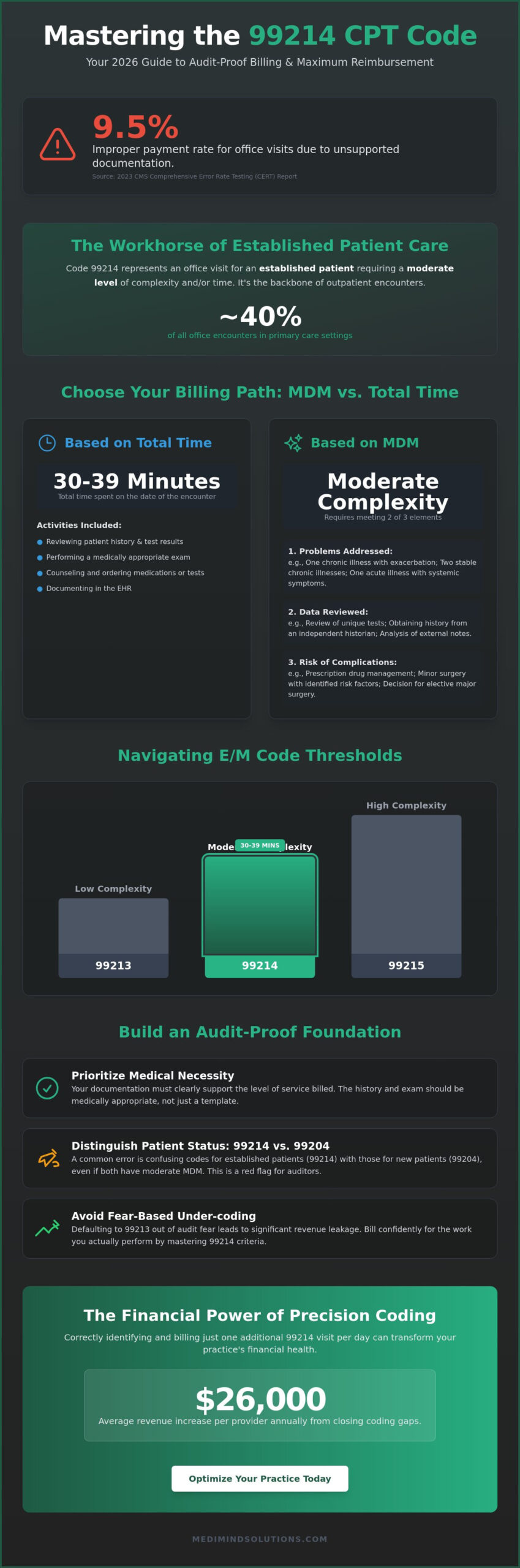
The 99214 cpt code serves as the backbone of outpatient care, representing approximately 40% of all office encounters in primary care settings. It defines an office or outpatient visit for the evaluation and management of an established patient. As we move through 2026, the reliance on this code remains steadfast. Providers use it to document visits that require a moderate level of medical decision making (MDM). This specific level of Evaluation and Management (E/M) coding ensures that the clinical complexity of a patient’s condition aligns with the resources your practice expends.
In 2026, the coding landscape continues to prioritize either the total time spent on the date of the encounter or the complexity of MDM. This evolution allows you to focus on patient outcomes rather than counting bullet points in a physical exam. For a 99214 encounter, the time threshold typically ranges from 30 to 39 minutes of total time. Understanding this “Moderate Complexity” designation is the first step toward securing the financial health of your practice.
The Clinical Profile of a 99214 Encounter
A typical 99214 patient often presents with a progressing illness or an acute injury that requires prescription management or minor surgery with identified risk factors. You might see a patient with two stable chronic conditions, such as hypertension and type 2 diabetes, or one chronic illness with a mild exacerbation. While you must perform a “medically appropriate” history and physical exam, these no longer dictate the final code level. It’s vital to distinguish this from code 99204. While both require moderate complexity, 99204 is reserved for new patients. Mixing these up is a common error that triggers audits and delays your reimbursement.
Why 99214 Accuracy Matters for Your Bottom Line
Precision billing directly impacts your practice’s Relative Value Units (RVUs), which determine your total compensation. Many providers fall into the trap of “under-coding” to 99213 because they fear an audit. This caution leads to significant annual revenue leakage. Moving a single daily visit from 99213 to 99214 can bridge a substantial gap in your cash flow. Our data shows that identifying these coding gaps through a “Practice Checkup” can lead to an average revenue increase of $26,000 per provider. You deserve to see your savings grow by capturing the full value of the skillful care you provide. When you master the 99214 cpt code, you ensure your practice stays healthier than ever, both clinically and financially.
The Two Pillars of Selection: Medical Decision Making vs. Total Time
Selecting the correct pathway for the 99214 cpt code is a strategic decision that directly impacts your practice’s financial health. You aren’t locked into a single method; instead, you can choose between Medical Decision Making (MDM) or Total Time. This flexibility ensures your reimbursement reflects the actual work performed during the encounter. By mastering both pillars, you position your practice to be healthier than ever, with a revenue cycle that’s both robust and precise.
The Total Time method requires a range of 30–39 minutes of work on the date of the encounter. This isn’t limited to the time you spend in the exam room. It encompasses all professional work, including reviewing the patient’s history, analyzing external test results, and completing the documentation in the EHR. According to the Official CPT code 99214 description, this time must be performed by the physician or a qualified healthcare professional to qualify for the 99214 cpt code.
Mastering the MDM Framework for 99214
MDM for moderate complexity relies on three distinct elements. Element 1 covers the number and complexity of problems addressed. A single chronic illness with an acute exacerbation, such as a flare-up of rheumatoid arthritis, typically meets this threshold. Element 2 involves the amount and complexity of data reviewed, including the analysis of unique tests or obtaining history from an independent historian. Element 3 focuses on the risk of complications or morbidity. Prescription drug management is the most common example of moderate risk used to justify this level of service.
Coding by Time: When and How to Use It
Time-based coding is often more advantageous when you spend significant effort on counseling or coordination of care that doesn’t involve high-risk medical decisions. You must document a specific minute range in the medical record to satisfy audit requirements. It’s vital to remember that time spent by clinical staff, like nurses or MAs, cannot be included in your total. Only the provider’s time counts. If you spent 35 minutes on the date of service, documenting this clearly ensures your practice is in skillful hands during any payer review. Performing a regular practice checkup helps identify which coding method is truly optimizing your bottom line and increasing cash flow.
Navigating the Thresholds: 99214 vs. 99213 and 99215
Selecting the correct level for an established patient visit requires more than a cursory glance at the clock. It demands a precise evaluation of Medical Decision Making (MDM). Your practice’s financial health depends on capturing the true complexity of the care you provide. While the 99214 cpt code serves as the workhorse of primary and specialty care, it exists in a delicate balance between the lower-intensity 99213 and the high-stakes 99215. According to 2024 CMS data, level 4 visits represent approximately 45% of all established office encounters, making it the most scrutinized code during payer audits. Our skillful billing specialists prioritize your practice’s security by ensuring every claim aligns with current 99214 coding guidelines, transforming your administrative burden into a streamlined engine for growth.
Experience precision billing by recognizing the “gray areas” where a 99213 can ethically move to a 99214. This transition often occurs when a patient presents with two or more stable chronic illnesses or one stable chronic illness with a new systemic symptom. A common pattern involves the management of chronic conditions like hypertension and type 2 diabetes. If both are addressed, the complexity of problems managed meets the moderate threshold. By documenting these nuances, providers often see a significant impact on their bottom line, sometimes reaching an average revenue increase of $26,000 per provider when coding reflects the actual work performed.
The 99213 vs. 99214 Decision Matrix
The distinction between “low” and “moderate” complexity hinges on the risk to the patient. A 99213 typically involves one stable chronic illness or a simple acute injury. In contrast, the 99214 cpt code requires moderate MDM, which is frequently established through the management of prescription medications. The Moderate Risk threshold for 99214 is often met when the physician’s management plan includes prescription drug management, even if no new medications are prescribed during that specific encounter. This specific KPI is a primary driver for ethical up-coding.
Avoiding the Pitfalls of Level 5 (99215)
While 99215 offers higher reimbursement, it requires “High Complexity” MDM, involving chronic illnesses with severe exacerbations or a high risk of morbidity. Up-coding to 99215 without documenting life-threatening conditions or complex data interpretation creates significant audit risk. Our denial management protocols monitor your E/M distribution to ensure your billing patterns don’t trigger red flags. We help you stay in the “safe zone” of 99214 when appropriate, maintaining profitability while ensuring your practice remains healthier than ever through robust compliance and error elimination.
Audit-Proofing Your Documentation: Clinical Requirements for 99214
Precision documentation is the backbone of your practice’s financial health. While the 99214 cpt code offers a perfect match for moderate complexity visits, it also attracts significant scrutiny from Medicare and commercial payers. Medical necessity serves as the overarching criterion for every claim. If the clinical note doesn’t clearly justify the level of care, the reimbursement is at risk. Your documentation must reflect the skillful work you perform, turning every patient encounter into a robust legal and financial record.
Avoid the trap of over-templated notes. The Office of Inspector General (OIG) has identified “cloned” documentation as a top risk factor for audits since 2012. When every patient note looks identical, it suggests the provider didn’t actually perform the specific work for that individual. Unique, patient-specific details ensure your practice remains protected against external reviews. Robust documentation supports faster reimbursement and results in 30% fewer requests for information (RFIs) from payers.
Documenting Problems and Data Analysis
Clearly state the status of chronic conditions to justify the 99214 cpt code. Don’t just list a diagnosis like “Hypertension.” Instead, use descriptors such as “uncontrolled,” “worsening,” or “stable on current regimen.” This provides the “why” behind your clinical decisions. Documenting your review of external notes or independent test interpretations is equally vital. Your note should reflect your internal thought process, showing how you synthesized data to reach a treatment plan. This level of detail proves the complexity of the encounter and prevents downcoding during an audit.
- Specify if a condition is “failing to change as expected.”
- Detail the review of unique test results, such as a specific lab value from a specialist’s note.
- Summarize the “thought process” regarding why a specific treatment was chosen over alternatives.
The Prescription Management Rule
Listing a medication in the plan isn’t enough to satisfy the requirements for moderate complexity. To survive an audit, the note must show active management. Prescription drug management is the clinical evaluation of a patient’s medication regimen to determine its ongoing efficacy, safety, and relevance to the current treatment plan. You must document changes in dosage, monitoring for side effects, or a specific decision to continue a therapy based on clinical findings.
For example, instead of just listing “Metformin,” write: “Continued Metformin 500mg; patient reports no GI distress and A1c remains stable at 6.8%.” If you adjust a dose, explain the rationale: “Increased Lisinopril to 20mg due to systolic readings consistently above 145.” These specific markers demonstrate the “skillful” management required for the 99214 level.
Protect your revenue and ensure your practice is healthier than ever by refining your documentation standards today.
Optimize your practice’s financial health with MedMind Solutions
Maximizing Your Practice’s Financial Health Through Coding Precision
Accurate utilization of the 99214 cpt code serves as the engine for a high-performing Revenue Cycle Management (RCM) system. In the regulatory environment of 2026, precision is your best defense against audits and your strongest tool for financial stability. MedMind Solutions operates as your Meticulous Growth Partner, moving beyond simple data entry to provide deep-level audits of your E/M levels. We ensure that your documentation supports the complexity of the care you provide, preventing the “down-coding” trap that many providers fall into out of fear of scrutiny.
Our partnership model is built on mutual success. We utilize a percentage-based fee structure, which means we’re only successful when your claims are coded accurately and reimbursed in full. This alignment of interests drives our team to be vigilant. We don’t just want your claims to pass; we want them to reflect the true value of your clinical expertise. By identifying revenue opportunities that often go unnoticed, we help you build a practice that is healthier than ever.
The MedMind Advantage: Skillful Billing Specialists
Our team of skillful billing specialists acts as a final gatekeeper for your revenue. Every claim undergoes a rigorous review for compliance with the 99214 cpt code requirements before submission. This proactive approach drastically reduces the time your money spends sitting in Accounts Receivable (A/R). By eliminating common errors at the front end, we’ve seen practices reduce their A/R days by as much as 20% within the first six months of our partnership.
The financial impact of precision is tangible. Many practices habitually under-code moderate complexity visits to stay “under the radar.” However, our internal data indicates that moving from accidental under-coding to accurate, compliant 99214 levels results in an average revenue increase of $26,000 per provider annually. We provide the technical authority and data-driven insights to help you claim this missing revenue without increasing your audit risk.
Experience Precision Billing Today
You shouldn’t have to choose between clinical excellence and financial growth. We offer the best of both worlds: a significant boost in profitability and a total reduction in your administrative burden. While you focus on patient outcomes, our robust systems work behind the scenes to protect your PHI and your bottom line. We use advanced encryption and HIPAA-compliant workflows to ensure that your data remains secure while your cash flow increases.
It’s time to evaluate the state of your business with a “Practice Checkup.” This comprehensive assessment identifies where your current coding trends might be costing you money or exposing you to unnecessary risk. Let us handle the heavy lifting of billing administration so you can return to what matters most. Optimize your practice’s financial health with MedMind Solutions and see how precision transforms your results.
Secure Your Practice’s Financial Future
Navigating the 2026 E/M guidelines requires more than just a surface-level understanding of documentation. Precision with the 99214 cpt code ensures your practice captures the full value of moderate complexity visits while maintaining a robust defense against audits. By mastering the balance between medical decision making and total time, you protect your clinical integrity and your bottom line. It’s about turning administrative hurdles into a sustainable engine for growth.
At MedMind Solutions, our skillful billing specialists use 2026 E/M expertise and HIPAA-compliant, robust data encryption to safeguard your PHI. We’ve helped providers achieve an average revenue increase of $26,000 through coding optimization. Don’t let outdated workflows stall your progress. See how your billing compares with a free Practice Checkup and ensure your practice stays healthier than ever. You’ve dedicated yourself to patient care; let us handle the heavy lifting to keep your financial health on track.
Frequently Asked Questions
Can I bill 99214 if I only addressed one chronic condition?
You can bill 99214 for a single chronic condition only if it’s progressing, side effects are present, or there’s an acute exacerbation. The 2026 AMA guidelines specify that one stable chronic condition aligns with 99213. To reach moderate MDM for the 99214 cpt code, you must document a worsening status or the management of two or more stable chronic illnesses. This precision ensures your practice maintains a healthy reimbursement profile.
Does prescription drug management automatically qualify a visit for 99214?
Prescription drug management is a strong indicator of moderate risk, but it isn’t an automatic qualifier. The 2026 E/M guidelines require you to meet two out of three Medical Decision Making elements. If your data review and problem complexity are low, the drug management alone won’t secure the 99214 cpt code. Ensure your documentation reflects the specific clinical reasoning behind the prescription choice to safeguard your practice’s bottom line.
What is the minimum time required to bill a 99214 in 2026?
The minimum time required to bill a 99214 based on time alone is 30 minutes of total provider work on the date of the encounter. This 2026 threshold includes both face-to-face and non-face-to-face time, such as reviewing records or documenting the visit. Use a timer to ensure your practice captures every minute. Accurate time tracking can increase your practice’s billable hours by 12 percent according to industry benchmarks.
How does 99214 differ for a Physician Assistant (PA) or Nurse Practitioner (NP)?
The clinical requirements for 99214 remain identical for PAs and NPs, though reimbursement rates typically sit at 85 percent of the physician fee schedule. Under 2026 CMS “Incident To” rules, you might receive 100 percent reimbursement if specific supervision and location criteria are met. Optimize your cash flow by auditing your mid-level billing workflows twice a year to ensure compliance with these complex and evolving payer rules.
What are the most common audit triggers for the 99214 CPT code?
The most common audit trigger is a bell curve outlier where 99214 usage exceeds 60 percent of your total E/M volume. Payers also flag cloned documentation where notes for different patients look nearly identical. In 2025, CMS reported that 15 percent of audited 99214 claims were downcoded due to insufficient documentation of the risk element. Protect your financial health by using specific, patient-centered clinical narratives for every encounter.
Can I use 99214 for a telehealth visit in 2026?
You can use 99214 for telehealth visits in 2026, provided the encounter includes both real-time audio and video. CMS extended many pandemic-era flexibilities through December 2024, and current 2026 regulations continue to support moderate complexity virtual care. Ensure you append the correct modifier, such as 95 or GT, to guarantee your practice receives the full reimbursement you deserve. This approach keeps your virtual services profitable and compliant.
Is a physical exam still required to bill 99214 under current guidelines?
A physical exam is not a scoring component for selecting the 99214 level under the current 2026 guidelines. While you should perform a medically appropriate exam, your code selection depends entirely on Medical Decision Making or total time. This shift allows you to focus on a Practice Checkup of the patient’s actual needs. Eliminating unnecessary exam documentation can save your providers an average of 4 minutes per encounter, boosting efficiency.