

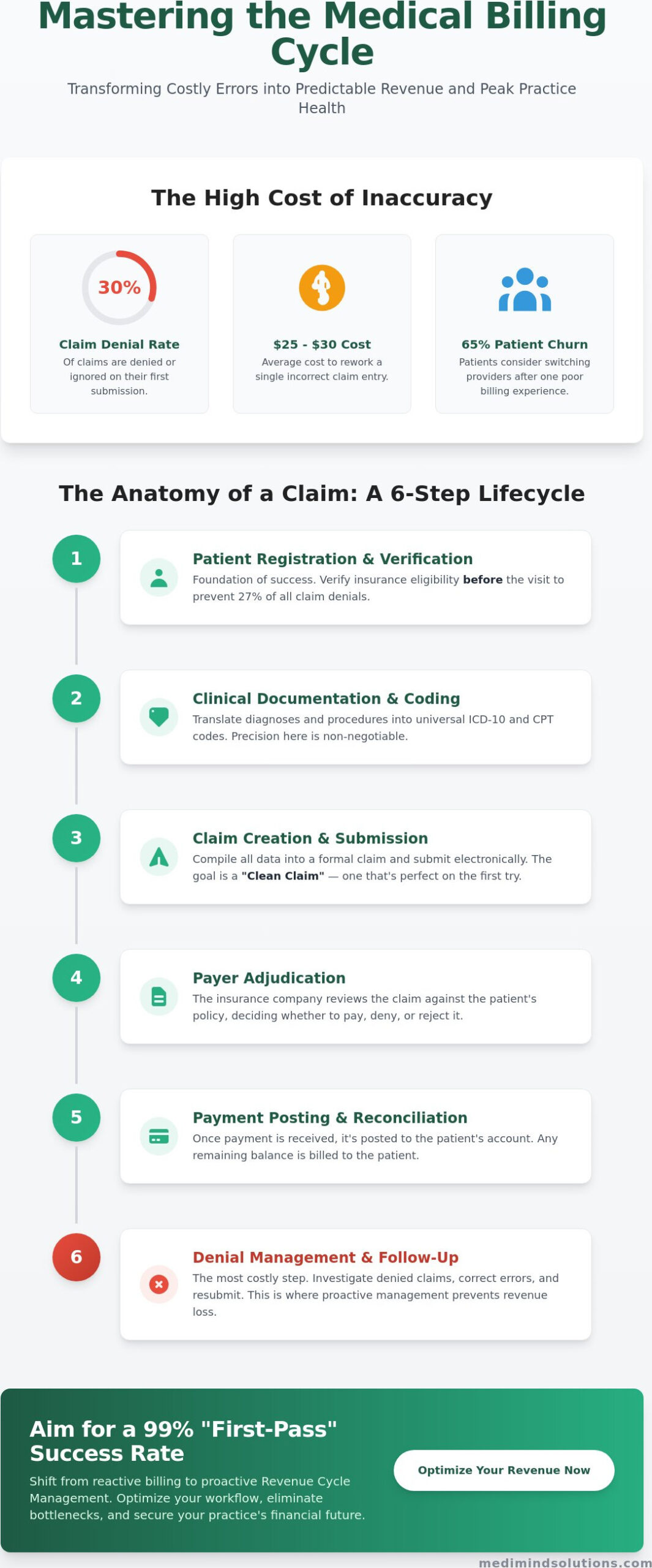
Did you know that nearly 30% of claims are denied or ignored on the first submission, forcing practices to spend an average of $25 to $30 just to rework a single entry? It’s a frustrating reality that often leaves providers feeling more like debt collectors than healers. You likely started your practice to focus on patient outcomes, yet the administrative weight of medical billing often feels like it’s dragging down your clinical mission. We agree that your time is better spent in the exam room than buried under a mountain of coding paperwork and rising overhead.
It’s time to perform a financial checkup and restore your practice to peak performance. This guide will help you master the complexities of the billing cycle and discover how to optimize your revenue through precision administrative management. We’ll walk you through the essential steps to achieve faster reimbursement cycles and lower your error rates. You’re about to learn how to transform a chaotic back office into a robust engine for predictable cash flow and a healthier bottom line.
Key Takeaways
- Perform a comprehensive “Practice Checkup” to understand how your administrative workflow serves as a vital diagnostic tool for your overall business health.
- Master the anatomy of a claim to ensure your medical billing process is precise enough to eliminate front-end denials and maximize reimbursement.
- Evaluate the “best of both worlds” approach to determine whether managing a billing department internally or offloading the heavy lifting to specialists is your perfect match.
- Transition from reactive billing to proactive Revenue Cycle Management (RCM) to identify and resolve the workflow bottlenecks limiting your financial growth.
- Implement a “protective shield” of HIPAA compliance and data integrity to secure your PHI while maintaining a robust and stable financial foundation.
What is Medical Billing and Why Does It Define Your Practice Health?
Your practice’s vitality depends on more than just clinical outcomes; it relies on a robust financial heartbeat. Think of your billing workflow as a diagnostic tool. A regular “Practice Checkup” reveals whether your operations are lean or if you’re hemorrhaging revenue through administrative gaps. At its core, medical billing is the critical bridge that converts your clinical expertise into sustainable financial reimbursement. It’s the process that ensures your skillful care translates into the resources needed to keep your doors open.
To truly optimize your revenue, you must look past the paperwork. Understanding What is Medical Billing? involves recognizing it as a specialized communication process between healthcare providers and insurance companies. While many view medical billing as a clerical task, high-performing practices treat it as Revenue Cycle Management (RCM). Billing is the transactional act of submitting a claim. RCM is the overarching strategy that manages the entire life of a patient account. This distinction defines the difference between basic survival and long-term profitability.
The Three Pillars of the Billing Ecosystem
The billing ecosystem functions through three interconnected parties, each requiring precise management to maintain financial health.
- The Patient: The cycle begins at the front desk. Verifying eligibility and explaining financial responsibility upfront prevents 60% of common billing disputes.
- The Provider: Your clinical documentation is the engine of the entire system. Precision in coding ensures that every service rendered is captured and compensated correctly.
- The Payor: Insurance companies and government programs have rigid, ever-changing requirements. Navigating these rules requires constant vigilance to avoid “timely filing” denials.
The High Cost of Administrative Inaccuracy
Administrative errors are expensive. Industry data from Change Healthcare indicates that nearly $262 billion in medical claims are denied every year in the US healthcare system. While a 95% clean claim rate once seemed acceptable, that 5% failure rate now represents a significant threat to your bottom line. Modern practice profitability requires a “first-pass” success rate closer to 99% to offset rising overhead costs and declining reimbursement rates.
The damage isn’t just financial; it’s relational. When a patient receives an unexpected or incorrect bill due to a simple coding error, their trust in your practice dissolves. Statistics show that 65% of patients would consider switching providers after a single poor billing experience. Precision in medical billing protects your reputation just as much as it protects your cash flow. By eliminating errors, you provide the security and relief your patients expect, making your practice healthier than ever.
The Anatomy of a Claim: A Step-by-Step Lifecycle
A successful claim starts with a perfect match between patient registration and insurance requirements. This lifecycle is a high-stakes race where precision in the initial 24 hours often determines if a provider gets paid or faces a costly delay. Skillful billing specialists act as the first line of defense, ensuring every data point aligns before the claim leaves the office. By integrating robust EHR and PM systems, practices facilitate a faster data flow that reduces manual entry errors and accelerates the medical billing cycle.
Front-End Processes: The Foundation of Success
Your financial health begins at the front desk. Verifying insurance eligibility before a patient sees the doctor prevents “unbillable” services that drain resources. Statistics from 2023 indicate that nearly 27% of all claim denials result from registration and eligibility errors. Capturing accurate demographics and PHI is vital to prevent identity-based rejections. A clean claim is the gold standard for reimbursement, representing a submission that contains no errors and requires no manual intervention from the payor.
Coding and Submission: The Language of Reimbursement
Precision coding transforms clinical encounters into a language payors understand. This involves translating complex diagnoses into ICD-10 codes and procedures into the CPT code set maintained by the American Medical Association. Digital submission is the industry standard because it’s significantly faster than paper methods. Before reaching the payor, a clearinghouse scrubs the claim to identify potential issues. This proactive step ensures your submission is “healthier than ever” before it undergoes final scrutiny. If you want to see how your current workflow compares, you can request a practice checkup to identify hidden bottlenecks.
Back-End Management: The Follow-Up Phase
The journey doesn’t end at submission. During adjudication, payors evaluate the claim to decide whether to pay, deny, or reject it based on policy terms. Effective medical billing requires an artful approach to denial management; diligent follow-up is the key to capturing maximum profits. Once the payor issues an Explanation of Benefits (EOB), specialists post payments and reconcile accounts. This meticulous vigilance ensures that every dollar earned is a dollar collected, keeping your practice’s bottom line robust and stable.
In-House vs. Outsourced Medical Billing: Finding Your Perfect Match
Choosing the right path for your revenue cycle management is a vital step toward long-term stability. While keeping operations internal might feel like it offers more control, the reality often involves managing complex administrative burdens that drain resources. A strategic partnership allows you to experience the best of both worlds. You gain the freedom to focus on patient care while a team of specialists ensures your practice remains financially healthier than ever.
The True Cost of In-House Billing
Managing medical billing internally often carries hidden expenses that go far beyond a simple salary. According to 2023 data from the Bureau of Labor Statistics, the median annual wage for medical records specialists is approximately $48,780. When you add 30% for benefits, payroll taxes, and office space, the total cost for one employee easily exceeds $63,000. Staff turnover adds another layer of financial strain. Replacing a specialized biller can cost a practice up to 50% of that position’s annual salary in recruiting and training time.
Internal departments also face the risk of single-point failure. If your lone biller takes a leave of absence or resigns, your cash flow stops immediately. You are also responsible for constant software licensing fees and hardware maintenance. These recurring costs eat into your bottom line without providing the specialized expertise a dedicated agency offers.
The Advantages of a Skillful Billing Partner
Partnering with a professional service provides a robust team of specialists with collective expertise across multiple specialties. This model eliminates the “single-point failure” risk. Because these partners utilize performance-based models, their success is tied directly to yours. Most agencies charge a percentage of collected revenue; this ensures their goals align perfectly with your practice’s profitability. You don’t pay for effort; you pay for results.
Security and regulatory adherence are also streamlined. Professional partners take the lead on maintaining HIPAA compliance and ensuring all data encryption protocols are up to date. This vigilance protects your practice from costly audits and data breaches. You can monitor every dollar through advanced reporting and real-time financial dashboards. These tools provide 24/7 visibility into your KPIs, including:
- Days in Accounts Receivable (AR): See how quickly your claims turn into cash.
- Clean Claim Rate: Track the precision of your initial submissions to reduce denials.
- Collection Ratio: Compare your actual payments against the total amount allowed by payers.
As your practice grows, an outsourced partner scales with you instantly. You won’t need to rent more office space or purchase additional workstations to accommodate growth. This scalability allows you to expand your patient base without increasing your administrative overhead. Experience the relief of knowing your financial health is in skillful hands, allowing you to return your full attention to the exam room.
Beyond the Basics: Optimizing Your Revenue Cycle for Growth
Your practice deserves more than just reactive processing. Moving from basic medical billing to a proactive Revenue Cycle Management (RCM) model is like giving your office a comprehensive “Practice Checkup.” While reactive billing focuses on fixing errors after they happen, proactive RCM identifies potential failures before they impact your bank account. This shift ensures your practice remains healthier than ever, allowing you to focus on patient outcomes rather than paperwork.
Practice Management Consulting plays a vital role in this evolution. By conducting a deep dive into your administrative workflow, skillful consultants identify specific bottlenecks, such as incomplete insurance verification at the front desk or lagging clinician documentation. Addressing these issues early can lead to a revenue increase of $26,000 per provider. It’s about precision and partnership, turning your back office into a robust engine for expansion.
Cash flow depends heavily on your “Days in A/R” (Accounts Receivable). High-performing practices aim to keep this number under 35 days, according to MGMA industry benchmarks. When you reduce the time it takes to collect payments, you gain the immediate liquidity needed to hire new staff or invest in leading medical technology. Leveraging real-time data allows you to predict future revenue cycles with 98% accuracy, providing the confidence to plan your next practice expansion.
Advanced Denial Management Strategies
Successful practices don’t just resubmit claims; they perform a root cause analysis to stop denials at the source. If 15% of your claims fail due to “coordination of benefits” errors, you’ve found a specific training opportunity for your intake team. Skillful specialists then navigate the complex appeals process, fighting for every dollar by providing the exact clinical documentation payers require. The denial rate is the percentage of claims denied by payers compared to the total number of claims submitted, and keeping this figure below 5% is critical for long-term practice sustainability.
Patient-Centric Billing and Collections
The patient experience doesn’t end when they leave the exam room. Managing patient statements with empathy ensures that your financial interactions don’t damage the provider-patient relationship. Transparency is your best tool here. When patients understand their financial responsibility upfront, you reduce “bad debt” and the need for collection agency referrals. Implement clear, written payment policies to provide security for both your practice and your patients. This collaborative approach fosters trust and ensures faster collections.
Securing Your Practice: HIPAA, Compliance, and Data Integrity
Data security acts as the protective shield for your practice’s financial health. Without it, even the most efficient medical billing system remains vulnerable to catastrophic failure. A single data breach in the healthcare sector now costs an average of $10.93 million, according to the 2023 Cost of a Data Breach Report. We view security as a non-negotiable pillar of your revenue cycle. It’s about protecting your patients’ trust and your practice’s longevity at the same time. Robust encryption and constant vigilance are what keep your bottom line secure and your mind at ease.
The Fundamentals of HIPAA in Billing
Protecting Protected Health Information (PHI) during the claims transmission process requires more than a standard firewall. It demands end-to-end encryption for every digital transaction. Your billing partner must serve as a dedicated ally. This relationship is solidified through a Business Associate Agreement (BAA), which ensures your partner adheres to the same stringent federal standards you do. Regular compliance audits serve as a vital diagnostic tool. These audits prevent the legal and financial penalties that the Office for Civil Rights (OCR) enforces, which reached significant levels in recent years. Staying compliant isn’t just about following rules; it’s about maintaining a stable, profitable practice.
Modern billing requires a proactive approach to auditing. This includes:
- Conducting annual risk assessments to identify technical vulnerabilities.
- Ensuring all staff receive updated training on PHI handling.
- Verifying that every digital touchpoint meets SOC 2 Type II security standards.
The Future of Financial Health
The industry is moving rapidly toward value-based care. Traditional medical billing models are evolving to accommodate CMS guidelines like MACRA and MIPS, where reimbursements are tied to patient outcomes rather than just volume. AI and automation are the engines driving this change. These technologies increase processing speed while maintaining the human precision required for complex coding. You also need to look ahead to ICD-11. This new system introduces 55,000 unique codes, a massive jump from the 14,000 found in ICD-10. Future-proofing your practice requires a partner who understands these regulatory shifts and has the technical sophistication to implement them seamlessly.
We handle the heavy lifting of compliance so you can focus on what matters most: your patients. Our group of skillful billing specialists ensures that your data remains safe and your reimbursements remain high. It’s the best of both worlds for the modern provider who values both security and growth. We help you stay ahead of the curve so your cash flow remains steady and predictable.
Don’t leave your revenue to chance. Experience precision billing with a Practice Checkup from MedMind Solutions and ensure your practice stays healthier than ever.
Achieve Your Practice’s Full Financial Potential
Mastering the complexities of medical billing is more than an administrative task; it’s a vital checkup for your practice’s long-term vitality. By refining your claim lifecycle and finding the perfect match for your billing needs, you’re protecting your bottom line against common revenue cycle leaks. Security remains paramount. That’s why we utilize full HIPAA and PHI data encryption to ensure your patient information stays protected while you focus on clinical excellence.
Our team of skillful specialists is dedicated to your growth. We’ve helped providers see an average revenue increase of $26,000 per provider by maintaining a 98%+ clean claim submission rate. These aren’t just numbers; they’re the result of precision systems designed to eliminate errors and accelerate your cash flow. You don’t have to carry the burden of complex administration alone when you have a meticulous partner ready to handle the heavy lifting.
Take the first step toward a healthier financial future today. See how much your practice can save with our ROI Calculator and discover the impact of professional optimization. It’s time to experience the peace of mind that comes with a robust, high-performing revenue cycle. Your practice is in skillful hands, and we’re excited to help you thrive.
Frequently Asked Questions
What is the difference between medical billing and medical coding?
Medical coding involves translating clinical notes into standardized alphanumeric codes like ICD-10, while medical billing uses those codes to create and submit insurance claims. Think of coding as the clinical translation of a patient visit and billing as the financial execution. Accurate coding ensures compliance; meanwhile, precision billing focuses on securing maximum reimbursement from payers to protect your bottom line.
How much do medical billing services typically cost for a small practice?
Medical billing services typically cost between 5% and 10% of a practice’s monthly net collections according to industry benchmarks from the Medical Group Management Association (MGMA). Some providers charge a flat fee per claim, which often ranges from $4 to $6. These performance-based models ensure your partner remains incentivized to capture every dollar, turning your administrative overhead into a scalable investment for growth.
What is a “clean claim” and why is it important for my revenue?
A clean claim is a submission that contains no errors and requires no additional information from the provider to be processed by the payer. Achieving a 95% clean claim rate is the industry gold standard for maintaining a healthy cash flow. When you submit accurately the first time, your practice avoids the 14 day delay typically associated with re-processing and appeals.
How can I reduce the number of denied claims in my practice?
You can reduce denied claims by implementing a robust front-end eligibility verification process to catch insurance changes before the patient visit. Change Healthcare reports that 86% of denials are potentially preventable through better data entry and coding precision. Focus on your top five denial reasons and use automated scrubbing tools to identify technical errors. This proactive approach ensures your practice’s financial health remains stable.
What are “Days in A/R” and what is a healthy range for a physician?
Days in Accounts Receivable (A/R) measures the average number of days it takes for your practice to get paid after a service is rendered. A healthy range for a high-performing practice is below 40 days, while anything over 50 days indicates a bottleneck in your revenue cycle. Monitoring this KPI allows you to identify slow-paying carriers and optimize your collection speed to ensure a predictable cash flow.
Is my patient data safe when using an outsourced billing service?
Your patient data is secured through 256-bit encryption and strict adherence to HIPAA Title II regulations when you partner with a professional service. Skillful billing specialists conduct annual SOC 2 Type II audits to verify their security protocols and protect Protected Health Information (PHI). These measures often exceed in-house security capabilities, giving you the peace of mind that your practice is fully shielded from data breaches.
How long does it typically take to see an increase in revenue after switching services?
Most practices see a measurable increase in collections within 60 to 90 days after transitioning to a specialized partner. This timeline accounts for the initial cleanup of old A/R and the implementation of more efficient submission workflows. Industry data shows that providers often experience a 15% boost in net revenue during the first quarter as the new system identifies previously overlooked reimbursement opportunities.
What is the role of a clearinghouse in the medical billing process?
A clearinghouse acts as a secure intermediary that scrubs your claims for errors before transmitting them to various insurance payers. It translates your software’s data into the specific HIPAA-compliant formats required by different carriers. By catching 98% of technical errors before they reach the insurance company, the clearinghouse functions as a vital filter that accelerates your reimbursement cycle and reduces administrative friction.