

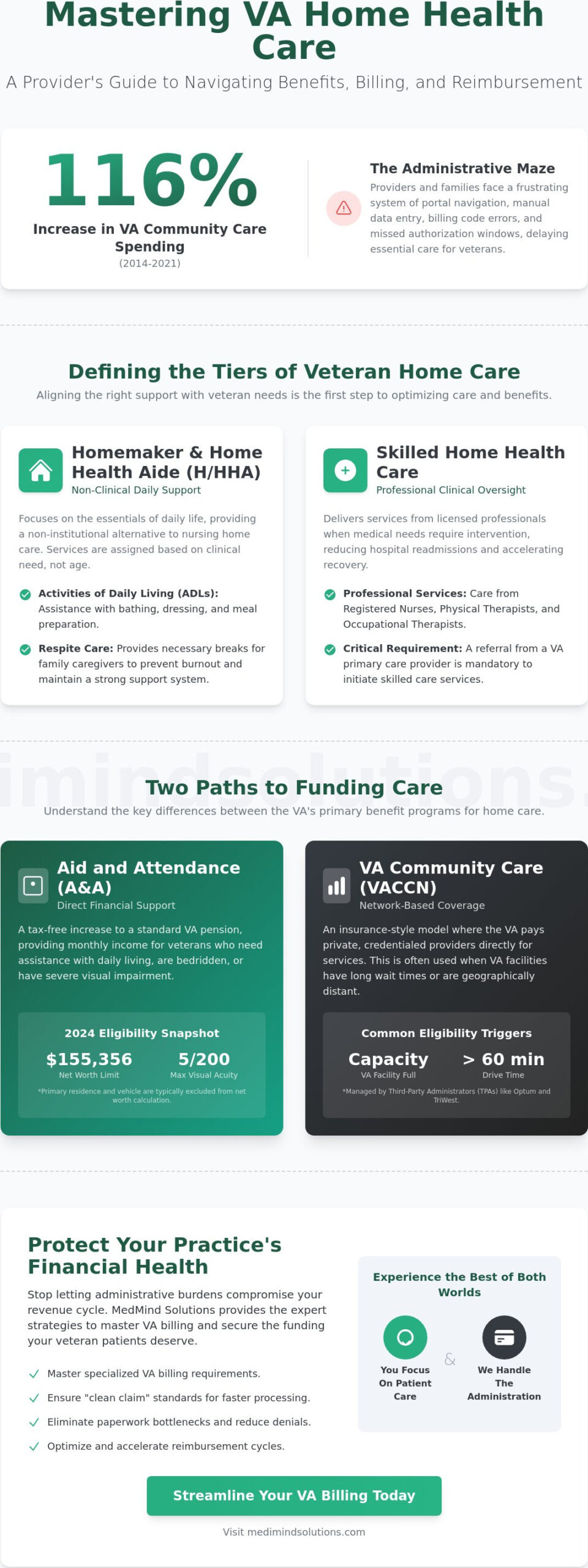
Did you know that the VA’s total spending on community care programs jumped by 116% between 2014 and 2021? This massive expansion means more opportunities for home health care for veterans, yet many providers and families still find themselves trapped in a maze of administrative delays. You likely feel that the current system of portal navigation and manual data entry is a full-time job in itself. It’s frustrating to watch essential care wait on a desk because of a single billing code error or a missed authorization window.
At MedMind Solutions, we believe your practice’s financial health should be as robust as the clinical care you provide. This guide will help you master the complexities of VA benefits and the Veterans Affairs Community Care Network (VACCN) billing requirements. We’ll examine specific eligibility criteria, walk through the steps to accelerate benefit approval, and provide a clear roadmap for optimizing your reimbursement cycles. You’ll gain the precision tools needed to eliminate paperwork bottlenecks and secure the funding your veteran patients deserve.
Key Takeaways
- Understand the critical distinctions between clinical home health and non-clinical homemaker services to better align support tiers with veteran needs.
- Navigate the complexities of the VA Community Care Network (VACCN) and Aid and Attendance benefits to ensure sustainable funding for home health care for veterans.
- Master the administrative journey—from VA Form 10-10EZ to clinical assessments—to accelerate eligibility and reduce the burden on families and providers.
- Protect your practice’s financial health by mastering the specialized billing requirements and clean claim standards unique to the VA reimbursement cycle.
- Experience the “best of both worlds” by leveraging expert revenue cycle strategies that handle the heavy lifting of administration while you focus on patient care.
What is Home Health Care for Veterans? Defining the Support Tiers
The U.S. Department of Veterans Affairs manages a robust network of support designed to help heroes age in place. This commitment isn’t just about comfort; it’s a strategic decision to improve clinical outcomes in a familiar environment. Home health care for veterans encompasses a range of medical and personal support systems that allow individuals to avoid the high costs and emotional strain of long-term facility placement. Understanding these tiers is the first step toward a healthier financial outlook for your household. By identifying the right level of support early, you don’t just improve care; you maximize benefits and protect your family’s assets from the drain of uncoordinated medical expenses.
Homemaker and Home Health Aide (H/HHA) Services
Homemaker and Home Health Aide services focus on the essentials of daily life. These specialists provide assistance with activities of daily living (ADLs) such as bathing, dressing, and meal preparation. The VA assigns these services based on clinical need rather than just age, meaning a younger veteran with a disability can access the same level of care as a senior. H/HHA services function as a non-institutional alternative to nursing home care. This tier also includes vital respite care. Respite care provides family caregivers a necessary break, which prevents burnout and ensures the primary support system remains strong. It’s a proactive way to maintain the stability of the entire household.
Skilled Home Health Care
When medical needs require professional intervention, skilled home health care for veterans provides clinical oversight. This tier involves services from registered nurses, physical therapists, or occupational therapists who come directly to the home. The veteran population often requires a mix of short-term and long-term skilled care. For example, a veteran might need short-term physical therapy after a hip replacement or long-term nursing care to manage chronic conditions like diabetes or heart failure. To begin this process, a veteran must receive a referral from a VA primary care provider. This referral ensures that clinical care is precise and integrated into the veteran’s existing health records. Using these benefits effectively leads to faster recovery times and a significant reduction in hospital readmission rates.
Navigating VA Benefits: Aid and Attendance vs. Community Care
Understanding the financial framework of home health care for veterans requires a clear distinction between direct monthly payments and network-based service coverage. The Aid and Attendance (A&A) benefit functions as an add-on to the standard VA pension, providing a tax-free increase in monthly income for those who meet specific clinical and financial criteria. In contrast, the VA Community Care Network (VACCN) operates like a traditional insurance model where the VA pays private providers directly for services rendered. Balancing these two programs is the key to maintaining the financial health of a veteran’s long-term care plan.
The Aid and Attendance Pension Eligibility
Clinical eligibility for A&A is rigorous; it is designed for veterans who are genuinely unable to function independently. To qualify, a veteran must meet at least one of several criteria: they must require the aid of another person to perform daily activities like bathing or dressing, be bedridden due to illness, or have corrected visual acuity of 5/200 or less. For 2024, the VA set the net worth limit for this pension at $155,356. This figure includes both annual income and assets, though the veteran’s primary residence and vehicle are typically excluded from the calculation. This benefit provides the liquid capital necessary to afford private-pay care, giving families the flexibility to choose their own caregivers or supplement existing services.
VACCN and the Role of Third-Party Administrators
The VACCN relies on regional administrators, primarily Optum and TriWest, to manage the logistics of provider networks and medical claims. For a private home care agency to participate, they must undergo a meticulous credentialing process to ensure they meet VA standards for safety and clinical precision. Veterans often transition to community-based care when VA facilities are at capacity or when drive times exceed 60 minutes for primary care. Detailed information on how these authorized services function is available through VA Homemaker and Home Health Aide Services. This transition allows veterans to receive care in the comfort of their own homes while the VA handles the reimbursement directly with the provider.
A common misconception is that veterans or their surviving spouses will face massive out-of-pocket costs for these services. In reality, when VACCN authorizations are managed with technical precision, the veteran’s out-of-pocket cost is often $0. For providers, aligning your practice with these VA structures can lead to a 20% increase in consistent reimbursement compared to traditional private-pay models. Ensuring your practice remains profitable while serving those who served requires a group of skillful billing specialists who understand the nuances of VA claim submission and regional administrator requirements. By combining A&A pension funds with VACCN authorized hours, many families find they can cover 100% of their home care needs without depleting their life savings.
The Administrative Journey: Eligibility and Application Process
Starting the process for home health care for veterans often feels like a daunting climb. Many families and providers hesitate because they believe the paperwork is too complex to navigate alone. This misconception often delays vital care. You don’t have to manage this burden in isolation. View the VA application as a structured roadmap where precision in documentation leads directly to authorized hours and reliable reimbursement.
The journey begins with three specific actions to secure authorization:
- Submit VA Form 10-10EZ: This is the baseline application for health benefits that establishes the veteran’s enrollment in the VA system.
- Request a Clinical Assessment: A primary care physician must verify the medical necessity for at-home assistance.
- Receive Authorization: Once approved, the VA issues a referral through the VA Community Care Program, allowing the veteran to receive services from private providers.
Approval timelines typically range from 7 to 21 days, depending on the urgency of the case and the accuracy of the initial filing. Skillful management of these documents prevents the “denial-and-resubmit” cycle that plagues many practices. By focusing on data accuracy from day one, you ensure a smoother path to clinical support.
Establishing Clinical Necessity
Authorization hinges on a Geriatric Evaluation or a social worker’s comprehensive assessment. These experts document dependencies in Activities of Daily Living (ADLs), such as bathing, dressing, or medication management. Precise documentation of these specific needs ensures the veteran receives the maximum authorized hours. Clinical need serves as the primary driver for all VA home care authorizations, making medical evidence the most critical component of your application.
Utilizing the HSRM and VA Portals
The Health Share Referral Management (HSRM) system has revolutionized how providers track referrals and manage home health care for veterans. This digital platform reduces the heavy lifting of veteran care administration by providing a centralized hub for authorization data. It ensures 100% HIPAA compliance and protects PHI while accelerating the approval timeline. Digital tools are the best of both worlds; they increase the speed of care delivery while maintaining a robust audit trail. You can track status updates in real-time, which eliminates the guesswork of traditional mail-in processes and optimizes your practice’s workflow.
Financial Health for Care Providers: Mastering VA Billing and Reimbursement
Providing home health care for veterans is a noble mission, yet the financial backend requires a level of precision that standard Medicare or private insurance rarely demands. While Medicare often relies on standardized prospective payment systems, the Veterans Affairs Community Care Network (VACCN) operates on a strict, authorization-based model. If your practice doesn’t align its billing with the specific VA authorization number, your claim is flagged immediately. Maintaining a clean claim rate above 98% isn’t just a goal; it’s the only way to ensure your cash flow remains steady and predictable.
Precision billing is the heartbeat of your practice’s financial health. Common errors, such as using outdated HCPCS codes or failing to update patient eligibility, lead to denials that can trap your revenue in a 90-day limbo. You can’t afford these delays when serving those who served. By eliminating these administrative bottlenecks, you ensure that your group of skillful specialists can focus on what matters most: the veteran. Experience a practice checkup that identifies these leaks and secures your bottom line.
Understanding Electronic Visit Verification (EVV)
The 21st Century Cures Act mandates EVV for all personal care and home health services. This federal requirement isn’t just a regulatory hurdle. It’s a vital tool to prevent fraud and minimize errors. EVV data captures six specific points of information, including the exact location and time of service. When this data integrates directly with your billing process, it creates a “perfect match” that the VA requires for payment. Accurate time-tracking through EVV leads to faster reimbursement, often reducing the payment cycle by 15 to 20 days compared to manual logs.
Managing Denials and Appeals for VA Claims
Most VA claim denials stem from two avoidable issues: authorization mismatches and coding errors. If the service codes on your claim don’t mirror the VA authorization exactly, the system rejects it automatically. You need a robust system to track Key Performance Indicators (KPIs) like Days Sales Outstanding (DSO) and denial rates. Diligent follow-up on aged receivables is essential. You shouldn’t let unpaid claims sit past the 30-day mark without intervention. Skillful billing specialists use these metrics to identify systemic issues, allowing you to fix the root cause of denials before they impact your profitability.
Secure the financial future of your practice while delivering high-quality home health care for veterans. Experience precision billing with MedMind Solutions and see your savings grow through optimized reimbursement cycles.
Optimizing the Revenue Cycle for Veteran Care Services
Providing high-quality home health care for veterans requires more than clinical excellence; it demands a robust financial foundation. We call this the “Best of both worlds” approach. You focus on the heroes who served our country, while we ensure your practice remains financially healthy. When billing processes for VA claims are precise, agencies can reinvest in better equipment, specialized training, and more staff. This direct link between financial stability and patient care quality is undeniable. A practice struggling with cash flow cannot provide the same level of consistent, high-touch care as one with a streamlined revenue cycle. Efficiency in the back office translates directly to peace of mind for the provider and the veteran alike.
The MedMind Solutions Partnership
Our group of skillful billing specialists supports home health agencies by lifting the heavy administrative weight of VA coordination and PHI management. Experience precision billing designed to maximize your bottom line without the overhead of an in-house team. We operate on a percentage-based model. This means our success is tied directly to your practice’s health; we only thrive when you do. By outsourcing these complex tasks, agencies often see a reduction in days in AR (Accounts Receivable) from 50 days down to 35 or fewer. This increased cash flow provides the liquidity needed to expand services and hire top-tier clinicians. We handle the heavy lifting of codes and compliance so you can focus on the mission of care. Our team acts as a meticulous growth partner, ensuring every claim reflects the hard work your clinicians perform daily.
Experience a Practice Checkup
The path to peak performance begins with a comprehensive audit of your current workflows. We offer a Practice Checkup to identify exactly where revenue leaks occur in your home health care for veterans billing cycle. While many agencies accept a 95% clean claims rate as the industry standard, that 5% margin represents thousands of dollars in lost revenue every month. Our systems move you toward near-perfect reimbursement through meticulous error elimination and vigilant follow-up on every line item. We track key KPIs to ensure your growth stays on an upward trajectory. This isn’t just about collecting money; it’s about building a sustainable business that can serve veterans for decades. See how MedMind Solutions can optimize your veteran care billing and see your savings grow through a partnership built on trust and results.
Strengthen Your Practice While Honoring Their Service
Providing home health care for veterans is a noble mission that demands clinical excellence and administrative precision. You’ve learned that navigating the complexities of VA benefits, from Aid and Attendance to the VACCN, requires a deep understanding of eligibility and documentation. Mastering the billing cycle isn’t just about paperwork; it’s about ensuring your practice remains sustainable so you can continue serving those who protected our country. When you bridge the gap between complex VA regulations and efficient reimbursement, your entire organization thrives.
MedMind Solutions acts as your meticulous growth partner to handle the heavy lifting of your revenue cycle. Our skillful billing specialists bring specialized expertise in VA and VACCN billing to eliminate errors and accelerate your collections. We’ve helped providers see an average revenue increase of $26,000 per provider while maintaining robust HIPAA-compliant data security. It’s time to give your practice a financial checkup and ensure your bottom line is healthier than ever.
Optimize your practice’s financial health with MedMind Solutions today. You focus on the patients; we’ll handle the precision billing that keeps your doors open and your mission moving forward.
Frequently Asked Questions
Does the VA pay for 24/7 home health care for veterans?
No, the VA generally doesn’t cover round-the-clock medical assistance in the home. Most VA programs provide part-time or intermittent services, typically limited to 12 to 14 hours of care per week depending on clinical need. For veterans requiring 24/7 supervision, the VA often recommends community residential care or nursing home placement. It’s a matter of clinical necessity and resource allocation within the VHA system.
What is the difference between VA home care and the Aid and Attendance benefit?
VA home care is a medical service provided through the Veterans Health Administration, while Aid and Attendance is a financial pension benefit. Aid and Attendance provides a monthly cash payment added to a veteran’s pension to help pay for daily assistance. Conversely, home health care for veterans involves direct clinical services like nursing or physical therapy delivered to the home. It’s the best of both worlds for those needing clinical and financial support.
Can a family member be paid as a caregiver for a veteran?
Yes, family members can receive payment through the Program of Comprehensive Assistance for Family Caregivers (PCAFC). As of October 2022, this program expanded to include veterans of all eras who have a 70% or higher service-connected disability rating. Eligible caregivers receive a monthly stipend, access to health insurance, and at least 30 days of respite care per year. This ensures your practice’s patients receive skillful care from loved ones.
How long does it take for the VA to approve home health care services?
The VA typically completes the initial clinical assessment for home health services within 7 to 14 days of a doctor’s referral. Once the VA confirms eligibility, they issue an authorization to a community provider. Total processing time depends on the local VA Medical Center’s workload, but most veterans see a provider within 30 days of the request. Speeding up this process is vital for the patient’s physical and financial health.
What is the VACCN and how do I find a provider in my area?
The VACCN is the Veterans Affairs Community Care Network, which connects veterans with local, non-VA healthcare providers. It operates through six regional hubs managed by Optum and TriWest Healthcare Alliance. You can find a provider by using the VA Facility Locator tool on the official VA.gov website and selecting “Community Providers” from the search menu. This network ensures a perfect match between veterans and local medical specialists.
What happens if a veteran is over the income limit for home care benefits?
Veterans who exceed the income limit may still receive care but are often required to pay a copayment for non-service-connected conditions. According to 2024 VA guidelines, these copays are based on the veteran’s priority group and financial assessment. Your financial health remains protected as the VA caps annual out-of-pocket costs for those in lower priority groups. It’s an essential safeguard for maintaining your practice’s bottom line.
Is skilled nursing care included in VA home health benefits?
Yes, skilled nursing care is a standard part of the home health care for veterans benefit package. This includes clinical services like wound care, catheter management, and intravenous therapy performed by a Registered Nurse or Licensed Practical Nurse. The VA authorizes these services when a physician determines the veteran is homebound and requires professional medical intervention. This precision care helps veterans stay healthier than ever in their own homes.
How do providers bill the VA for home care services correctly?
Providers must submit clean claims through the Health Share Referral Manager (HSRM) or the EDI clearinghouse to ensure prompt reimbursement. Using the correct Standardized Form 1500 or UB-04 is essential for maintaining a healthy cash flow. Ensure you include the valid authorization number to avoid denials and achieve a 98% first-pass clean claim rate. Our skillful billing specialists handle the heavy lifting to optimize your practice’s profitability.