

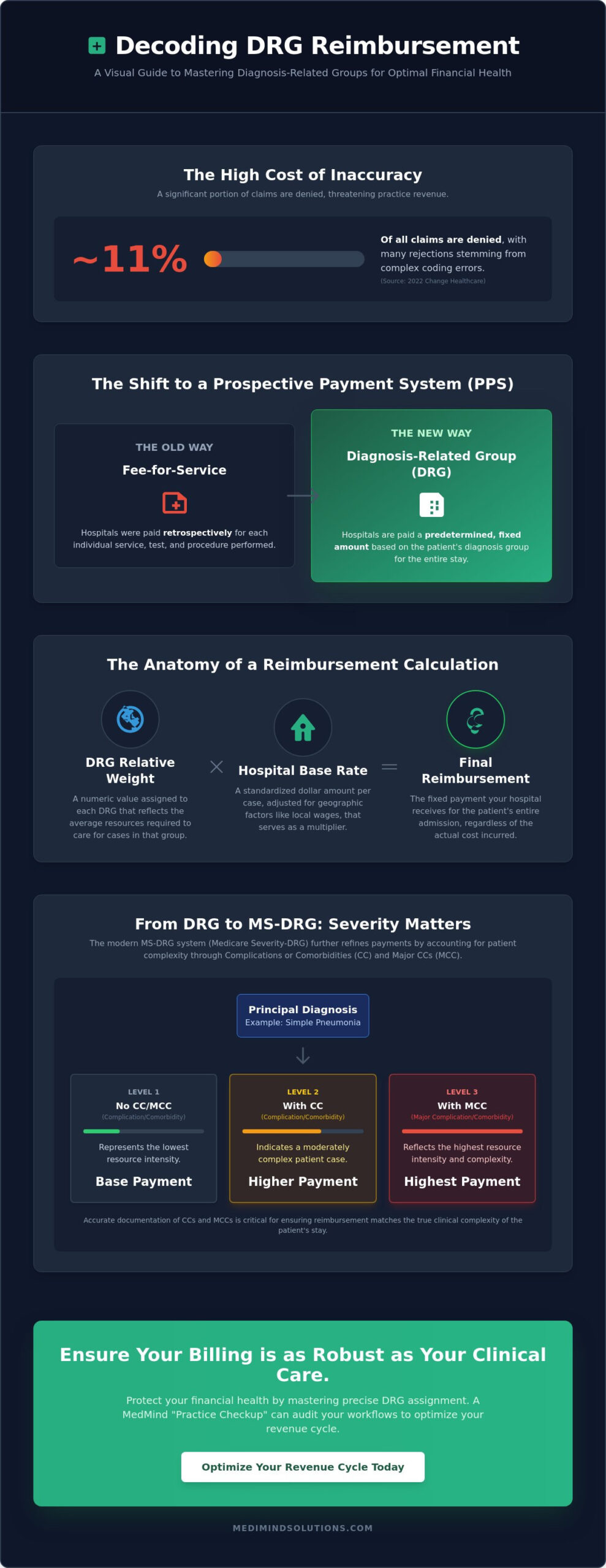
Did you know that according to a 2022 Change Healthcare report, nearly 11% of all claims are denied, with a significant portion of those rejections stemming from complex coding errors? For many providers, the shift from traditional fee-for-service models to case-mix classification feels like an administrative hurdle that threatens their financial stability. You likely feel the pressure of maintaining a healthy cash flow while worrying about the precision of your drg assignments. It’s frustrating when your team provides excellent care, yet your reimbursement doesn’t reflect the complexity of the patient’s condition due to documentation gaps.
We understand that your practice’s financial health is just as vital as the physical health of your patients. This guide is designed to act as a skillful partner, helping you master the complexities of diagnosis-related groups to optimize your bottom line. You’ll gain the confidence to handle compliance audits and reduce denial rates through better documentation practices. We’ll explore the critical differences between standard classification and MS-DRG systems while providing a clear roadmap for your team to follow. Experience the relief of knowing your billing is as robust and precise as your clinical care.
Key Takeaways
- Navigate the shift to prospective payment systems to better understand how modern inpatient classification impacts your bottom line.
- Unlock the mechanics of reimbursement by learning how base payment rates and Case-Mix Index (CMI) interact to determine your practice’s revenue.
- Differentiate between MS-DRG severity levels to ensure your coding accurately reflects the clinical complexity of every patient stay.
- Protect your financial health by mastering precise drg assignment, effectively reducing costly claim denials and pended “Days in A/R.”
- Learn how a MedMind “Practice Checkup” can audit your current workflows to optimize your revenue cycle and ensure long-term stability.
Understanding Diagnosis-Related Groups (DRG) in Modern Healthcare
Inpatient care requires a delicate balance between clinical excellence and fiscal responsibility. A Diagnosis-Related Group (DRG) acts as a classification system that categorizes hospital stays into groups with similar clinical characteristics and resource requirements. This framework marked a fundamental shift in 1983 when the Centers for Medicare & Medicaid Services (CMS) moved away from retrospective fee-for-service models. Instead, they adopted a Prospective Payment System (PPS). This change means hospitals receive a predetermined, fixed amount for each patient based on their assigned drg rather than the individual costs incurred during the stay.
The primary objective is to drive hospital efficiency and rigorous cost control. By setting these fixed rates, the system encourages providers to streamline workflows and eliminate unnecessary expenditures without compromising patient outcomes. Experience precision billing by aligning your clinical documentation with these requirements. When your team captures the full scope of patient care accurately, you ensure that your reimbursement matches the resources expended. This proactive approach protects your practice from the financial drain of under-coding or resource mismanagement.
A Brief History of the DRG System
Researchers at Yale University developed the first iteration of this system in 1975 to help hospitals monitor quality and productivity. Following the 1983 Social Security Amendments, CMS adopted the framework to manage escalating Medicare costs. This transition fundamentally changed how the government reimbursed inpatient care, moving the industry toward a performance-based model. The system has since evolved into the Medicare Severity Diagnosis-Related Group (MS-DRG) used today. This modern version, introduced in 2007, accounts for the severity of a patient’s condition and the presence of complications or comorbidities. It ensures that reimbursement reflects the actual intensity of care provided to the millions of seniors enrolled in Medicare programs.
Why DRGs Matter to Your Bottom Line
Fixed-rate payments fundamentally shift the financial risk from the payer to the provider. If your facility delivers care for less than the drg payment, you retain the surplus; however, if costs exceed the fixed rate, the hospital absorbs the loss. This reality makes your practice’s financial health dependent on precision coding and efficient resource management. You must treat every inpatient stay as a test of operational excellence where clinical accuracy meets fiscal stability. See your savings grow by auditing your current coding processes for gaps in documentation. Essentially, a DRG serves as the standardised currency of hospital reimbursement. Achieving maximum profitability requires a skillful approach to documentation, ensuring every patient’s complexity is captured to reflect the true cost of care. Your financial health is just as vital as the physical health of the patients you serve.
How the DRG System Determines Your Reimbursement Rates
Understanding the mechanics of your facility’s revenue is vital for long-term stability. The drg model isn’t just a coding requirement; it’s a financial blueprint that dictates how much capital flows into your practice. Instead of paying for every individual aspirin or bandage, the system looks at the total resources required to treat a specific condition. This shift from volume to value requires a meticulous approach to documentation to ensure your practice remains healthier than ever.
The Anatomy of a DRG Calculation
The math behind your payment is precise. The core formula is DRG Weight x Hospital Base Rate = Reimbursement. Every year on October 1, the Centers for Medicare & Medicaid Services (CMS) updates these relative weights to reflect changes in medical technology and resource intensity. These weights represent the “costliness” of a patient. For example, a weight of 2.0 suggests the case requires twice the resources of the average patient. To stay ahead of these shifts, you can reference the official Diagnosis-Related Group (DRG) System guidelines, which provide the foundational methodology for these annual adjustments.
Your hospital’s base rate acts as the multiplier. This rate isn’t universal; it’s adjusted based on your specific circumstances. Key factors that shift this number include:
- Geographic Location: The Wage Index adjusts for the varying costs of labor in different regions.
- Teaching Status: Facilities that train the next generation of doctors receive Indirect Medical Education (IME) adjustments.
- Disproportionate Share (DSH): Hospitals serving a higher percentage of low-income patients receive additional support.
- Outlier Cases: If a patient’s care costs exceed a specific threshold, additional payments help cover the “heavy lifting” of that complex case.
Standardizing Costs Across Different Patient Populations
To keep the system organized, cases are grouped into 25 Major Diagnostic Categories (MDCs), which are generally based on organ systems. Your drg assignment begins with the principal diagnosis, the condition established after study to be chiefly responsible for the patient’s admission. However, secondary diagnoses, such as Complications or Comorbidities (CC) and Major CCs (MCC), can significantly increase the weight of the claim. If your team misses a secondary diagnosis, you leave money on the table.
The Case-Mix Index (CMI) serves as a vital KPI for your facility. It’s the average DRG weight for all patients treated in a specific period. A rising CMI often indicates that your facility is treating more complex cases, which should correlate with increased cash flow. Don’t fall for the misconception that these rules only apply to Medicare. While CMS pioneered the system, nearly all private payers and Medicaid programs have adopted similar “all-payer” DRG models to standardize their own costs. Managing these complexities is easier when you have a group of skillful billing specialists to audit your claims for precision. Finally, remember that discharge status matters. If a patient is transferred to home health or a skilled nursing facility earlier than the CMS geometric mean length of stay, your final reimbursement may be reduced to a per-diem rate.
MS-DRG vs. DRG: Navigating Severity and Coding Complexity
In October 2007, CMS shifted the industry standard by implementing Medicare Severity Diagnosis-Related Groups (MS-DRGs). This evolution of the traditional drg system was designed to reward clinical precision. It ensures that hospitals receive higher payments for treating patients with more complex needs. By categorizing cases into three distinct levels of severity, the system creates a direct link between the intensity of care and your practice’s financial health.
- Non-CC: Patients without complications or comorbidities.
- CC: Patients with complications or comorbidities that increase resource use.
- MCC: Patients with major complications or comorbidities, representing the highest level of resource intensity.
Precision is vital because the difference in reimbursement between these tiers is substantial. While upcoding poses a significant compliance risk and can lead to federal audits, under-coding is a silent profit killer. It results in lost revenue for services your team has already performed. Partnering with skillful billing specialists helps you find the perfect match between patient care and accurate coding. Experience precision billing by treating every claim as a vital part of your practice’s growth.
Defining CCs and MCCs
Understanding the distinction between a comorbidity and a complication is essential for optimizing your bottom line. A comorbidity is a pre-existing condition, like chronic heart failure, that the patient has upon arrival. A complication, such as a post-operative hemorrhage, arises during the hospital stay. Both can trigger higher reimbursement if documented correctly. For example, identifying an MCC like Sepsis or Acute Renal Failure can significantly increase the relative weight of a claim. In many cases, a single MCC can boost the total reimbursement for a stay by over 30% compared to a Non-CC case, ensuring your revenue remains healthier than ever.
Documentation: The Key to Accurate MS-DRG Assignment
Clinical precision in physician notes is non-negotiable. Common documentation gaps, such as failing to specify the type of pneumonia or the stage of a pressure ulcer, often lead to lower-tier drg assignments. These omissions drain your cash flow and misrepresent the complexity of your work. See your savings grow by ensuring every diagnosis is captured with technical authority. If it isn’t documented, it didn’t happen—and it won’t be paid. This meticulous approach ensures your practice remains robust and protected during every audit cycle, allowing you to focus on the physical health of your patients while we handle the heavy lifting of administration.
The Impact of DRG Accuracy on Your Practice’s Financial Health
DRG accuracy acts as the pulse of your financial health. Many providers believe a 95% clean claim rate represents the industry gold standard. This is no longer true. A claim can be technically clean but clinically inaccurate. If your team misidentifies a drg, you either leave money on the table or invite federal scrutiny. Precision is the only way to keep your practice healthier than ever.
Improper assignments lead to pended claims and high denial rates. Every “Day in A/R” drains your resources. The HFMA reports that reworking a single claim costs roughly $25. When claims sit in review, your cash flow stagnates. Clinical Documentation Improvement (CDI) serves as your primary shield. It ensures the medical record reflects the true complexity of patient care, protecting your revenue from arbitrary downgrades. You don’t want your hard-earned payments stuck in a cycle of endless appeals.
Preventing Denials and Audit Risks
Vigilance is your best defense against “DRG Creep.” This occurs when coding consistently reflects higher severity than documented, which triggers OIG scrutiny. In 2023, the OIG prioritized drg upcoding in their Work Plan, making internal audits essential for compliance. MedMind Solutions uses robust systems to catch these discrepancies before submission. Our skillful billing specialists perform a “Practice Checkup” on your coding patterns to eliminate errors. We ensure your documentation and codes are a perfect match, reducing your risk profile significantly.
Optimizing the Revenue Cycle
Achieving maximum profits requires more than just submitting bills; it requires strategic optimization. We link accuracy directly to increased cash flow. Our team handles the heavy lifting of complex mapping, allowing you to focus on patients. By outsourcing to experts, providers often see an average revenue increase of $26,000 per provider. We use specific KPIs to track reimbursement trends over time, giving you the best of both worlds: clinical excellence and fiscal stability. You can see your savings grow when every code reflects the actual resources used during a patient’s stay.
Experience precision billing and secure your practice’s future today. Schedule your financial health assessment with MedMind Solutions.
Optimizing Your Revenue Cycle with MedMind’s Precision Billing
Managing drg assignments shouldn’t feel like a gamble with your practice’s revenue. MedMind Solutions provides a perfect match for facilities facing the technical hurdles of complex coding and reimbursement. We understand that the transition from clinical care to financial documentation is where many practices lose their hard-earned income. That’s why we begin every partnership with a comprehensive Practice Checkup. This deep-dive audit analyzes your current workflows to identify where reimbursements are leaking and where compliance risks might be hiding in your documentation.
Our group of skillful billing specialists handles the granular technical details, ensuring every diagnosis and procedure code aligns perfectly with payer requirements. We don’t just process claims; we act as a vigilant shield for your revenue. By catching errors before they reach the payer, we help you avoid the cycle of denials and appeals that drain your staff’s energy. This meticulous attention to detail is why we’re considered a meticulous growth partner for practices nationwide, providing a level of accuracy that manual systems simply can’t replicate.
Experience Precision Billing
We leverage advanced technology to deliver HIPAA-compliant, error-free coding that protects your sensitive data while maximizing efficiency. Our systems are built to handle the heavy lifting of data encryption and PHI security, so you don’t have to worry about regulatory slip-ups. By automating the most tedious aspects of the revenue cycle, we significantly reduce the administrative burden on your clinical staff. This shift allows your team to focus on patient outcomes rather than chasing paperwork or correcting billing mistakes.
MedMind Solutions offers the best of both worlds: a measurable increase in profitability alongside total regulatory security. Our commitment to your financial health ensures long-term stability in an increasingly volatile healthcare market. On average, our precision-focused approach helps providers see a revenue increase of $26,000 per provider through optimized collections and reduced denials. We believe that a practice’s fiscal well-being is just as vital as the physical health of the patients it serves, and we work tirelessly to keep your bottom line healthier than ever.
Take the Next Step Toward a Healthier Bottom Line
Starting a partnership for full-service medical billing is a streamlined process designed for immediate impact. During the first 30 days of RCM optimization, our team integrates with your existing systems, cleans up backlogged claims, and establishes clear KPIs for your practice. You’ll receive transparent reporting that shows exactly where your money is and how fast it’s coming in. You won’t have to guess about your cash flow anymore. It’s time to move beyond the stress of manual drg tracking and embrace a more robust, professional financial future.
Secure Your Practice’s Financial Future
Mastering the complexities of the drg system is no longer just an administrative task; it’s a vital component of your practice’s long-term survival. Accurate coding ensures your reimbursement rates reflect the true intensity of patient care. When you prioritize MS-DRG precision and ICD-10 compliance, you eliminate the technical errors that lead to costly claim denials and audits. Your financial health deserves the same level of clinical rigor you provide to your patients every day. Don’t let coding complexities drain your resources or distract your team from their primary mission.
MedMind Solutions acts as your meticulous growth partner, handling the heavy lifting of revenue cycle management with clinical precision. Our partners see an average revenue increase of $26,000 per provider through our skillful coding strategies and robust data security protocols. We maintain full HIPAA compliance to keep your PHI safe while optimizing your bottom line. It’s time to trade administrative stress for predictable cash flow and professional stability. See how MedMind Solutions can optimize your bottom line and help your practice become healthier than ever. Your success is our priority, and we’re ready to build a more profitable future together.
Frequently Asked Questions
What is the main purpose of the DRG system in healthcare?
The main purpose of the DRG system is to provide a standardized, prospective payment framework for hospital inpatient services. By grouping patients with similar clinical needs, CMS creates a predictable reimbursement model that encourages hospitals to operate efficiently. This system rewards providers who manage resources skillfully, allowing your facility to maintain a robust bottom line while delivering high quality patient care.
Is there a difference between DRG and CPT codes?
Yes, DRG and CPT codes serve distinct functions within your revenue cycle. A drg bundles every service, supply, and room charge of an entire inpatient stay into one single payment category. In contrast, CPT codes identify specific individual procedures or services provided during an encounter. While CPT codes apply to both inpatient and outpatient settings, the DRG system is used exclusively for inpatient hospital reimbursement.
How many DRGs are currently in use by CMS?
CMS currently utilizes 767 MS-DRGs as of the Fiscal Year 2024 regulatory update. This classification system organizes more than 70,000 different ICD-10-CM diagnosis codes into these specific groups to streamline payment processing. Understanding these categories is vital for your practice’s financial health, as it ensures your team codes every patient encounter with the clinical precision required for accurate collections.
Can a patient have more than one DRG assigned per stay?
No, a hospital can’t assign more than one DRG per patient discharge regardless of the stay’s length or complexity. The system selects the single most appropriate group based on the principal diagnosis and any significant procedures performed during the visit. Even if a patient receives treatment for three different conditions during a 12 day stay, the final claim reflects only the primary driver of resource consumption.
How does an MCC (Major Comorbidity) affect my reimbursement?
An MCC increases your reimbursement by moving the patient encounter into a higher tiered drg with a larger relative weight. For instance, documenting a major complication like acute respiratory failure can shift a standard pneumonia case into a more intensive category that pays a higher rate. Our specialists ensure you capture every MCC accurately to secure the maximum profits your practice deserves for managing complex cases.
What happens if a hospital’s cost for a patient exceeds the DRG payment?
If a hospital’s treatment costs exceed the fixed DRG payment, the facility typically absorbs the financial loss. However, CMS provides “outlier payments” to protect providers from extreme financial risk in exceptionally expensive cases. These additional funds trigger once costs surpass a specific threshold, which was set at $42,750 for the 2024 fiscal year, ensuring that a single high resource case doesn’t jeopardize your practice’s stability.
Are DRGs used for outpatient medical billing?
DRGs aren’t used for outpatient medical billing; instead, CMS utilizes the Outpatient Prospective Payment System (OPPS). This system relies on Ambulatory Payment Classifications (APCs) to determine reimbursement for clinic visits and same day surgeries. While DRGs focus on the total cost of an inpatient bed stay, APCs handle the individual services and supplies used during a brief outpatient encounter that lasts less than 24 hours.
How often does CMS update the DRG weights and classifications?
CMS updates DRG weights and classifications annually to reflect changes in medical technology and resource costs. These updates take effect on October 1 each year, coinciding with the start of the federal fiscal year. Staying current with these yearly adjustments is essential for precision billing, as even a 1% shift in relative weight can impact your facility’s total annual revenue and long term growth strategy.