

What if the 45 days your veteran claims spend in accounts receivable aren’t an unavoidable byproduct of government bureaucracy, but a symptom of a fixable billing fracture? You’ve likely spent countless hours navigating the HSRM portal or deciphering the shifting lines between Optum and TriWest jurisdictions, only to face another claim rejection. It’s frustrating to provide world-class care to our nation’s heroes while your own practice’s financial health suffers from administrative friction. We understand that your priority is the patient, not the paperwork.
By mastering the latest vaccn protocols, you can transform this complex burden into a streamlined revenue stream. This guide provides the precision tools you need to achieve a 100% clean claim rate and secure maximum reimbursements without the typical delays. You’ll discover a step-by-step workflow for 2026 that eliminates authorization errors and accelerates your payment cycles, ensuring your practice stays robust and ready to serve.
Key Takeaways
- Master the transition from legacy programs to the streamlined vaccn to ensure your practice remains the preferred choice for veteran care.
- Identify your regional Third-Party Administrator (TPA) to navigate the five-region structure with the clinical precision required for timely reimbursements.
- Leverage the Health Share Referral Manager (HSRM) portal to bypass standard commercial billing errors and optimize your practice’s cash flow.
- Align your medical coding with specific SEOC requirements to achieve the “best of both worlds”—exceptional patient service and maximum profitability.
- Implement a robust five-step verification process to protect your practice’s financial health and ensure every claim is processed with total accuracy.
What is the VA Community Care Network (VACCN)?
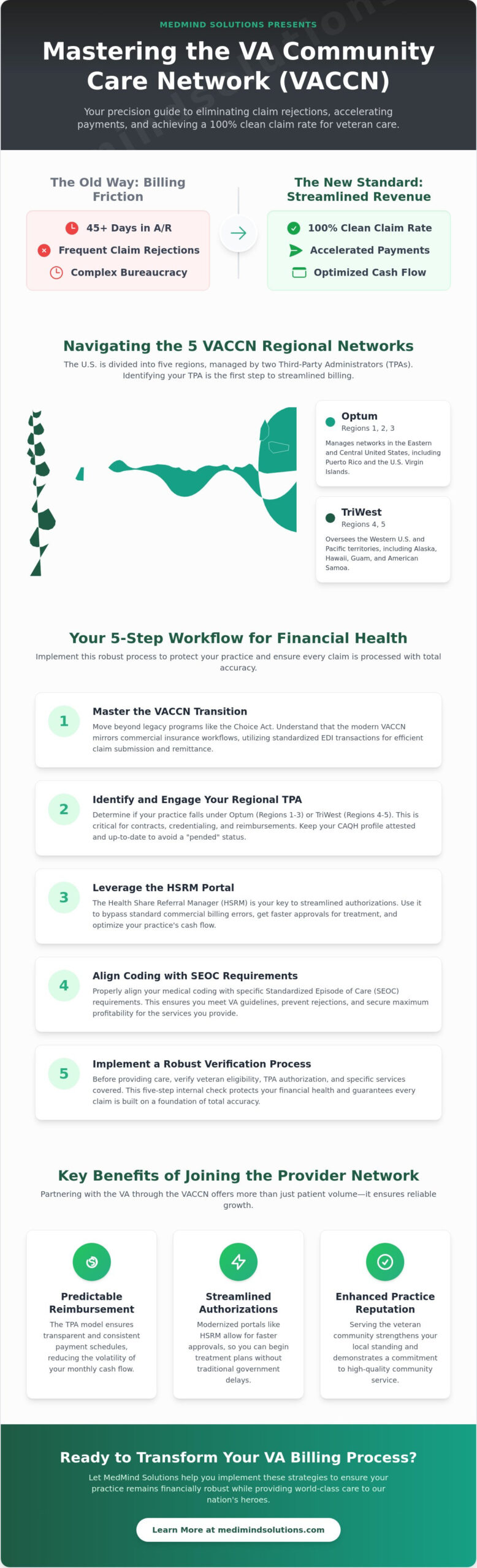
The VA Community Care Network (VACCN) is the Department of Veterans Affairs’ primary vehicle for purchasing medical services from private providers. It isn’t just another government program; it’s a robust, streamlined system designed to bridge the gap between veteran needs and community expertise. By consolidating various legacy programs under the MISSION Act of 2018, the VA created a more predictable environment for medical practices to thrive while serving those who served.
This network functions through a partnership with Third-Party Administrators (TPAs) such as Optum and TriWest. These entities manage the administrative layers, allowing your practice to focus on clinical excellence. While the VA manages its internal operations through VA’s healthcare regions (VISNs), the vaccn extends that reach into the private sector. The goals are clear: improve timeliness, ensure clinical quality, and simplify the billing process for every participant.
The Shift from Choice Act to VACCN
The transition from the old Veterans Choice Program to the current network changed how claims are adjudicated. Five years ago, providers often faced fragmented rules and delayed payments. Today, the vaccn operates on an industry-standard model that mirrors commercial insurance workflows. This shift eliminated many of the manual hurdles practices previously navigated to receive payment.
Many providers still hold the misconception that VA billing is a bureaucratic nightmare. This isn’t the case anymore. The current system utilizes standardized electronic data interchange (EDI) transactions. This means your team can submit claims and receive remittances just as they do with major commercial payers. It’s a precision-engineered process that supports your practice’s financial health and reduces the time your staff spends on the phone with representatives.
Benefits of Joining the Provider Network
Joining this network offers a unique opportunity to optimize your bottom line while fulfilling a vital social mission. You gain direct access to a dedicated patient base of over 19 million veterans who require specialized and general care. This isn’t just about volume; it’s about reliable growth through a partnership-oriented approach. Consider these specific advantages:
- Predictable Reimbursement: The TPA model ensures that payment schedules are transparent and consistent, reducing the volatility of your monthly cash flow.
- Streamlined Authorizations: Modernized portals allow for faster approvals, meaning you can start treatment plans without the traditional government delays.
- Practice Reputation: Serving the veteran community strengthens your local standing and demonstrates a commitment to high-quality community service.
Experience the security of a partnership that values both your clinical skills and your practice’s profitability. By integrating these services, you ensure your business remains healthier than ever while providing essential care to those who need it most. The result is a perfect match between your practice’s growth goals and the VA’s commitment to veteran wellness.
Navigating Regional Networks: Optum, TriWest, and Your Practice
The VA Community Care Network operates through a structured regional system designed to ensure Veterans receive timely care outside of traditional VA facilities. This five-region map dictates which administrator handles your contracts, credentialing, and reimbursements. Optum Public Sector Solutions manages Regions 1, 2, and 3, covering the Eastern and Central United States. TriWest Healthcare Alliance oversees Regions 4 and 5, which encompass the Western U.S. and Pacific territories. Identifying your specific TPA is the first step toward achieving a healthier bottom line through precise government billing. The TPA functions as the critical intermediary that validates medical necessity and facilitates the actual transfer of funds from the VA to your practice.
TPA Responsibilities and Provider Relations
TPAs act as the gatekeepers for your practice’s entry into the network. They manage the entire credentialing lifecycle, which typically requires a 90-day window for initial approval. You’ll need to maintain an active, “attested” status on your CAQH profile, as both Optum and TriWest pull data directly from this source to verify your credentials. If your CAQH data is even slightly outdated, it can trigger a “pended” status, delaying your ability to see Veterans and impacting your vaccn participation. Our team often sees that a simple “Practice Checkup” of your digital credentials can prevent months of administrative gridlock. You can access specific provider handbooks and mandatory 2026 training modules through the Optum or TriWest portals to ensure your staff stays compliant with the latest regulatory shifts.
Regional Nuances in Claim Submission
Submitting claims for vaccn services requires technical precision tailored to your region’s specific EDI (Electronic Data Interchange) requirements. While both administrators accept standard 837P and 837I transactions, their routing addresses and Payer IDs differ significantly. For practitioners in Optum regions, the myVACCN portal serves as the primary hub for authorization tracking and claim status inquiries. Conversely, providers in TriWest territories must utilize the TriWest Provider Portal for similar tasks. Precision is vital here; even a minor 5% error rate in EDI mapping can lead to thousands in delayed monthly revenue. Consider these regional requirements:
- Optum (Regions 1-3): Requires specific enrollment for the myVACCN portal and utilizes Optum-specific Payer IDs for electronic claims.
- TriWest (Regions 4-5): Focuses on the TriWest Provider Portal for authorization management and secure claim attachments.
- EDI Standards: Both TPAs mandate HIPAA-compliant 5010 transactions, but clearinghouse configurations must match regional TPA protocols to avoid immediate rejection.
By aligning your internal workflows with these regional expectations, you transform a complex government program into a robust stream of predictable revenue. Our skillful billing specialists ensure that your practice doesn’t just participate in the network but thrives within it, maintaining the financial health necessary to focus on what matters most: Veteran care.
The Critical Differences in VACCN Claims Processing
Standard commercial billing workflows often collapse when applied to veteran claims. While commercial carriers focus heavily on medical necessity, the vaccn framework operates on a strict authorization-first model. Your practice’s financial health depends on recognizing that a “clean claim” in this system requires more than just accurate CPT codes. It demands a perfect match between the service rendered and the specific authorization on file. When these don’t align, denials happen instantly, regardless of how necessary the care was for the patient. Success in this environment requires a shift from passive billing to proactive authorization management.
Standardized Episodes of Care (SEOC)
SEOC bundles define the exact scope of billable services for a veteran. These aren’t just suggestions; they’re rigid clinical boundaries that dictate what you can and cannot bill. If you’re treating a patient under a musculoskeletal SEOC, every CPT code you submit must exist within that specific bundle. When a patient requires care that exceeds the original authorization, you can’t simply bill for the extra work and hope for the best. You must submit a Request for Service (RFS) and receive approval before the additional care is provided. According to the VA Community Care Network (CCN), failing to match the claim to the specific authorization number remains the leading cause of payment rejection. Precision here ensures you don’t leave revenue on the table due to administrative technicalities.
The HSRM Portal Mastery
The Health Share Referral Manager (HSRM) is the central nervous system for modern veteran care. By 2026, manual faxing has become a relic that adds an average of 32 days to the reimbursement cycle, creating unnecessary friction in your cash flow. Skillful providers use the HSRM portal to receive referrals electronically, which eliminates data entry errors and speeds up the “Practice Checkup” process. This portal isn’t just for viewing referrals; it’s the primary tool for uploading clinical documentation. This step is vital because the payment cycle often won’t trigger until the VA receives the clinical notes associated with the vaccn claim. Switching to a fully digital workflow through HSRM provides the best of both worlds: increased speed and higher accuracy. This proactive approach protects your bottom line and keeps your practice’s fiscal health stronger than ever.
5 Steps to Maximizing Your VACCN Reimbursements
To keep your practice’s financial health robust, you need a proactive strategy. Maximizing your vaccn reimbursements isn’t just about submitting forms; it’s about mastering a specific lifecycle of veteran care. Follow these five steps to optimize your bottom line and ensure your cash flow remains healthier than ever.
- Verify Before the Visit: Confirm eligibility and secure a valid authorization before the veteran enters the exam room. This eliminates the risk of providing uncompensated care and ensures a perfect match between the patient and the approved service.
- Map to SEOC Requirements: Align your medical coding with the specific Standardized Episode of Care (SEOC) guidelines for that visit. If the service isn’t listed in the SEOC, it won’t be paid without an additional secondary authorization.
- Submit Electronically: Send claims via 837P or 837I transactions within the 180-day timely filing window. Electronic submissions facilitate faster collections and reduce the manual errors associated with paper billing.
- Daily HSRM Monitoring: Check the Health Share Referral Manager (HSRM) portal every morning for status updates. This allows you to respond to documentation requests immediately, preventing small delays from becoming permanent denials.
- The Monthly “Practice Checkup”: Analyze your vaccn-specific A/R days every 30 days. If your aging bucket for VA claims exceeds 45 days, your workflow requires a skillful adjustment to identify where the bottleneck exists.
Avoiding Common Coding Pitfalls
Precision is your best defense against revenue leakage. Use modifiers like 26 for professional components or TC for technical components only when the SEOC explicitly allows them. Ensure your ICD-10 codes directly mirror the medical necessity defined in the VA’s authorization letter. Precision coding prevents federal audits by creating a transparent, defensible link between the veteran’s condition and the services billed.
Denial Management and Appeals
The most common reason for VACCN denials is “No Authorization Found,” which often stems from simple data entry errors or billing for services outside the authorized date range. If a claim is rejected, use the TPA portal—either Optum or TriWest—to submit a formal appeal with the original authorization attached. Track your “Clean Claim Rate” as a vital KPI; a healthy practice should maintain a rate of 98% or higher to sustain consistent profitability and growth.
Ensuring Long-Term Financial Health with Veteran Care Billing
Serving those who served is a noble mission, but your practice’s financial health is the engine that makes this care possible. You deserve the “best of both worlds” promise; a thriving clinic and the honor of supporting veteran health. The complexity of vaccn billing often creates a bottleneck that slows your cash flow. If your team spends hours chasing TriWest or Optum, your revenue cycle is leaking profit. MedMind Solutions steps in to handle the heavy lifting of VACCN administration, ensuring your practice remains healthier than ever.
The Value of Meticulous RCM Partnerships
Specialized VA billing isn’t a side task. It’s a technical discipline. Expert billing specialists reduce “Days in A/R” for complex claims by catching coding errors before they reach the payer. When you compare the cost of internal staff training and turnover to a professional RCM, the ROI is clear. Outsourcing to a group of skillful billing specialists allows you to focus on patient care while experts manage PHI and HIPAA compliance with clinical precision. Our robust systems eliminate the stress of regulatory changes, giving you security and relief.
A robust, compliant veteran care revenue cycle requires a specific framework to succeed. Use this final checklist to evaluate your current performance:
- Eligibility Verification: Are authorizations confirmed 48 hours before the appointment?
- Clean Claim Rate: Is your first-pass claim rate above 98%?
- Secondary Billing: Do you have an automated process for coordinating benefits?
- KPI Reporting: Can you see your collections and aging reports in real-time?
- Data Security: Is your billing partner using advanced encryption for all PHI?
Taking the Next Step
Don’t guess about your performance. Request a comprehensive audit of your current VA billing workflow to identify where revenue is being lost. Seeing the savings is the first step toward optimization. On average, optimized billing can increase revenue by $26,000 per provider. This isn’t just about numbers; it’s about the stability of your practice. Experience the clinical precision of our team and watch your bottom line grow. Our partnership model ensures you stay focused on the veterans who need you most. Experience precision billing with a MedMind Practice Checkup today.
Master Your Practice’s Financial Health in 2026
Navigating the complexities of the VA Community Care Network requires more than clinical excellence. It demands administrative precision. By mastering the regional requirements of Optum and TriWest and implementing a rigorous reimbursement strategy, your practice can turn veteran care into a pillar of stability. Success with vaccn billing in 2026 hinges on eliminating the technical errors that lead to denials and delays. You don’t have to carry the heavy lifting of government administration alone.
MedMind Solutions acts as your meticulous growth partner, providing robust HIPAA compliant data encryption to protect your PHI while optimizing your cash flow. Our specialized billing experts maintain a 98% clean claim rate for government billing, helping providers achieve an average revenue increase of $26,000. It’s time to give your practice the financial checkup it deserves so you can focus on the patients who served our country. Experience the relief of a healthier bottom line; contact MedMind Solutions today.
Your commitment to veterans is vital. We are here to ensure your practice stays healthier than ever as you continue this important work.
Frequently Asked Questions
Is the VACCN the same as the VA Choice Program?
No, the VACCN replaced the Veterans Choice Program (VCP) on June 6, 2019, following the implementation of the MISSION Act. This change consolidated multiple community care programs into a single, efficient system. By moving to this unified network, the VA improved the speed of payments and clinical data sharing. Your practice benefits from this streamlined approach because it reduces the administrative complexity of managing multiple veteran care initiatives.
How do I check a veteran’s eligibility for community care?
You check a veteran’s eligibility by accessing the HealthShare Referral Manager (HSRM) or contacting the local VA community care department directly. Eligibility depends on 6 distinct criteria, such as the 20-day wait time standard for primary care or the 28-day standard for specialty care. Don’t provide care based solely on a veteran’s word; always confirm they have an active referral. This precision prevents unpaid claims and keeps your practice’s bottom line healthy.
What is the timely filing limit for VACCN claims in 2026?
The timely filing limit for vaccn claims in 2026 is 180 days from the date you provided the service. Filing within this 180-day window is critical for maintaining your cash flow and avoiding technical denials. If you miss this deadline, the VA won’t reimburse the claim regardless of the medical necessity. Our billing specialists recommend submitting claims within 48 hours to optimize your collection cycle and ensure maximum profitability.
Do I need a separate contract for Optum and TriWest?
Yes, you need a specific contract with either Optum or TriWest depending on your geographic region. Optum oversees Regions 1, 2, and 3, while TriWest handles Regions 4 and 5, and recently gained the contract for Region 6 in 2024. You can’t treat veterans across different regions without the proper network credentials for each administrator. Securing the right contract is the first step toward a successful, skillful partnership with the VA.
Can I bill a veteran for the remaining balance not paid by the VA?
No, you cannot bill a veteran for any balance remaining after the VA pays their portion of the claim. Under 38 U.S.C. 1725, providers must accept the VA’s payment as payment in full for authorized services. Balance billing is a violation of your provider agreement and can lead to removal from the network. Focus on optimizing your internal coding to ensure you’re receiving the maximum allowable reimbursement from the start.
What happens if I provide care without an authorization number?
Providing care without an authorization number usually leads to an immediate claim denial and zero reimbursement for the services rendered. The VA requires an approved referral for 100% of non-emergent care to ensure the service meets their clinical guidelines. For emergency visits, you must report the care within 72 hours to the VA’s centralized portal. This proactive step is vital for protecting your practice from avoidable financial losses and keeping your revenue stream secure.
How long does it typically take to get reimbursed through the VACCN?
Most providers receive reimbursement through the vaccn within 30 days when submitting clean electronic claims. Paper claims generally take longer, often stretching to 45 days for processing and payment. By using electronic 837 transactions, you can speed up your revenue cycle and see your savings grow. This consistent rhythm of payment helps maintain the financial health of your practice while you focus on delivering high-quality veteran care.
What is the HSRM portal and is it mandatory for all providers?
The HealthShare Referral Manager (HSRM) is a secure, cloud-based platform used to manage referrals, and while the VA doesn’t make it strictly mandatory, it’s the industry standard for 2026. It allows your staff to view authorization details and upload medical documentation directly to the VA. Using HSRM eliminates the heavy lifting of manual faxing and phone calls. This digital integration ensures HIPAA compliance while accelerating the speed of your clinical and financial workflows.