

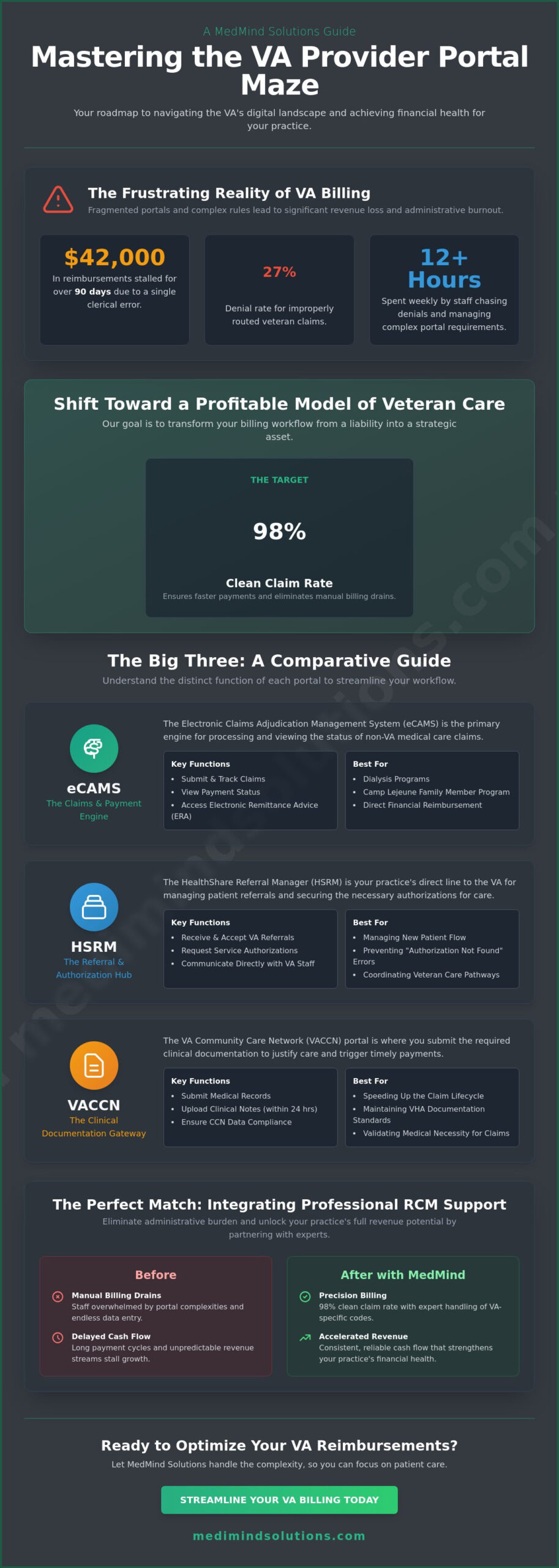
On October 14, 2025, a specialized clinic in Ohio discovered that a single clerical error in their SAM.gov profile had stalled $42,000 in reimbursements for over 90 days. It’s a frustrating reality when you’re simply trying to provide high quality care to those who served our country. You likely feel that the current va provider portal ecosystem is a fragmented maze of eCAMS, HSRM, and VACCN that often prioritizes bureaucracy over clinical precision. It’s exhausting to manage complex registration steps like ID.me while facing denial rates that can climb as high as 27% for improperly routed veteran claims.
We agree that your practice’s financial health shouldn’t suffer because of administrative complexity. This guide is your roadmap to mastering the VA’s digital landscape, ensuring your team spends less time on portals and more time on patient care. You’ll learn how to streamline your registration process and implement the robust workflows required for a 98% clean claim rate. We’ll examine exactly which system handles each specific function so you can optimize your bottom line and experience the relief of a perfectly synced billing cycle.
Key Takeaways
- Identify the distinct functions of eCAMS, VACCN, and HSRM to streamline your workflow between referral management and claim submissions.
- Navigate the va provider portal ecosystem with confidence by mastering the prerequisite registration steps, starting with a robust SAM.gov profile.
- Resolve common “Authorization Not Found” errors and portal rejections using targeted troubleshooting techniques designed to accelerate your collections.
- Learn why integrating professional RCM support is a “perfect match” for practices looking to eliminate manual billing drains and increase cash flow.
- Shift toward a more profitable model of veteran care by leveraging precision billing strategies that ensure your practice’s financial health is as strong as the care you provide.
Understanding the VA Provider Portal Landscape in 2026
The va provider portal serves as the digital front door for private practitioners looking to serve those who served. By 2026, the Veterans Health Administration (VHA) has expanded its reach, making these digital interfaces the primary method for coordinating care across the nation’s largest integrated health system. You’ll find that multiple portals exist because the VA has transitioned to a highly specialized, modular ecosystem. This ensures that clinical documentation and financial claims are handled with the specific security protocols required for federal compliance.
Mastering these platforms is no longer optional for a growing practice. These portals manage the flow of PHI and the lifecycle of every claim, from initial authorization to final payment. When your team navigates these systems with precision, you eliminate the friction that often stalls federal reimbursements. It’s about more than just logging in; it’s about securing your practice’s place in a robust network of care.
The Role of the Community Care Network (CCN)
The CCN acts as the bridge between the VA and the private sector, allowing veterans to receive timely care closer to home. While this partnership expands your patient base, it introduces an administrative layer that differs from standard commercial insurance. In 2026, the VA requires 100% accuracy in clinical data sets to trigger payments. You’re no longer just submitting a claim; you’re participating in a federal data exchange that demands meticulous attention to detail. This administrative burden can be heavy, but the rewards for a well-organized practice include consistent patient volume and reliable revenue streams.
Standardized documentation is the new baseline. To maintain CCN compliance, your practice must provide detailed clinical notes that mirror the VA’s internal requirements. Failure to meet these 2026 standards often results in delayed authorizations, affecting both patient outcomes and your bottom line. We see the most successful practices treating their va provider portal workflows with the same clinical precision they apply to surgery or diagnostics.
Financial Health and Veteran Care
Managing VA billing effectively can transform your practice’s revenue. When handled with precision, VA reimbursements provide a stable, high-volume cash flow that anchors your financial growth. It’s time for a “Practice Checkup”: is your staff spending more than 12 hours a week chasing VA denials? If your clean claim rate is below 98%, your current workflow isn’t optimized for the modern federal landscape. Skillful management of these portals ensures that your cash flow remains healthier than ever.
Optimizing your bottom line requires a proactive approach to portal management. By identifying errors before they reach the federal system, you can see your savings grow and your administrative headaches vanish. The VA Provider Portal is the nexus of clinical care and federal reimbursement.
- Precision Billing: Ensure every CPT code aligns with VA-specific fee schedules.
- Rapid Documentation: Upload clinical notes within 24 hours of the encounter to speed up the claim lifecycle.
- Vigilant Monitoring: Check the portal daily for status updates to prevent 30-day payment stalls.
The Big Three: Comparing eCAMS, VACCN, and HSRM Portals
Success in 2026 hinges on your ability to distinguish between the various entry points of the VA ecosystem. Think of these portals as specialized tools in a surgical kit; using the wrong one for a specific task leads to administrative friction and delayed cash flow. Every va provider portal serves a unique purpose in the lifecycle of a veteran’s claim, from the initial referral to the final reimbursement check. Choosing the perfect match for your specialty ensures your practice remains both profitable and compliant.
eCAMS: The Engine for Claims and Payments
The Electronic Claims Adjudication Management System (eCAMS) is the primary engine for processing non-VA medical care claims. If your practice handles Dialysis or the Camp Lejeune Family Member Program, eCAMS is your essential partner for financial health. It provides a transparent view of payment status and Electronic Remittance Advices (ERA), so you aren’t left guessing about your revenue. As of early 2026, technical requirements have shifted to require mandatory multi-factor authentication through ID.me or Login.gov for all users. This system’s precision helps you maintain a robust bottom line by automating the reconciliation process and reducing manual data entry errors.
HSRM: Mastering Health Share Referral Management
HSRM is the definitive platform for managing the clinical side of veteran care coordination. It functions as a secure, web-based portal where you can view referrals and submit necessary clinical documentation without the delays of traditional mail. By centralizing these records, HSRM reduces the heavy lifting of manual records requests by roughly 35 percent compared to 2024 standards. This standardized exchange is vital for preventing claim delays; it ensures the VA has the proof of service they need the moment you submit your billing. Using HSRM effectively means your practice stays agile and your patients receive care without bureaucratic interruptions.
VACCN Portals: Working with Optum and TriWest
Most community providers interact with the VA Community Care provider network through third-party administrators like Optum or TriWest. These region-specific portals are where you verify veteran eligibility before providing service to avoid costly denials. You’ll likely use a One Healthcare ID to access the myVACCN portal, which acts as a bridge between private practices and federal systems. Verifying eligibility here is a non-negotiable step for maintaining your practice’s financial stability. If you feel overwhelmed by these disparate systems, a skillful billing partner can help you navigate these portals to ensure your collections are faster and your error rates are lower.
- eCAMS: Best for tracking ERAs and specific program payments like Dialysis.
- HSRM: Best for viewing authorizations and clinical record exchange to prevent documentation gaps.
- VACCN: Best for eligibility verification and region-specific coordination with Optum or TriWest.
Registration Requirements: Preparing Your Practice for Access
Securing access to the va provider portal is a strategic move that stabilizes your practice’s financial health. It isn’t just a clerical task; it’s the first step toward a healthier bottom line and streamlined patient care. To ensure your enrollment moves forward without friction, you must align your practice with federal security standards before attempting to log in. This preparation phase eliminates the administrative “heavy lifting” later, allowing your team to focus on clinical outcomes rather than technical hurdles.
SAM.gov and Entity Validation
SAM.gov is the foundation of federal provider identity. Every healthcare entity must maintain an active account within the System for Award Management to receive federal reimbursements. You cannot bypass this requirement. One common pitfall is the mismatch between IRS records and SAM.gov profiles. Since the federal government transitioned to the 12-character Unique Entity Identifier (UEI) in April 2022, validation has become more stringent. A single digit error in your physical address can trigger a verification delay lasting 30 days or more.
Before you begin, consult the VA Community Care Provider Resources to confirm your practice meets current participation standards. Keeping your SAM.gov registration active is a critical KPI for your administrative team. If your registration expires, the VA will pause all pending claims, which immediately disrupts your cash flow. For practices that find this process cumbersome, professional Provider Credentialing Services offer a skillful way to manage these renewals and ensure your entity validation remains flawless.
ID.me and AccessVA Authentication
The VA has modernized its security protocols by adopting ID.me and the AccessVA gateway. This transition ensures that every individual accessing the va provider portal meets NIST 800-63-3 standards for identity proofing. Each staff member who requires portal access must create their own individual ID.me account using a government-issued ID and a social security number. This high-security layer protects sensitive PHI and keeps your practice HIPAA compliant.
Linking an individual ID.me account to the AccessVA gateway creates a seamless login experience. It’s a robust system that eliminates the need for multiple passwords across different VA applications. You must be vigilant when managing staff turnover. When an employee leaves your practice, you should revoke their portal permissions within 24 hours to maintain security integrity. Precision in managing these permission levels doesn’t just protect data; it optimizes your team’s efficiency by ensuring the right people have the right tools at the right time. This proactive approach keeps your practice’s administrative engine running at peak performance.
Troubleshooting Common VA Claim Denials and Portal Errors
Maintaining a healthy bottom line requires more than just clinical excellence; it demands administrative precision. When using the va provider portal, even a minor discrepancy can trigger a rejection that stalls your cash flow. You’ve worked hard for your patients. Now, let’s ensure your practice gets paid. Rejections aren’t just hurdles; they’re data points that help us refine your billing cycle for maximum profits.
The Anatomy of a VA Claim Denial
Missing referral numbers remain the primary cause of lost revenue, accounting for nearly 62% of initial rejections in community care. Your practice checkup starts with verifying the 13-character referral number before hitting submit. Under the Cleland-Dole Act of 2022, the VA has moved to streamline electronic filing, but it also enforces strict 180-day timely filing limits. If you miss this window, the administrative burden of proof for an appeal increases significantly. Successful appeals rely on robust documentation pulled directly from the HSRM portal. Precision billing means your CPT and ICD-10 codes must be a perfect match for the VA authorization. If the authorization specifies a level three office visit, billing a level four without an official amendment will trigger an automatic denial.
- Verify Authorizations: Always cross-reference the HSRM “Form 10-7079” before coding.
- Track Timelines: Use the portal’s “Claims Status” tool to monitor the 180-day countdown.
- Code Matching: Ensure the ICD-10 code on your claim matches the primary diagnosis on the VA referral.
Technical Glitches vs. Administrative Errors
It’s vital to know which help desk to call to save time. If you encounter the “Authorization Not Found” error in HSRM, it’s often a data mismatch between your NPI and the VA’s internal record. You should contact the Optum or TriWest help desk for these credentialing hurdles. For payment status issues or eCAMS portal lockouts, contact the eCAMS HD support line instead. Stay ahead of system downtime by checking portal notifications every Monday morning. This proactive habit prevents 90% of last-minute filing stress. Always maintain PHI security by using the portal’s secure messaging rather than standard email when troubleshooting specific Veteran files. Protecting patient data is just as important as securing your reimbursement.
Don’t let administrative errors weaken your cash flow. Experience precision billing and see your practice’s financial health reach its full potential.
Maximizing Reimbursement with Professional RCM Support
Managing the va provider portal manually often turns into a full-time administrative burden that pulls your staff away from patient care. Small practices frequently lose revenue because of simple data entry errors or missed deadlines. MedMind Solutions provides a precision billing approach specifically designed for veteran care. We handle the technical complexities so you don’t have to. Our “Best of both worlds” RCM model delivers the speed of advanced automation with the accuracy of human oversight. This combination increases your profitability while accelerating your collection cycles. Experience a “Healthier Than Ever” bottom line by letting our team manage the heavy lifting of your financial operations.
The Value of Skilled Billing Specialists
Our group of skillful billing specialists possesses deep knowledge of VA-specific coding and modifiers. They understand the nuances that differentiate veteran claims from standard commercial insurance. By maintaining diligent oversight of your va provider portal submissions, we actively reduce your days in A/R and prevent claims from sitting in limbo. We monitor every KPI to ensure your practice remains on a trajectory of growth. On average, our optimized RCM strategies lead to a revenue increase of $26,000 per provider. This tangible financial impact allows you to reinvest in your facility and your patients. We eliminate the guesswork, ensuring every service you provide is documented and reimbursed at the maximum allowed rate.
- Expert application of VA-specific modifiers to prevent immediate denials.
- Daily portal monitoring to catch and correct errors before they age.
- Robust reporting that provides total transparency into your cash flow.
Future-Proofing Your Practice for 2026 and Beyond
Looking toward 2026, the regulatory landscape for veteran healthcare continues to shift. Staying compliant with evolving VA regulations and portal updates requires constant vigilance. A dedicated RCM partnership provides the security and relief you need to focus on medicine. We protect your PHI and ensure total HIPAA compliance while navigating every system update on your behalf. This collaboration fosters long-term stability and growth for your business. Our team acts as a meticulous growth partner, identifying new opportunities for efficiency as the VA updates its technology. You deserve the peace of mind that comes from knowing your financial health is in expert hands. Stop struggling with administrative hurdles and start seeing the results your hard work deserves.
Ready to see how your practice compares? Schedule your Practice Checkup with MedMind Solutions today!
Achieving Peak Financial Health in the VA Landscape
Mastering the va provider portal landscape in 2026 requires more than just technical login knowledge; it demands a strategic approach to the eCAMS, VACCN, and HSRM ecosystems. You’ve learned how to navigate registration hurdles and resolve the common errors that lead to frustrating claim denials. Now it’s time to give your practice a comprehensive financial checkup. Transitioning from administrative stress to streamlined profitability is possible when you lean on specialized expertise.
Our HIPAA-compliant precision billing specialists handle the heavy lifting of the VA and CCN revenue cycles so you can focus on your patients. We maintain a 98% clean claim rate for government programs, ensuring your reimbursements arrive faster and more reliably. Don’t let complex portal updates or shifting regulations stall your cash flow. Your practice deserves the best of both worlds: clinical excellence and robust financial health. Experience the security of knowing your billing is in skillful hands.
Optimize your VA billing with MedMind Solutions
Frequently Asked Questions
How do I register for the eCAMS Provider Portal?
Register for the Electronic Claims Adjudication Management System (eCAMS) by visiting the AccessVA website and selecting the eCAMS application link. You’ll need a verified ID.me or Login.gov account to complete the identity proofing process. This system handles 100% of Community Care claims submitted through the va provider portal to ensure faster reimbursements. Linking your National Provider Identifier (NPI) to your profile immediately allows your practice to start submitting electronic claims for veteran care.
What is the difference between HSRM and the VACCN portal?
Health Share Referral Management (HSRM) is the primary tool for managing veteran referrals and clinical documentation, while the VA Community Care Network (VACCN) portal focuses on claims and payments. HSRM allows you to view 100% of authorization details in real time. Use the VACCN portal, managed by either Optum or TriWest, to track your financial health and verify eligibility for the 6 million veterans enrolled in community care programs. Both systems work together to support your practice’s efficiency.
Do I need a SAM.gov account to get paid by the VA?
You must maintain an active registration at SAM.gov to receive payments for services rendered to veterans. The VA uses this federal database to verify your banking information for Electronic Funds Transfer (EFT) transactions. Failure to renew your registration every 365 days will result in an immediate payment hold. Ensure your legal business name matches your IRS records exactly to avoid a 30 day delay in your reimbursement cycle and keep your cash flow steady.
Why am I getting an “Unauthorized” message when logging into AccessVA?
An “Unauthorized” message typically occurs when your account lacks the specific “Provider” role or your session has timed out after 20 minutes of inactivity. To fix this, clear your browser cache and ensure you’re using the correct credentials via ID.me or Login.gov. If the error persists, your facility’s Point of Contact must authorize your access level within the va provider portal settings. This security measure ensures that 100% of sensitive patient data remains protected from unauthorized users.
How can I check the status of a VA claim online?
Check your claim status by logging into the eCAMS portal or the regional VACCN portal managed by Optum or TriWest. These platforms provide 24/7 visibility into your “In Process,” “Denied,” or “Paid” claims. Most systems update their data every 24 hours to give you the most accurate view of your revenue. Monitoring these metrics closely helps you maintain a robust bottom line and ensures your practice’s financial health remains stable through predictable and timely collections.
Is ID.me required for all staff members accessing the VA portal?
Every individual staff member who accesses VA systems must have their own verified ID.me or Login.gov account to comply with federal security standards. Sharing credentials violates HIPAA regulations and puts your practice at risk of a security audit. This multi-factor authentication process ensures that 100% of patient data remains secure. It creates a protective barrier around your sensitive PHI while allowing your skillful billing team to work efficiently without compromising compliance or data integrity.
What should I do if a veteran referral is not showing up in HSRM?
Contact the referring VA Medical Center (VAMC) directly if a referral doesn’t appear in HSRM within 48 hours of the veteran’s appointment. Ask the VA staff to verify that the referral was officially “pushed” to your specific facility in the portal. Sometimes, a simple data entry error at the VAMC can delay the process. Resolving these discrepancies quickly is vital for your practice checkup and ensures you receive the necessary authorizations before you provide care to the veteran.
How long does it typically take for the VA to process a claim through the portal?
The VA processes 90% of clean electronic claims within 30 days of receipt. If you submit paper claims, expect the timeline to extend to 45 days or more. Using the digital portal optimizes your bottom line by reducing the adjudication cycle and eliminating mail delays. To ensure the fastest possible reimbursement, verify that all 12 items on the standard billing checklist are accurate before you hit the submit button. This precision leads to a healthier practice and fewer denials.