

Could a simple three-letter mix-up be quietly draining your practice’s financial health? The hcc medical abbreviation is one of the most significant yet misunderstood terms in modern medicine, acting as a bridge between high-stakes clinical care and complex administrative reimbursement. Whether you’re treating a patient with Hepatocellular Carcinoma or documenting for Hierarchical Condition Categories, the stakes couldn’t be higher. In 2023, CMS utilized over 9,700 ICD-10 codes within the HCC model to determine billions in Medicare Advantage payments; this makes precision more than just a goal, it’s a necessity for your practice’s survival.
We understand that the pressure to provide top-tier care while managing intricate coding requirements feels like a constant balancing act. It’s common to feel overwhelmed by the risk of under-coding chronic conditions that directly impact your risk adjustment factor scores and overall cash flow. This article promises to clarify the dual nature of HCC so you can ensure your documentation reflects the true complexity of your patient population. You’ll learn how to distinguish these terms with confidence, see the direct link between coding and revenue, and gain three actionable strategies to strengthen your practice’s financial foundation today.
Key Takeaways
- Learn to navigate the dual meanings of the hcc medical abbreviation to bridge the gap between clinical diagnosis and administrative coding precision.
- Discover the clinical nuances of Hepatocellular Carcinoma and why vigilant documentation is essential for managing patients with chronic liver disease.
- Master the CMS Hierarchical Condition Category model to ensure your practice captures the true complexity and cost profiles of your patient population.
- Protect your practice’s financial health by identifying how documentation gaps lead to lower RAF scores and missed revenue opportunities.
- Experience the peace of mind that comes with meticulous risk adjustment oversight, ensuring your practice is reimbursed for the expert care you provide.
What Does HCC Stand For? Understanding the Dual Medical Meanings
In the complex ecosystem of modern medicine, the hcc medical abbreviation serves a dual purpose that bridges the gap between the exam room and the billing office. One definition refers to a life-threatening malignancy, while the other dictates the financial viability of value-based care models. For a practice to remain healthy, providers and administrators must master both definitions with precision. Distinguishing between these two concepts is vital for clinical accuracy and the long-term financial health of your organization.
When HCC Refers to a Clinical Diagnosis
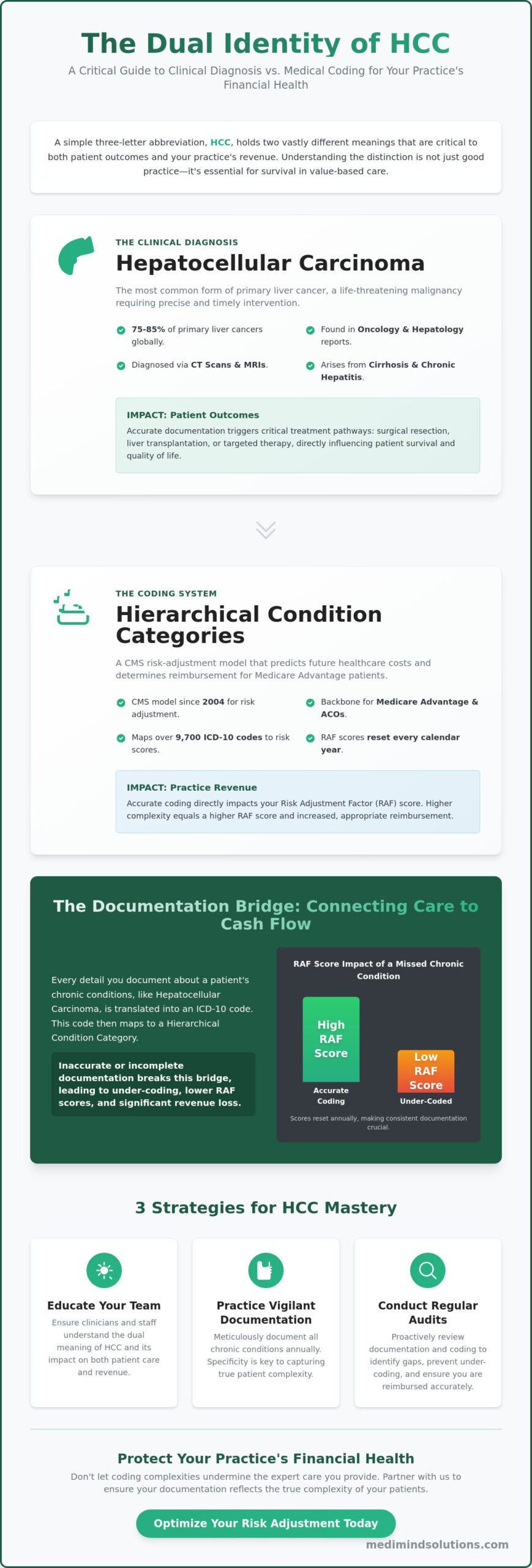
Clinically, HCC stands for Hepatocellular Carcinoma, which is the most common form of primary liver cancer. This malignancy accounts for approximately 75% to 85% of all primary liver cancers globally. Doctors usually encounter this term within the specialized fields of oncology and hepatology, or on diagnostic imaging reports like CT scans and MRIs.
Precise documentation of this condition is critical for patient outcomes. When a provider accurately identifies this malignancy, they trigger specific treatment pathways such as surgical resection, liver transplantation, or targeted therapy. Because this condition often arises in patients with underlying cirrhosis or chronic hepatitis B and C, the clinical stakes are high. Clear communication ensures that every member of the care team understands the severity of the diagnosis, allowing for a robust and timely intervention.
When HCC Refers to Medical Coding
On the administrative side, the hcc medical abbreviation represents Hierarchical Condition Categories. This is a risk-adjustment model implemented by CMS in 2004 to estimate future healthcare costs for patients. This system serves as the backbone for Medicare Advantage (MA) plans and Accountable Care Organizations (ACOs). It essentially creates a “digital twin” of a patient’s health complexity by mapping specific ICD-10 codes to risk scores.
The role of these categories is to ensure that payers provide higher reimbursements for patients with more complex, chronic conditions. It’s a system designed to reward quality and thoroughness rather than just the volume of visits. Common contexts for this meaning include:
- Annual Wellness Visits (AWVs) where chronic conditions are recaptured.
- Risk-adjustment audits to ensure documentation supports the billed codes.
- Financial reporting for value-based care contracts.
Accuracy in this area is paramount. If a patient’s complexity is under-reported, your practice loses the resources needed to provide high-quality care. A single missed diagnosis code can result in a significant drop in the expected reimbursement for that patient year. Our skillful billing specialists understand that meticulous documentation is the “perfect match” for a thriving practice, ensuring you’re optimizing your bottom line while focusing on patient wellness.
HCC in Medical Coding: The Hierarchical Condition Category System
The Centers for Medicare & Medicaid Services (CMS) launched the Hierarchical Condition Category model in 2004 to transition healthcare toward a more accurate, value-based payment structure. This system utilizes the hcc medical abbreviation to define a risk-adjustment framework that predicts future healthcare costs based on the complexity of a patient’s health. By grouping specific ICD-10-CM codes into categories with similar clinical profiles and cost expectations, CMS ensures that providers are fairly compensated for managing high-risk populations.
This model is inherently additive. When a patient presents with multiple chronic conditions, each relevant category contributes to a higher Risk Adjustment Factor (RAF) score. A higher RAF score leads to increased reimbursement, reflecting the intensive resources required for complex care. Because these scores reset every calendar year, your team must document and report chronic conditions annually. Missing a single year of documentation can cause a patient’s risk score to plummet, which directly threatens the financial health of your practice.
How the HCC Model Works
The system maps thousands of ICD-10 codes into roughly 86 to 115 categories, depending on the version used. The “hierarchy” logic dictates that if a patient has multiple related conditions within the same family, only the most severe manifestation contributes to the RAF score. For example, a specialist might be focused on Hepatocellular Carcinoma Explained, while the coding team ensures the documentation satisfies the MEAT criteria. To support an HCC, the medical record must show the provider did at least one of the following: Monitor, Evaluate, Assess, or Treat the condition. This clinical precision ensures that the hcc medical abbreviation translates into accurate revenue.
Evolving Models: Transitioning to CMS-HCC Version 28
The industry is currently navigating a major shift from Version 24 to Version 28. CMS began phasing in V28 in 2024, with a target for full implementation by 2026. This update significantly changes code mapping; while it expands the total number of HCC categories, it also removes over 2,000 ICD-10 codes that previously triggered risk-adjusted payments. These changes are designed to align payments with more recent clinical cost data and reduce coding variability. Practices that fail to update their internal workflows for V28 risk a significant decline in profitability. Securing a perfect match with a billing partner can help you navigate these transitions without losing momentum. Precision in this new era is the only way to maintain the robust cash flow your practice deserves.
HCC in Clinical Practice: Hepatocellular Carcinoma Explained
Hepatocellular carcinoma (HCC) represents the most common form of primary liver cancer, accounting for approximately 75% to 85% of all primary liver malignancies. When clinicians use the hcc medical abbreviation in a diagnostic context, they’re referring to a condition that’s closely tied to chronic liver damage. Most cases develop in patients with pre-existing cirrhosis or chronic infections like Hepatitis B and C. Because this cancer often remains asymptomatic until advanced stages, early detection is your practice’s best tool for improving patient survival rates. Accurately documenting this diagnosis with ICD-10 code C22.0 ensures your clinical records reflect the severity of the patient’s condition and support the necessary interventions.
Common Symptoms and Risk Factors
Hepatocellular carcinoma is a primary malignancy of the hepatocytes. Monitoring patient health for specific red flags is vital for timely intervention. You’ll often see symptoms like jaundice, abdominal swelling due to fluid buildup, and unexplained weight loss in patients with progressing disease. For those at high risk, especially individuals with cirrhosis, routine screening every 6 months is the industry standard to catch lesions when they’re still treatable. Identifying these risks early doesn’t just save lives; it allows for a more proactive approach to patient management. Precise documentation here isn’t just about care. It’s about establishing the medical necessity that drives your practice’s financial health and ensures you’re reimbursed for the high-level care you provide.
Diagnostic and Treatment Pathways
To confirm a diagnosis, providers rely on a combination of imaging and laboratory tests. Ultrasound serves as a primary screening tool, while multiphasic CT scans or MRIs provide the detailed visualization needed for staging. Clinicians also monitor Alpha-fetoprotein (AFP) levels, as elevated markers can indicate tumor activity. Treatment pathways vary based on the stage of the malignancy, ranging from localized ablation and embolization to full liver transplantation. Each of these steps requires meticulous recording to ensure the complexity of the case is captured for billing purposes.
Clear documentation for HCC treatment is the bridge between clinical excellence and administrative precision. While your team focuses on the patient, your coding must reflect the Hierarchical Condition Category (HCC) risk adjustment model to ensure proper resource allocation. Linking the clinical diagnosis to the correct coding framework protects your bottom line and supports long-term growth. This dual focus ensures that your practice remains robust while delivering life-saving care to patients facing a 5-year survival rate that often sits below 20% for distant-stage cases. By mastering the hcc medical abbreviation in both its clinical and administrative forms, you position your practice as a leader in both patient outcomes and fiscal stability.
The Impact of Precise HCC Documentation on Practice Revenue
Think of your documentation as a financial practice checkup. When you use the hcc medical abbreviation in the context of Hierarchical Condition Categories, you’re doing more than labeling a diagnosis. You’re quantifying the clinical resources required to treat a specific human being. Accurate HCC coding ensures that your practice is reimbursed for the actual complexity of your patients. Without this precision, your revenue remains stagnant while your workload increases.
Poor documentation leads to lower Risk Adjustment Factor (RAF) scores. This creates a dangerous optical illusion where your practice appears overpaid for simple care, even if you’re managing complex, multi-morbid patients. Consistent HCC tracking prevents revenue leakage by capturing every valid chronic condition. High-quality coding also acts as a robust shield, reducing the risk of costly denials and government audits that can derail your financial health.
Calculating the Value of RAF Scores
Precision at the point of care directly impacts your bottom line. A small increase of 0.1 in a patient’s RAF score can translate to approximately $1,050 in additional annual reimbursement according to recent CMS benchmarks. For a small practice with 500 Medicare Advantage patients, failing to document just one or two chronic conditions per patient can lead to hundreds of thousands in lost revenue. Clean claims start with robust documentation during the encounter. You’ll see your savings grow when you link every diagnosis to a specific treatment plan.
Avoiding Common HCC Coding Pitfalls
One major threat to your cash flow is the habit of copy-pasting old diagnosis codes without re-evaluating the patient. This practice often overlooks the hcc medical abbreviation requirements for annual recapturing. Chronic conditions must be documented every calendar year to remain active in the risk adjustment model. Another pitfall involves using unspecified codes. These generic labels often fail to trigger the appropriate HCC category, which leaves significant reimbursement on the table. Regular chart audits are essential for identifying these missed opportunities and ensuring your documentation meets the rigorous MEAT (Monitor, Evaluate, Assess, Treat) criteria.
Our group of skillful billing specialists handles the heavy lifting of administration so you can focus on patient care. We believe your practice’s fiscal well-being is just as vital as the physical health of the patients you serve. Experience the best of both worlds by combining clinical excellence with maximum profitability.
Experience precision billing and optimize your practice’s financial health today.
Optimizing Your Risk Adjustment with MedMind Solutions
Mastering the hcc medical abbreviation requires more than a passing familiarity with Hierarchical Condition Categories. It demands meticulous oversight to ensure every chronic condition is captured with clinical precision. MedMind Solutions provides the specialized expertise your practice needs to navigate these complexities. Our skillful billing specialists act as a protective layer for your revenue cycle. We ensure that documentation reflects the actual complexity of your patient population, which is vital for accurate risk adjustment scores. By handling the heavy lifting of RCM, we allow your team to return their focus to delivering exceptional patient care.
Precision in coding isn’t just about compliance; it’s about survival in a value-based care environment. When chronic conditions like diabetes or congestive heart failure aren’t documented to the highest level of specificity, your practice loses out on the resources needed to treat those patients. Our team bridges the gap between clinical encounters and financial stability. We treat your practice’s fiscal well-being with the same urgency you treat a patient’s health.
A Partnership Built on Precision and Growth
Our full-service medical billing approach identifies hidden revenue levers that often go unnoticed in standard coding workflows. We don’t just process claims; we optimize your bottom line by ensuring that every diagnosis is supported by robust documentation. Security is a cornerstone of our service. We maintain strict HIPAA compliance and utilize advanced data encryption to protect your PHI at every stage. Because we operate on a performance-based model, our success is directly tied to yours. We only thrive when your practice experiences increased cash flow and maximum profits. Many practices see an average revenue increase of $26,000 per provider when their billing is handled with this level of precision and care.
Take the Next Step Toward Financial Health
Administrative burdens shouldn’t pull your providers away from patient care. By handing the heavy lifting of RCM to our team, you allow your clinicians to focus on delivering exceptional outcomes. We invite you to request a consultation for a comprehensive audit of your current workflows. During this “Practice Checkup,” we’ll show you how our expert coding team reduces errors and streamlines your reimbursement process. Understanding the hcc medical abbreviation in both its clinical and administrative contexts is the first step toward a healthier practice. It’s time to see how precision billing can make your practice’s financial health stronger than ever.
- Identify missed opportunities in chronic condition documentation.
- Reduce the administrative stress on your clinical staff.
- Ensure robust HIPAA compliance and data security for all PHI.
- Monitor key performance indicators to sustain long-term growth.
Experience the MedMind difference and optimize your reimbursement today!
Take Control of Your Practice’s Clinical and Financial Accuracy
Mastering the hcc medical abbreviation ensures your team navigates the vital intersection of patient care and risk adjustment with confidence. Whether you’re managing hepatocellular carcinoma cases or optimizing hierarchical condition category coding, precision is your most valuable asset. Missteps in documentation don’t just affect clinical outcomes; they lead to missed reimbursements and administrative strain that your practice shouldn’t have to carry alone. Accuracy in these dual meanings is the foundation of both patient safety and fiscal stability.
MedMind Solutions acts as your meticulous growth partner, providing the robust support needed to streamline your billing cycles. Our skillful team of certified medical coders delivers a 98% or higher clean claim rate, ensuring your documentation translates directly into results. Practices working with us see an average revenue increase of $26,000 per provider, allowing you to focus on medicine while we handle the heavy lifting. It’s time to give your bottom line a professional checkup and ensure your practice remains healthier than ever.
Optimize your practice’s financial health with MedMind Solutions today. You’ve built a dedicated practice, and we’re here to help it thrive.
Frequently Asked Questions
Is HCC a diagnosis or a billing code?
HCC isn’t a diagnosis or a billing code; it’s a risk adjustment model that groups ICD-10 codes into categories. While a clinician diagnoses Hepatocellular Carcinoma (liver cancer), the hcc medical abbreviation usually refers to Hierarchical Condition Category in administrative settings. This system helps CMS predict future costs by looking at current health status. Precise documentation is the key to ensuring your practice’s financial health remains robust and your revenue stays protected.
How does an HCC score affect my Medicare Advantage payments?
Your Medicare Advantage payments fluctuate based on the Risk Adjustment Factor (RAF) derived from HCC scores. CMS uses this data to provide higher monthly capitated payments for patients with complex needs. For example, a patient with a 1.5 RAF score generates significantly more revenue than one with a 0.5 score. Optimizing your documentation ensures your practice receives the full reimbursement it earned through skillful patient care and meticulous attention to detail.
What are the most common conditions that qualify for an HCC?
Common conditions include morbid obesity with a BMI over 40, chronic obstructive pulmonary disease, and diabetes with chronic complications. These chronic illnesses represent high-cost care pathways that CMS tracks closely. In the V28 model, CMS identifies 115 distinct categories that impact your bottom line. Accurate coding for these specific conditions is essential for a healthy practice checkup, ensuring your profitability remains high while you focus on delivering excellent patient outcomes.
Can a patient have more than one HCC assigned to them?
A patient can absolutely have multiple HCCs assigned to them during a single year. These categories are additive, meaning the RAF scores for separate conditions like congestive heart failure and stage 4 chronic kidney disease combine to reflect the total clinical burden. Managing several chronic conditions requires precision billing to capture the full scope of your work. This cumulative approach ensures your reimbursement matches the intensive resources you provide to keep your patients healthy.
How often do I need to document a patient’s HCC conditions?
You must document and report every HCC condition at least once every calendar year to maintain accurate risk scores. CMS resets all patient RAF scores on January 1st, so previous documentation doesn’t carry over into the new cycle. If you don’t capture a chronic condition during an encounter in the current year, your practice loses that specific funding. Regular audits ensure your data remains healthier than ever and compliant with all federal standards.
What happens if my practice fails an HCC risk adjustment audit?
Failing a Risk Adjustment Data Validation (RADV) audit leads to heavy financial penalties and mandatory repayments to CMS. If auditors find a 5 percent error rate in your sampled charts, they can apply that percentage to your entire Medicare Advantage revenue for that period. This creates a massive financial strain that disrupts your cash flow. We protect your practice by ensuring every hcc medical abbreviation in your records is backed by robust MEAT documentation.
What is the difference between HCC V24 and V28?
The primary difference is that V28 is the newer risk adjustment model that CMS began phasing in during 2024. This update increased the number of HCC categories from 86 to 115 while removing over 2,000 ICD-10 codes that no longer predict costs accurately. V28 also introduces a new clinical version of the mapping logic. Transitioning to this model requires a skillful partner to prevent revenue leakage during the three year phase-in period starting now.
Does every ICD-10 code map to an HCC?
Only about 14 percent of the 70,000 available ICD-10-CM codes map to a specific HCC. CMS intentionally excludes acute or minor conditions like broken fingers or the common cold because they don’t predict long-term healthcare costs. Your team needs to focus on the 9,700 codes that actually drive your RAF scores. Using precision tools helps you identify these high-value codes, ensuring your bottom line stays strong and your documentation remains beyond any clinical reproach.