

Did you know that industry data from the Medical Group Management Association indicates that up to 65% of denied claims are never appealed, largely because the initial feedback from payers is too difficult to interpret? It’s a significant loss of revenue that often stems from a simple lack of clarity. Understanding the eob meaning is the first step toward reclaiming those funds and ensuring your practice remains as healthy as the patients you serve.
You’ve likely felt that spike of anxiety when seeing a “total charges” figure that doesn’t align with your expectations, or felt buried under a mountain of cryptic codes. We agree that these documents shouldn’t feel like a barrier to your success. This guide empowers you to master these complexities to ensure billing accuracy and protect your practice’s financial health. You’ll learn to identify errors early, decipher medical jargon with precision; and know exactly when a claim requires your immediate attention to ensure you’re reimbursed correctly every time.
Key Takeaways
- Master the fundamental eob meaning to distinguish insurance statements from actual medical bills, ensuring your practice avoids payment confusion and billing errors.
- Learn to navigate complex service lines and CPT codes with precision to verify that every claim is processed accurately and according to your contract.
- Identify the critical distinctions between EOBs, ERAs, and invoices to maintain a robust and transparent financial record for every patient encounter.
- Implement a strategic step-by-step process for cross-referencing encounter forms and appealing denials to recover revenue lost to coding errors or “medical necessity” disputes.
- Discover how partnering with a meticulous billing specialist can optimize your practice’s financial health by managing the heavy lifting of payment posting and reducing days in A/R.
What is an EOB? Defining the Explanation of Benefits
Understanding the eob meaning is the first step toward achieving total financial health for your medical journey. An Explanation of Benefits (EOB) is a detailed statement sent by your insurance carrier after you receive medical services. It isn’t a bill. Instead, it serves as a transparent roadmap showing how your insurance company processed a specific claim. This document bridges the gap between the provider’s service and the final reimbursement amount. It provides the clinical precision needed to verify that your benefits were applied correctly to every procedure.
You’ll see the “Not a Bill” disclaimer prominently displayed on the page. Pay close attention to this phrase. It ensures you don’t accidentally pay the insurance company for services already covered by your plan. Both the policyholder and the healthcare provider receive a version of this document. For providers, this often arrives as an Electronic Remittance Advice (ERA). This dual distribution creates a “best of both worlds” scenario where both parties have a clear record of the transaction, ensuring your practice’s billing remains healthier than ever.
EOB Meaning: Insurance vs. Business Context
In medical administration, the eob meaning refers strictly to the benefits statement. However, in general corporate settings, EOB might stand for “End of Business.” Within the healthcare sector, the medical definition is the dominant standard. These documents operate within a strictly HIPAA-regulated environment to protect your Private Health Information (PHI). Every EOB reflects the robust security measures required to maintain data integrity. Think of it as a “Practice Checkup” for your insurance coverage. It guarantees that your benefits align perfectly with the care you received, optimizing your bottom line through administrative clarity.
Why You Receive an EOB After Every Visit
The lifecycle of a medical claim begins the moment your provider submits it to the carrier. Once processed, the EOB is generated to provide a clear audit trail. This system acts as a vital fraud prevention tool. A 2023 industry report suggests that careful EOB review can identify errors in up to 30% of complex claims. By reviewing every statement, you can verify that the services listed match your actual visit, preventing unauthorized charges and ensuring maximum profits for your provider by reducing billing disputes.
EOBs also perform the heavy lifting of tracking your financial milestones. They show exactly how much of your annual deductible you’ve met and how close you are to your out-of-pocket maximum. Tracking these figures helps patients avoid overpaying by hundreds of dollars annually. It’s a skillful way to monitor your fiscal well-being while your provider focuses on your physical health. Use these statements to see your savings and confirm that your insurance partner is working as hard as you are.
How to Read an EOB: A Step-by-Step Breakdown
Understanding the eob meaning is the first step toward securing your practice’s financial health. When you open this document, start at the top header to identify the key players. This section contains the provider information, your unique member ID, and the claim number. Think of the claim number as a digital fingerprint. It allows you to track a specific visit through the entire reimbursement cycle, ensuring no transaction disappears into a data void.
Next, move your eyes to the service lines. Each row represents a specific medical action. You’ll see the dates of service paired with five-digit CPT procedure codes. These codes act as a universal language between your doctor and the insurance company. If a code looks unfamiliar, it’s a signal to double-check that the services rendered match what’s being processed. Precision at this stage prevents the 12% of billing errors that often lead to delayed payments.
The financial columns provide a transparent look at the transaction. You’ll typically see these four categories:
- Billed Amount: The standard price the provider charges for the service.
- Allowed Amount: The maximum amount the insurer agrees to pay based on their contract.
- Non-Covered Charges: Services that your specific plan doesn’t include, such as certain elective procedures.
- Patient Responsibility: The total amount you’re required to pay out of pocket.
The patient responsibility section is further broken down into deductibles, co-pays, and co-insurance. A deductible is the fixed dollar amount you must pay before insurance starts contributing. A co-pay is a flat fee, like $30, paid at the time of the visit. Co-insurance is your percentage of the cost, often 20% for many standard plans. By mastering the eob meaning and its various components, you can eliminate billing errors and ensure your practice remains profitable.
Understanding “Allowed Amounts” and Contractual Adjustments
Insurers don’t pay the full billed price because they negotiate discounted rates with in-network providers. These “write-offs” protect you from balance billing, which is the practice of charging a patient the difference between the billed and allowed amounts. A contractual adjustment is the difference between the original billed amount and the insurer’s allowed amount. Monitoring these adjustments with precision billing systems helps you maintain a robust bottom line while staying compliant with insurer contracts.
Common EOB Reason Codes and Remarks
The bottom of your EOB often contains an “alphabet soup” of remark codes. These letters and numbers explain why a claim was processed in a specific way. A “Pending” status means the insurer is waiting for more clinical data, while a “Denied” status indicates a hard stop due to an error or lack of coverage. If a claim is “Partially Paid,” it’s time to consult the glossary section at the end of the document. This reference guide translates cryptic codes into clear reasons, helping you identify if a coding error is affecting your cash flow.
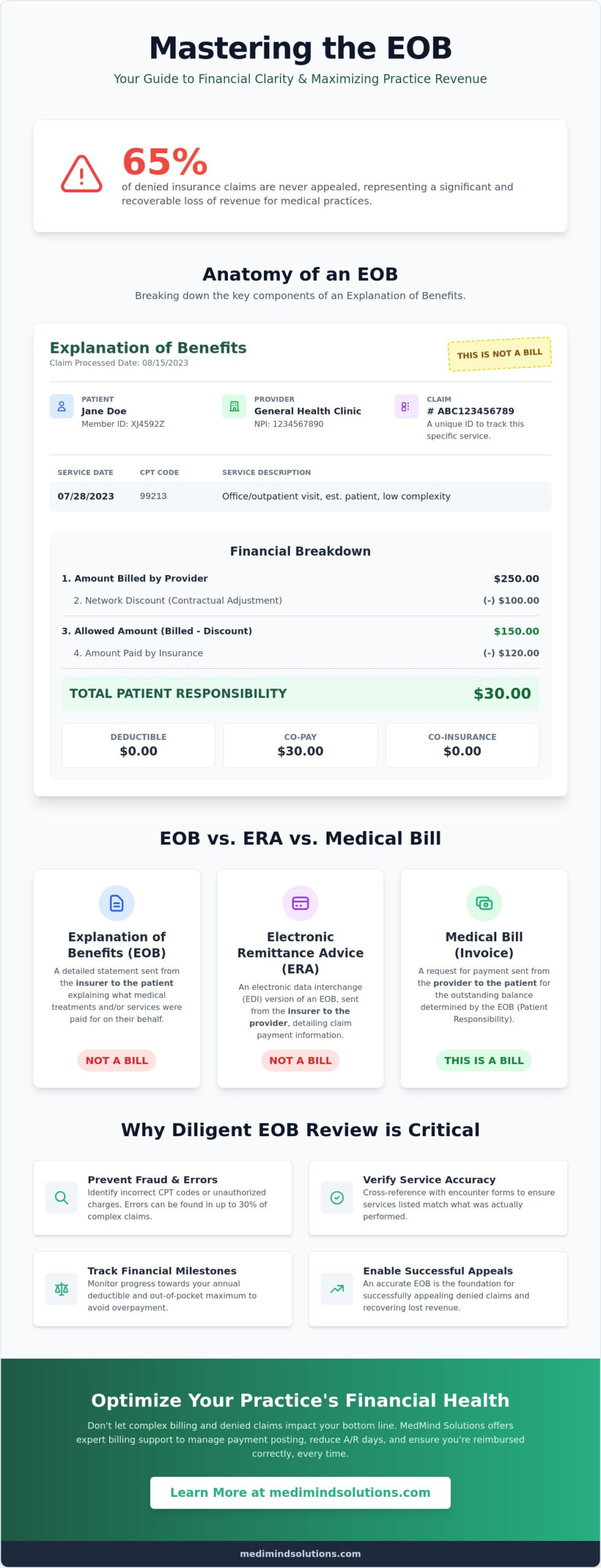
EOB vs. ERA vs. Medical Bill: Knowing the Difference
Understanding the eob meaning requires a clear distinction between three documents that often arrive in your mailbox or inbox at the same time. While they all reference the same doctor’s visit, they serve completely different purposes for your financial records. The medical bill is the only document that requires you to open your wallet. It’s the final invoice from your provider’s office, sent only after they’ve coordinated with your insurance company. If you receive a request for payment that hasn’t been filtered through an EOB first, you might be paying more than necessary.
The EOB is the patient’s copy of the insurance company’s decision-making process. It isn’t a bill; it’s a transparency tool. It shows what the provider charged, what the insurance company agreed to pay, and the specific discounts applied through your plan’s negotiated rates. For the provider, this same information arrives as an ERA (Electronic Remittance Advice). This digital version allows for automated posting and faster reconciliation. Billing integrity relies on these three documents matching perfectly. If the “Patient Responsibility” on your EOB doesn’t align with your final bill, it’s a red flag that requires a “Practice Checkup” to resolve.
The Provider Perspective: Why ERAs Matter for RCM
Skillful billing specialists use ERAs to optimize a practice’s bottom line. The transition from paper EOBs to electronic workflows is a game changer for revenue cycle management (RCM). ERAs allow for “auto-posting,” which eliminates manual entry errors and can speed up reimbursement cycles by 15 to 20 days. When we analyze a practice’s financial health, we often start by auditing historical EOB and ERA data. This precision billing approach identifies patterns in claim denials, allowing the practice to recover lost revenue and ensure they’re healthier than ever.
Why Patients Often Get Confused
Timing is the primary source of frustration for most patients. You’ll often receive an EOB weeks before or even after the doctor’s bill arrives. This gap creates a disconnect in your financial planning. Another major hurdle is the “Total Charges” shock. The largest number on the EOB is the provider’s standard sticker price, but it’s rarely what you or the insurance company actually pay. Most providers have negotiated contracts that significantly lower that initial figure.
- Wait for the statement: Always wait for the final provider bill before sending payment to ensure all insurance adjustments were applied.
- Compare the codes: Match the “Procedure Code” on your EOB to the one on your medical bill to prevent double-billing.
- Check the “Remark Codes”: These small notes explain why a claim was partially paid or denied.
By keeping these documents organized, you protect your bank account and ensure your provider receives the correct reimbursement for their skillful care. It’s the best of both worlds: financial security for the patient and steady cash flow for the practice.
Managing EOB Discrepancies and Denial Appeals
Understanding the eob meaning is only the first step toward financial clarity. The real value lies in your ability to act on that data when things go wrong. When a claim doesn’t align with your expectations, it impacts the financial health of your practice and the patient’s peace of mind. You must approach these discrepancies with clinical precision to ensure your practice remains healthier than ever. Follow this four step protocol to handle errors with the confidence of a meticulous growth partner.
- Step 1: Cross-reference the EOB with your original provider encounter form. This is your practice checkup. Compare the services listed on the EOB against your internal superbill to ensure every procedure performed was actually billed and documented.
- Step 2: Identify specific codes denied for medical necessity or coding errors. Look for denial codes like CO-50. These often indicate that the insurer requires more clinical data or that the procedure code doesn’t match the diagnosis.
- Step 3: Contact the insurance carrier to clarify ambiguous remark codes. Don’t let cryptic alphanumeric strings stall your cash flow. A direct conversation with a representative can often resolve simple misunderstandings about policy limits or filing requirements.
- Step 4: Collaborate with the provider’s billing office to file a formal appeal. Successful appeals rely on a partnership between the clinical and administrative teams. Gathering additional notes or corrected modifiers can turn a “no” into a “yes.”
Common Errors to Look For on Your Statement
Clerical slips are common, but they shouldn’t cost you your reimbursement. Check for duplicate billings where a single procedure is accidentally listed twice; this is a red flag for auditors. Ensure the member ID is accurate, as a single transposed digit leads to a “member not found” rejection. Finally, verify the date of service. Simple clerical errors regarding the day of a visit can delay your payment by 30 days or more.
The Power of the Appeal Process
You have a legal right to a fair and robust review of any denied claim. Don’t view a denial as a final verdict; it’s often just a request for more information. Precision billing and robust documentation can overturn a negative insurance decision and secure the revenue you’ve earned. Statistics show that 95% of claims should be clean, but the remaining 5% require skillful follow-up to protect your bottom line. We handle the heavy lifting so you can focus on patient care.
Experience precision billing and see your savings grow by partnering with a team that understands the nuances of the appeal process. Optimize your bottom line today with our skillful billing specialists.
Optimize Your Financial Health with Professional Billing Support
Managing the administrative side of a medical practice often feels like a second full-time job. MedMind Solutions steps in as your Meticulous Growth Partner to handle the heavy lifting of EOB processing and payment posting. We transform the complex eob meaning from a source of confusion into a roadmap for financial recovery. By automating the reconciliation of payments and adjustments, we effectively reduce days in Accounts Receivable (A/R) by an average of 15% to 20% within the first six months. Your data security remains our top priority. We ensure 100% HIPAA compliance through every stage of the billing lifecycle, utilizing 256-bit encryption to protect Protected Health Information (PHI). This vigilant approach eliminates the common errors that lead to delayed reimbursements.
Precision Billing: Beyond Just Sending Claims
Our group of skillful billing specialists does more than just submit paperwork. We analyze every Explanation of Benefits to identify hidden revenue that often slips through the cracks of manual systems. Through proactive ICD-10 and CPT coding audits, we target the root causes of denials before they happen. This precision has helped providers see an average revenue increase of $26,000 per year. You get the Best of Both Worlds: a significant boost in profitability and a drastic reduction in administrative stress. Our team monitors your billing cycle daily, ensuring that your cash flow remains consistent and your overhead stays low. See your savings grow as we optimize your bottom line through rigorous KPI tracking and error elimination.
- Reduced Denial Rates: Our specialists catch coding mismatches before submission.
- Faster Collections: Automated payment posting speeds up the entire revenue cycle.
- Expert Analysis: We decode the eob meaning to ensure every penny is accounted for.
Ready for a Healthier Bottom Line?
Small practices often struggle to keep up with the shifting regulations of national insurance carriers. MedMind Solutions brings national-scale billing expertise directly to your local office. We focus on your Key Performance Indicators (KPIs) so you can focus on your patients. Our commitment is to keep your practice healthier than ever by ensuring every claim is paid accurately and on time. Experience precision billing today and see how a dedicated partner can stabilize your cash flow. Contact us to start your practice checkup and secure your financial future. We are ready to help you reach maximum profits while maintaining the highest standards of clinical care.
Secure Your Practice’s Financial Health Today
Navigating the complexities of medical reimbursement starts with a clear grasp of the eob meaning. When you can accurately decode these statements and distinguish them from ERAs or final patient bills, you protect your practice from costly administrative errors. It’s about more than just reading a document; it’s about ensuring your revenue cycle remains uninterrupted and your patients stay informed. By identifying discrepancies early and managing denial appeals with precision, you maintain a steady cash flow that allows your clinical team to thrive.
Don’t let complex paperwork hinder your growth. Our group of skillful billing specialists handles the heavy lifting of administration so you can focus entirely on patient care. We utilize robust HIPAA-compliant data encryption to keep your information secure while driving significant results. On average, our partners see a revenue increase of $26,000 per provider. It’s time to treat your practice to a financial checkup and see how much more you could be earning. Experience precision billing and optimize your bottom line with MedMind Solutions. Your practice deserves the stability and growth that comes from expert financial oversight.
Frequently Asked Questions
Is an EOB a bill that I need to pay immediately?
No, an EOB is not a bill and requires no immediate payment to your provider. It’s a detailed report explaining how your insurance carrier processed a specific medical claim. You should wait until you receive a formal invoice from your doctor’s office before sending any funds. This ensures your financial health remains stable by avoiding accidental overpayments or duplicate transactions for services rendered.
How long should I keep my EOB statements for tax or record purposes?
You should keep your EOB statements for at least 1 year for routine record-keeping and 7 years if you’re claiming medical expenses as tax deductions. According to IRS Publication 502, taxpayers must maintain detailed records to support any health-related tax credits. Storing these documents ensures your practice’s records are audit-ready. Our skillful billing specialists recommend digital storage to keep your files organized and secure for long-term access.
What should I do if my EOB says my claim was denied?
You must review the “Reason Code” or “Remark Code” on the statement to identify why the insurer refused payment. Data from the Kaiser Family Foundation shows that nearly 17% of in-network claims are denied for administrative or clinical reasons. Contact your insurance company’s member services department within 30 days to start a formal appeal. Taking swift action helps optimize your bottom line and ensures you receive the maximum reimbursement allowed.
Why is the amount my doctor charged different from the “Allowed Amount” on my EOB?
The “Allowed Amount” is the maximum dollar figure your insurance company agrees to pay for a specific medical service based on their contract. If your doctor charges $300 for a visit but the negotiated rate is $180, your insurer uses the lower figure to calculate benefits. Understanding this aspect of the eob meaning helps you identify provider discounts. These discounts protect your wallet by ensuring you aren’t overcharged for in-network care.
Can I receive my EOB statements electronically instead of by mail?
Yes, most major insurance carriers provide an option to go paperless through their secure member portal. CMS reports that transitioning to electronic transactions reduces industry administrative costs by over $16 billion annually. Switching to digital delivery provides a faster, more secure way to track your claims. It’s a perfect match for patients who want to reduce clutter while maintaining a robust, searchable history of their healthcare spending.
What happens if I find a mistake on my EOB after I’ve already paid the bill?
You should contact both your medical provider and your insurance company immediately to request a corrected claim and a refund. A study by the Medical Billing Advocates of America found that up to 80% of medical bills contain at least one error. Vigilance is key to maintaining your fiscal well-being. Once the provider processes the correction, you’ll see your savings returned, ensuring your personal budget stays healthier than ever.
How does an EOB help prevent healthcare fraud and abuse?
Reviewing your EOB helps you verify that you aren’t being billed for services, supplies, or office visits you never actually received. The FBI estimates that healthcare fraud costs the United States between $70 billion and $234 billion every year. By acting as a meticulous partner in your own care, you can spot “phantom billing” or unbundled charges. Reporting these discrepancies to your insurer protects the integrity of the entire healthcare system.
What does “Patient Responsibility” mean on an EOB?
This figure represents the total amount you’re legally required to pay the provider after your insurance has paid its portion. It’s the sum of your deductible, co-insurance, and any flat co-payments required by your plan. A clear grasp of the eob meaning ensures you can perform a personal financial checkup. This transparency allows you to verify that the final bill from your doctor matches the insurance company’s calculations exactly.