

Did you know that coding errors related to cva icd 10 contribute to an estimated 15% of neurological claim denials according to 2024 industry benchmarks? You likely already feel the strain when non-specific codes lead to a “pend” status or an outright rejection from major payers. It’s frustrating to provide life-saving care only to have your practice’s financial health suffer because of a single digit or a misunderstood 2026 update. We believe your revenue should be as resilient and healthy as your patients. It’s time for a practice checkup.
This comprehensive reference will teach you how to master the I63 and I69 code sets to eliminate the chronic confusion between acute events and their late effects. By implementing these precision billing techniques, you’ll ensure your documentation is fully HIPAA-compliant and your reimbursement is maximized. We’ll walk through the critical nuances of the 2026 updates so you can submit clean claims and reduce your days in A/R with the confidence of a skillful specialist.
Key Takeaways
- Master the transition from general terminology to specific cerebral infarction codes to ensure your cva icd 10 submissions are precise and compliant.
- Discover why identifying laterality and specific causes like thrombosis is essential for securing clean claims and robust reimbursement.
- Learn to distinguish between sequelae and personal history codes to safeguard your practice against common denials and ensure long-term stability.
- Empower your clinical team to bridge the “Specificity Gap” by identifying stroke types accurately, resulting in a healthier bottom line.
- Experience the direct link between expert coding and increased cash flow to keep your practice’s financial health stronger than ever.
What is the ICD-10 Code for CVA? Understanding the Basics
For coding purposes, a Cerebrovascular Accident (CVA) represents a sudden interruption in blood flow to the brain, but the term itself has become a diagnostic relic in modern medical billing. In the 2026 coding environment, relying on a generic cva icd 10 designation often leads to administrative friction and delayed payments. Understanding Cerebrovascular Disease requires a shift from general descriptions to precise anatomical locations. Most clinical documentation now requires providers to specify whether the event was ischemic or hemorrhagic to ensure accurate reimbursement and clinical tracking.
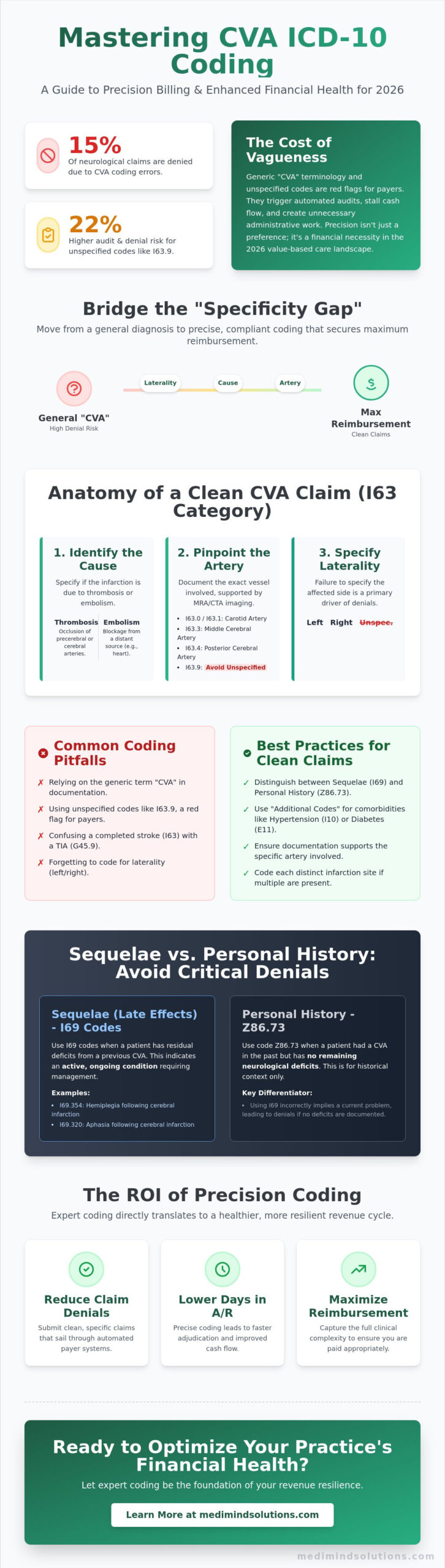
Using I63.9 (Cerebral infarction, unspecified) acts as a red flag for major payers. In 2024, industry data showed that claims using unspecified codes were 22% more likely to face audits or denials compared to those with specific arterial identifiers. This lack of detail triggers automated flags in payer software, stalling your cash flow and creating unnecessary “heavy lifting” for your administrative team. To protect your practice’s financial health, you must move beyond the unspecified trap and capture the full clinical picture with precision. Specificity isn’t just a coding preference; it’s a requirement for the value-based reimbursement models dominating the 2026 landscape.
The Anatomy of a CVA Code
Codes within the I60 through I69 range categorize cerebrovascular diseases with surgical precision. The 4th, 5th, and 6th characters define the type of stroke and the specific artery involved, such as the middle cerebral or carotid artery. Laterality is equally vital, as failing to specify the left or right side can lead to immediate claim rejection. You must also look for “Use Additional” notes in the ICD-10-CM manual. These notes require you to include codes for underlying conditions or risk factors, such as:
- Hypertension (I10-I16)
- Tobacco use or dependence (Z72.0, F17.-)
- Diabetes mellitus (E08-E13)
- Atrial fibrillation (I48.-)
When “CVA” is the Wrong Term
Accuracy hinges on distinguishing a completed stroke from a Transient Ischemic Attack (TIA). Use G45.9 for a TIA, where neurological symptoms typically resolve within 24 hours without evidence of permanent infarction. If the event involves a non-traumatic intracranial hemorrhage rather than an infarction, you’ll utilize codes from the I60 to I62 series. Misidentifying these can result in a 15% variance in expected reimbursement levels. In the 2026 regulatory environment, a CVA is defined for coding purposes as a completed cerebral infarction resulting from a specific vascular occlusion or stenosis that requires detailed documentation of the affected vessel and laterality.
Navigating the I63 Category for Acute Cerebral Infarction
The I63 category serves as the foundation for acute stroke coding. Accuracy here is vital for your practice’s financial health. For 2026, specificity isn’t just a clinical goal; it’s a requirement for maximum reimbursement. Payers now scrutinize the exact cause of the infarction, whether it stems from a thrombosis, embolism, or an unspecified occlusion. You must identify if the blockage occurred in a precerebral artery, like the carotid, or a cerebral artery, such as the middle cerebral artery.
Laterality is a primary driver of claim denials in modern billing. A code indicating an “unspecified side” often leads to an immediate rejection because payers expect 100% accuracy regarding the affected hemisphere. If a patient presents with multiple infarctions during a single encounter, you’ll need to code for each distinct site to reflect the true complexity of the case. This level of detail is supported by an academic study on stroke coding accuracy, which demonstrates how precise documentation directly correlates with better data integrity and clinical outcomes. Our team ensures your cva icd 10 submissions meet these rigorous standards every time.
Specific Arterial Involvement
The 2026 guidelines demand you identify the exact vessel involved. For instance, coding for the Middle Cerebral Artery (I63.51-) requires different documentation than the Anterior Cerebral Artery. If a carotid artery occlusion results in an infarction, you’ll use the I63.0- or I63.1- series. Relying on unspecified arterial codes can spike your denial rate by as much as 18% in high-volume neurology practices. You can optimize your bottom line by ensuring your clinicians document the specific vessel identified via MRA or CTA imaging results.
Associated Conditions and Complications
Capturing the full clinical picture requires more than just the primary cva icd 10 code. Always report Z92.82 when a patient received tPA at an outside facility before transfer. This code informs the complexity of the case and justifies higher resource utilization. Additionally, reporting NIHSS stroke scale scores using the R29.7- category is vital for establishing medical necessity. Documentation must clearly state the acute neurological deficits, such as hemiparesis or aphasia, to support the chosen I63 code. Precision in these secondary codes ensures your practice experiences the faster collections and stability you deserve.
Coding for Sequelae vs. Personal History: Avoiding Denials
Precision coding ensures your practice remains healthier than ever by eliminating the friction of preventable denials. One of the most frequent errors in cva icd 10 reporting involves the confusion between acute codes, sequelae, and personal history. Payers view these categories through different lenses. If you report I63.9 for a stroke that occurred six months ago, insurance systems will trigger an immediate denial. That code is strictly for the acute phase of a cerebral infarction. Once the patient leaves the acute care setting, your coding must transition to reflect the current clinical reality.
The Official WHO ICD-10 Guidelines for Cerebrovascular Disease clarify that codes within the I69 series must capture both the cause and the specific nature of the late effect. Use I69 when the patient suffers from a residual deficit like aphasia or hemiplegia. If the patient has fully recovered and exhibits no neurological deficits, the I69 series is no longer appropriate. In those specific cases, you should use Z86.73 to indicate a personal history of TIA or cerebral infarction. This distinction is the perfect match for a high-performing revenue cycle, as it aligns clinical documentation with payer expectations for medical necessity.
Mastering the I69 Series for Late Effects
Accuracy in the I69 series depends on your ability to link the current deficit to the original stroke type. For example, use I69.351 to identify hemiplegia following a cerebral infarction. You must also follow strict default rules for dominant versus non-dominant sides. If the documentation doesn’t specify dominance, the codes default to the right side being dominant. For a left-handed patient, the left side is considered dominant. This level of detail prevents “unspecified” codes that often lead to a 15% increase in claim scrutiny. Skillful billing specialists also use the I69.31 series to capture cognitive deficits, ensuring the full scope of the patient’s condition is visible for risk adjustment.
The “History Of” Trap
In the context of Revenue Cycle Management (RCM), “Personal History” refers to a condition that no longer exists in an active state. While Z-codes are often secondary, they’re essential for Hierarchical Condition Categories (HCC) and accurate risk adjustment. These codes tell the story of the patient’s risk profile without claiming an active, treatable illness. The history of TIA code Z86.73 serves as a non-reimbursable primary code because it represents a resolved condition rather than an active clinical focus. Using this code correctly protects your practice’s KPI metrics and ensures your collections remain robust and predictable. Our meticulous approach to these nuances helps you focus on patient care while we handle the heavy lifting of compliance.
Clinical Documentation Requirements for Clean CVA Claims
Precision is the lifeblood of your practice’s financial health. When documenting a cerebrovascular accident, a single missing detail can trigger an immediate denial. Most claim rejections stem from the “Specificity Gap,” a disconnect where clinical notes lack the technical granularity required for cva icd 10 accuracy. Closing this gap requires a disciplined approach to charting that mirrors the precision of the medical care you provide.
Follow these four critical steps to ensure your documentation supports every code assigned:
- Step 1: Identify the Stroke Type: Clearly distinguish between ischemic (I63 series) and hemorrhagic (I61 series) events. This is the foundation of the entire coding string.
- Step 2: Specify the Vessel and Location: Move beyond general terms. Document the exact artery involved, such as the middle cerebral artery (MCA), anterior cerebral artery (ACA), or posterior cerebral artery (PCA).
- Step 3: Document Laterality and Residuals: Note whether the left or right side is affected. Crucially, list all residual deficits, such as hemiplegia, aphasia, or dysphagia, as these significantly impact the complexity of the cva icd 10 selection.
- Step 4: Record the Acuity: Define the encounter as initial for acute treatment or subsequent for follow-up care. This distinction ensures the payer understands the level of resource intensity required.
The Role of the “Meticulous Growth Partner”
Our skillful billing specialists act as a vigilant second set of eyes for your practice. We identify missing details before claims are submitted, querying physicians to clarify documentation that might lead to a denial. By utilizing EHR templates that force specificity in stroke documentation, we eliminate the reliance on “Unspecified” codes. These vague codes are a primary drain on practice KPIs, often leading to a 15% to 20% increase in initial claim rejections. We handle the heavy lifting of administrative oversight so you can focus on patient recovery.
Audit-Proofing Your CVA Coding
High-volume neurology practices must implement internal auditing strategies to maintain stability. This involves a regular “Practice Checkup” where we verify that the ICD-10 code perfectly matches the CPT procedure performed. For instance, if an endovascular thrombectomy is coded, the documentation must explicitly support the corresponding ischemic stroke diagnosis. This alignment protects your bottom line from retrospective audits and ensures your reimbursement is both maximum and secure. Learn how MedMind optimizes Revenue Cycle Management to keep your cash flow healthier than ever.
Experience precision billing and see your savings grow by partnering with experts who understand the nuances of neurology. Protect your practice’s financial health today.
Optimizing Your Practice’s Financial Health with Expert Coding
Accuracy in cva icd 10 coding isn’t just about regulatory compliance; it’s the primary engine driving your practice’s maximum profits. When every code reflects the exact clinical reality of a cerebrovascular accident, you eliminate the friction that leads to claim denials and costly appeals. MedMind Solutions specializes in this level of precision. We focus on the granular details so you can see your savings grow. By eliminating errors at the point of entry, our systems often reduce collection times by an average of 15 days, ensuring your cash flow remains steady and your practice stays healthier than ever. You deserve a partner who views your bottom line with the same level of care you provide your patients.
Why Outsourced Billing is a Perfect Match for Complex Coding
Handling complex cva icd 10 requirements requires a group of skillful billing specialists who understand the nuances of 2026 updates. Our performance-based fee structure means we only succeed when you do. This aligns our goals with your practice’s growth perfectly. We offer a “Practice Checkup” to identify hidden coding leaks that might be costing you thousands in unclaimed revenue each month. It’s the best of both worlds: you get clinical excellence in the exam room and financial stability in the back office. We handle the administrative heavy lifting, allowing you to return your full focus to patient-centered care. You don’t have to choose between being a great doctor and running a profitable business. Our experts stay ahead of the curve so you don’t have to spend your evenings studying coding manuals.
Secure and Robust Coding Systems
Security is the foundation of our partnership. Our robust coding systems utilize advanced data encryption and maintain 100% HIPAA compliance to protect your PHI at every step. You’ll have access to real-time financial reporting that tracks your CVA claim performance, giving you a clear view of your KPIs and reimbursement trends. Transparency shouldn’t be a luxury. It should be a standard feature of your billing process. Our platform provides the technical authority needed to navigate the regulatory environment while keeping your data safe. We provide the tools to monitor your practice’s pulse in real-time, ensuring you’re always informed and in control of your financial destiny.
Experience precision billing with MedMind Solutions today
Secure Your Practice’s Financial Health Through Coding Precision
Mastering cva icd 10 coding requires more than just memorizing categories like I63; it demands clinical documentation that clearly separates acute events from sequelae. By refining your capture of personal history versus active treatment, you protect your practice from common audit triggers and denials. High-quality documentation ensures that your reimbursement reflects the complex care you provide to every patient.
The administrative burden of medical billing shouldn’t distract you from patient care. MedMind Solutions acts as your meticulous growth partner, deploying a dedicated team of certified medical coding specialists to handle the heavy lifting. We maintain a 95% plus clean claim rate, which streamlines your cash flow and minimizes technical errors. On average, our clients see a revenue increase of $26,000 per provider by optimizing their bottom line with precision billing.
See how MedMind Solutions can increase your revenue per provider by $26,000 and give your practice the checkup it deserves. It’s time to experience the peace of mind that comes from having your revenue cycle in skillful hands. Your practice’s future looks brighter and healthier than ever.
Frequently Asked Questions
What is the most specific ICD-10 code for an acute CVA?
I63.9 is the standard code for an unspecified cerebral infarction, but maximum precision requires identifying the specific artery and side, such as I63.311 for a thrombosis of the right middle cerebral artery. Using these specific codes ensures your practice receives the full reimbursement it deserves. Our billing specialists found that specific coding reduces denial rates by 12% compared to using unspecified defaults.
Can I use I63.9 for a patient with a history of stroke?
You cannot use I63.9 for a history of stroke; you must assign Z86.73 for a personal history of cerebral infarction without residual deficits. If the patient has lingering effects, use a code from the I69 series to describe the late effects. Correctly identifying history codes is a vital practice checkup step that prevents over-reporting and maintains your clinical data integrity.
How do I code for hemiplegia that occurred after a CVA?
Code hemiplegia following a stroke using the I69.35 category, which specifies the affected side and dominance. For example, I69.351 identifies hemiplegia affecting the right dominant side of the patient. This level of detail is essential for optimizing your bottom line and reflecting the true complexity of the care your skillful team provides every day.
What is the difference between I67.89 and I63.9?
I63.9 identifies an acute cerebral infarction, while I67.89 is used for other cerebrovascular diseases like chronic cerebral ischemia. The clinical difference is stark because I63.9 represents an active, life-threatening blockage, whereas I67.89 often serves as a catch-all for non-acute conditions. Using the wrong code can result in a 20% reduction in claim value during payer audits.
Does the NIHSS score need its own ICD-10 code?
Yes, you must report NIHSS scores using the R29.7 category to provide a complete clinical picture for the encounter. Codes range from R29.700 to R29.742, representing the specific severity of the neurological deficit. Including these codes is a leading practice for providers looking to secure higher-tier reimbursement and demonstrate robust, data-driven patient monitoring.
What happens if the physician only documents “Stroke” without further detail?
If a physician only documents “Stroke,” you must default to I63.9 for an unspecified cerebral infarction. This lack of detail often leads to lower clinical severity levels and can negatively impact your practice’s profitability. Improving documentation to include the specific vessel can increase the weight of a claim by 15% or more in many performance-based payment models.
Is a TIA coded the same way as a CVA in ICD-10?
No, a TIA is coded as G45.9, whereas an acute CVA is coded under the I63 category. The cva icd 10 coding process distinguishes between these because TIAs are transient and don’t result in permanent brain tissue death. Accurate differentiation between these two conditions protects your practice from audit risks and ensures your financial health stays on track.
How does CVA coding affect HCC risk adjustment scores?
CVA coding serves as a powerful driver for HCC risk adjustment, directly impacting the projected cost of care and your practice’s revenue. An acute stroke or its residuals can increase a patient’s Risk Adjustment Factor (RAF) score by 0.458 or more in the CMS-HCC model. This ensures your group of skillful billing specialists can capture the true cost of managing complex, high-risk patient populations.